Parasaurolophus
DinosaurWikipedia
25
MENTIONS
14
EPISODES
13
PODCASTS
Search complete. 25 mentions across 14 episodes found for "Parasaurolophus".
Nov 19, 2026

Steven LentonHOST
Spinosaurus.
Steven LentonHOST
I know from doing the dinosaur books with Andy Day, Parasaurolophus, because I'd always do a joke, because Andy's really funny, and I thought, I want a bit of this humour on the stage.
Steven LentonHOST
So when people would ask us what our favourite dinosaur was, I would say the dinosaur that likes to go shoe shopping, which is the Saurolophus.
Elissa ElwickGUEST
Is that an actual one?

Kevin HarringtonHOST
You can see the woman with like it looks like she looks like a daytime version of one of the hell priests, the Cenobites from Hellraiser.
Thom WoodleyHOST
She looks like a Parasaurolophus, the dinosaur.
Thom WoodleyHOST
Yeah.
Thom WoodleyHOST
And then like just a bunch of, yeah, anyway, a bunch of- Oh, is

speaker_0NARRATOR
Reconstructing the vocalizations of an extinct animal is a form of acoustic archaeology, blending fossil anatomy with the principles of physics.
speaker_0NARRATOR
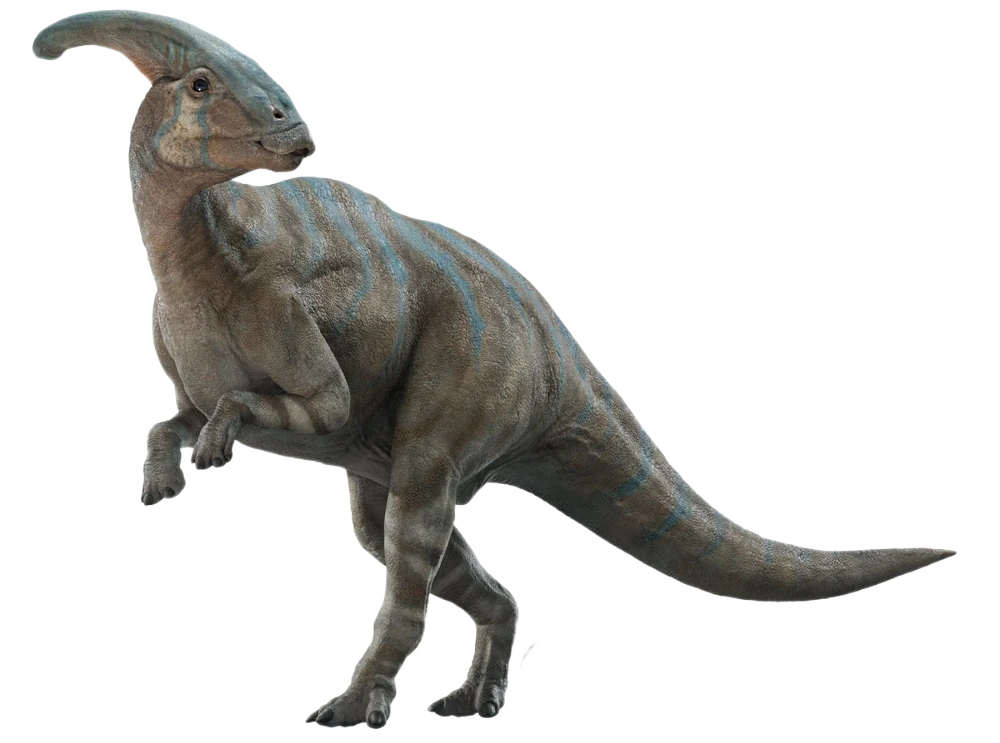
One of the first pioneering efforts was conducted in 1981 by David Weishampel, who studied the duck-billed dinosaur Parasaurolophus.
speaker_0NARRATOR
This herbivore had a giant, hollow crest on its head connected to its airway, which Weishampel demonstrated would have functioned as an excellent resonating chamber.
speaker_0NARRATOR
By creating a physical model of the crest, he was able to estimate and reproduce the deep honking calls the animal likely made.

speaker_0HOST
The name literally means spiked lizard.
speaker_0HOST
And his four drones, an Ankylosaurus, a Pachycephalosaurus, a Parasaurolophus, and a Dimetrodon.
speaker_0HOST
Which again, is not a dinosaur.
speaker_0HOST
It's actually more of a proto-mammal.

AnthonyHOST
Up next, there's a duckbill.
AnthonyHOST
So that's Parasaurolophus, but I believe they're using it to kind of explain the Magnapolia.
AnthonyHOST
We go over here.
AnthonyHOST
I took a picture with me holding a Stomp Chomp Roar t-shirt.

MiloGUEST
Fast, go.
MiloGUEST
Parasaurolophus, T-Rex, Majungasaurus, Matheosaurus, Ornithomonas.
Lucie FinkHOST
Those were random.
Lucie FinkHOST
Can you tell me about golf? Because I don't know anything about it.
15 MINS LATER
Lucie FinkHOST
Can you tell me if you can name five dinosaurs right now? Fast,
MiloGUEST
go.
MiloGUEST
Parasaurolophus, T-Rex, Madungasaurus, Matheosaurus, Ornithomonas.
Lucie FinkHOST
Those were random.

Eric SkwarczynskiHOST
Thank you so much, April.
Eric SkwarczynskiHOST
That the Parasaurolophus duck-billed dinosaurs use their crest to breathe fire because of Job 41, 18 through 21.
Eric SkwarczynskiHOST
I severely embarrassed myself with that fact as an adult.
Eric SkwarczynskiHOST
And she also says that she learned that Satan controlled the airwaves.

TimHOST
It's not that simple, but that's kind of the big picture.
TimHOST
So hadrosaurs are known for having big crests, some of them, like Parasaurolophus.
TimHOST
In a way, they're kind of...
TimHOST
I think people think of them as being kind of boring.
TimHOST
Big beaks and chewing teeth.
TimHOST
The other group of Hadrosaurs is the Lambiosaurines, the Lambiosaurinae, which contains Lambiosaurus.
TimHOST
And like Parasaurolophus, Corythosaurus, these are the ones that had the big crests that you're probably more used to picturing, like big bony crests.
TimHOST
If you know what Parasaurolophus is, that's the one that has the big crest going straight back from the back of its head.

speaker_0HOST
It also includes the sauropods, the long-necked, long-tailed, enormous herbivores like Brachiosaurus diplodocus and Argentinosaurus.
speaker_0HOST
The bird-hipped group, meanwhile, includes many of the well-known herbivores, Triceratops, Stegosaurus, Ankylosaurus, Parasaurolophus, and their many relatives.
speaker_0HOST
Between these two groups, over 1,000 distinct species of non-avian dinosaur have been named and described from fossils, and new species are being discovered at a rate of about 50 per year.
speaker_0HOST
Many more species certainly existed, but left no fossil record.
37 MINS LATER
speaker_0HOST
The armour plates covering its back and sides were embedded in the skin and ranged from small, pebble-like nodules to large, flat plates, together creating a nearly impenetrable shield.
speaker_0HOST
Even the eyelids of some ankylosaurs were armoured, with bony plates that protected the eyes from attack.
speaker_0HOST
Parasaurolophus, a duck-billed dinosaur from the late Cretaceous, had a long, curved, hollow crest extending from the back of its skull.
speaker_0HOST
The crest contained a complex network of nasal passages, and researchers have used CT scans and computer modelling to reconstruct the sounds it might have produced.
AnthonyHOST
I love...
AnthonyHOST
It kind of almost looks like Parasaurolophus a little bit.
AnthonyHOST
I don't know if it was meant to be Parasaurolophus because I think that's a horn on the back of its head, but it is Dino-mite.
AnthonyHOST
And lastly...
AnthonyHOST
I've got from Declan, this is the Yankylosaurus.
4 more episodes mention Parasaurolophus.
Create an account to see the whole feed, search across every transcript, and follow the entities you care about.