Pangloss
Fictional characterWikipedia
83
MENTIONS
15
EPISODES
15
PODCASTS
Search complete. 83 mentions across 15 episodes found for "Pangloss".
Oct 21, 2026

Peter EyersHOST
learnt.
Eddie PerfectGUEST
And I was playing Pangloss Voltaire in that.
Eddie PerfectGUEST
And that meant, you know, narrating the show, driving the show, but also, you know, so I turned up for the first time in my life with the whole show under my belt.
Eddie PerfectGUEST
And I really liked it.

DanHOST
He poured all of his frustration into his most famous book, Candide.
DanHOST
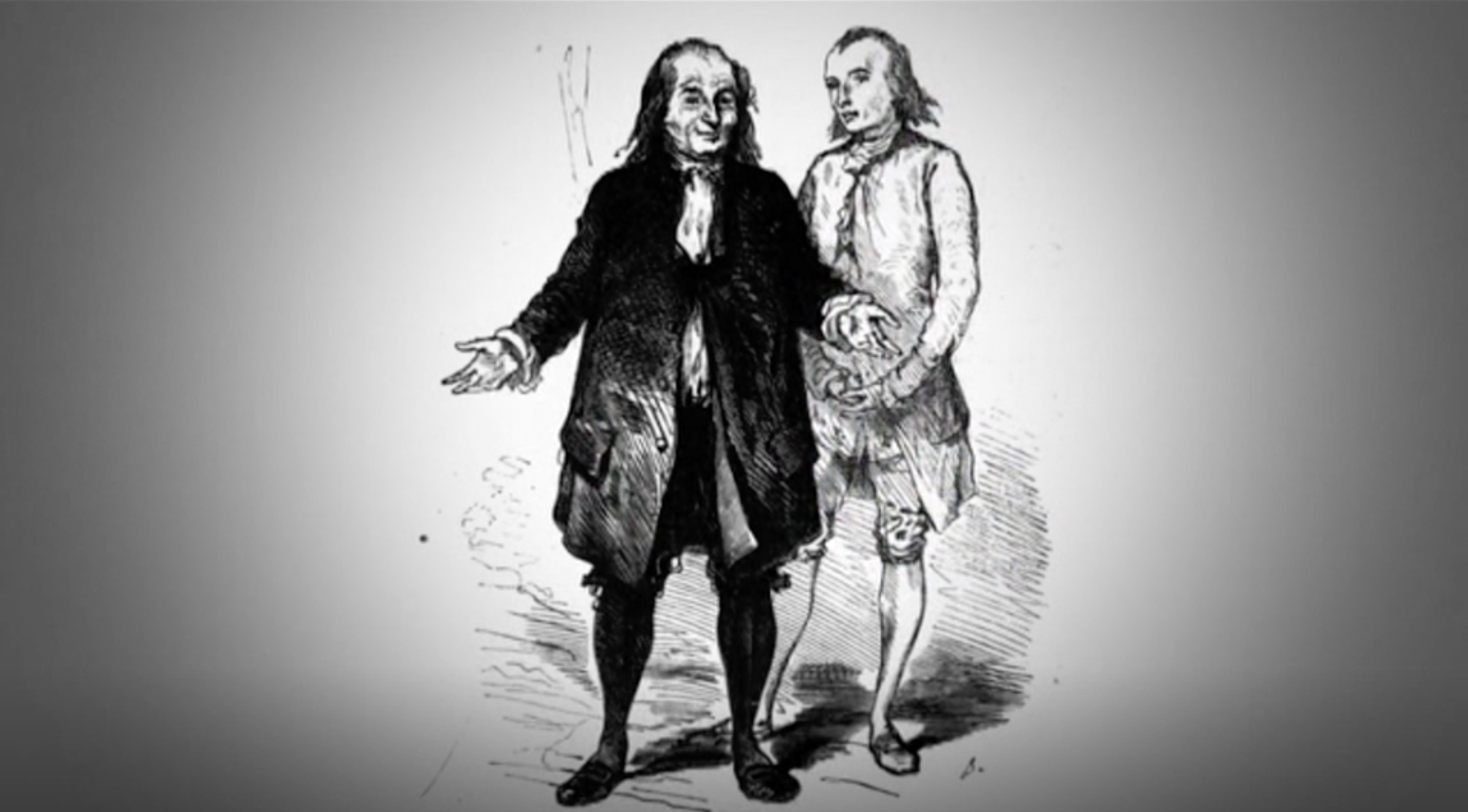
It's a satire about a naive young man named Candide and his incredibly stubborn philosophy tutor, Pangloss.
DanHOST
Pangloss relentlessly insists everything happens for a reason, even as he and Candide get shipwrecked, beaten, and forced to endure basically every disaster imaginable.
DanHOST
At the very end of the book, after losing almost everything, the surviving characters find themselves living on a small, obscure farm in Turkey.
DanHOST
Pangloss is still going on and on, trying to logically prove how all the horrific things they went through were actually a good thing in the grand scheme of the universe.
DanHOST
Finally, Candide cuts him off.
DanHOST
He looks at his tutor and says a line that became the defining pillar of Voltaire's entire philosophy.

KeeganHOST
Part of this is assuredly the magic of youth, the uncomplicated, the, the idyllic nature of the world while we're too young to understand the world's difficulties and complexities and its suffering.
KeeganHOST
But Candide is also-- comes to believe in his life in a kind of paradisaical existence because he's instructed by Pangloss, who is called the family's oracle, really the, sort of their, their intellectual on hand at the castle, and, uh, Candide listens attentively and innocently to this philosopher's lectures.
KeeganHOST
Pangloss more or less expresses the viewpoints of Leibniz, or rather, a caricature of Leibniz, though the way he is presented, I think, uh, it goes a fair bit beyond just a mere satire of Leibniz, which I will explain in a moment.
KeeganHOST
But this is how Pangloss's teaching is described.
KeeganHOST
Quote, "Pangloss was a professor of metaphysico-theologico-cosmolo-nigology.
KeeganHOST
He proved admirably that there is no effect without a cause, and that in this best of all possible worlds, the Baron's castle was the most magnificent of castles, and his lady the best of all possible baronesses.
KeeganHOST
'It is demonstrable,' said he, 'that things cannot be otherwise than they are, for all being created for an end, all is necessarily for the best end.
KeeganHOST
Therefore, we eat pork all year round.'" Consequently, they who assert that all is well have said a foolish thing.

Eric ZwickGUEST
There are also...
Eric ZwickGUEST
This is not the best of all possible worlds, so I'm not coming to you like Dr. Pangloss to say we can't do better.
Eric ZwickGUEST
And in a lot of these industries, we see profits and growth of this mainstream millionaire class that comes at the expense of consumers and new entrants.
Eric ZwickGUEST
And so, you know, this is maybe a Chicago take.

Philippe AghionGUEST
One is to say absolute optimism.
Philippe AghionGUEST
I would say Pangloss, you know, Candide, Voltaire's Candide.
Philippe AghionGUEST
There is a figure there, there is a character called Pangloss.
Philippe AghionGUEST
And Pangloss tells you, no matter what happens, it will always go well.
Philippe AghionGUEST
I'm not really Pangloss.
Philippe AghionGUEST
The opposite extreme is truly pessimistic.
Philippe AghionGUEST
Whatever you do, it will be a disaster.

Laurence AntonHOST
Candide was a satirization of the worldview of one of the primary optimists of the time, Gottfried Leibniz.
Laurence AntonHOST
The novel follows Candide, a privileged young man who was raised and immersed in the optimism of Leibniz by his tutor, Pangloss.
Laurence AntonHOST
One day, Candide is banished from the castle he was raised in and is cast out into the world, where he witnesses and experiences many of the calamities of life, from earthquakes and disease to war and murder.
Laurence AntonHOST
And we follow how his experience of these calamities clashes with the optimism that he was raised with.

Erik RostadHOST
He encounters all these different experiences, and he encounters all these philosophers who have systems that they believe in.
Erik RostadHOST
And so the first philosopher we find is Pangloss, and at the very beginning, Candide falls in love with, uh, the baroness, uh, uh, the baron's daughter, and her name is Cunagon- Cunegonde.
Erik RostadHOST
And he, he, you know, she's ...
Erik RostadHOST
He's not supposed to like her 'cause he's, he d- he's not at her level, and he end up getting kicked out of the castle because he, he likes her and, and they're, they're, uh, together, and, um, he gets kicked out.
Erik RostadHOST
So he kinda goes on this quest, and he's with Pangloss, h- this philosopher, and they go out on this quest, and it, it, it has the feel of, uh, uh, Don Quixote.
Erik RostadHOST
And, uh, so the two of these guys are out on, on this quest, and they're just encountering all these different things, and there's so much of suffering that they, they themselves encounter, but then in s- the stories they hear of others.
Erik RostadHOST
And so you, you see, uh, Candide, this, this main character kind of having to grapple with what about all these terrible things that are happening in the world? And, and you just kind of, like, after reading that poem from 1756, you really see ...

LukePANELIST
Uh, it's like, uh-
Drew PinskyGUEST
Or Pangloss.
Bobby LeeHOST
Don't, don't, don't give him anything.
Drew PinskyGUEST
Best part came-
Bobby LeeHOST
Finish it.
Drew PinskyGUEST
I'm just, I'm giving him the characters.
LukePANELIST
The Pangloss, and they invade Candide, and he has to, like, fight them off to-
Drew PinskyGUEST
All right.

Shankar VedantamHOST
In 1759, the French writer and philosopher Voltaire published a satirical novel about a young man and his tutor.
Shankar VedantamHOST
Pangloss, the tutor, instructs the student, Candide, that they live in, quote, "The best of all possible worlds." As the story unfolds, Candide witnesses war, disease, natural disasters, torture, and death.
Shankar VedantamHOST
Pangloss encounters many of these tragedies himself.
Shankar VedantamHOST
Yet no matter what happens, he continues to insist that everything is unfolding exactly as it should.
Shankar VedantamHOST
It's from this character that we get the word Panglossian, describing someone who relentlessly maintains that everything is for the best.
Shankar VedantamHOST
Most of us are not as optimistic as Pangloss, but many of us do carry assumptions in our heads about how life works, that good choices lead to good outcomes, that the world is fair, and that everything will make sense in the end.
Shankar VedantamHOST
These assumptions are often unconscious and unarticulated until something happens to destabilize us.
Shankar VedantamHOST
This week on Hidden Brain, and in a companion episode on Hidden Brain Plus, when bad things happen to good people.

Shankar VedantamHOST
In 1759, the French writer and philosopher Voltaire published a satirical novel about a young man and his tutor.
Shankar VedantamHOST
Pangloss, the tutor, instructs the student, Candide, that they live in, quote, "The best of all possible worlds." As the story unfolds, Candide witnesses war, disease, natural disasters, torture, and death.
Shankar VedantamHOST
Pangloss encounters many of these tragedies himself, yet no matter what happens, he continues to insist that everything is unfolding exactly as it should.
Shankar VedantamHOST
It's from this character that we get the word Panglossian, describing someone who relentlessly maintains that everything is for the best.
Shankar VedantamHOST
Most of us are not as optimistic as Pangloss, but many of us do carry assumptions in our heads about how life works, that good choices lead to good outcomes, that the world is fair, and that everything will make sense in the end.
Shankar VedantamHOST
These assumptions are often unconscious and unarticulated until something happens to destabilize us.
Shankar VedantamHOST
This week on Hidden Brain, and in a companion episode on Hidden Brain Plus, when bad things happen to good people.
5 more episodes mention Pangloss.
Create an account to see the whole feed, search across every transcript, and follow the entities you care about.