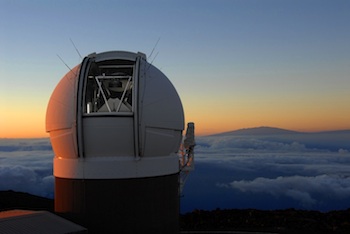
Pan-STARRS
Astronomical observatoryWikipedia
3
MENTIONS
3
EPISODES
3
PODCASTS
Search complete. 3 mentions across 3 episodes found for "Pan-STARRS".
Sep 29, 2026

Al GrauerHOST
The six, which received follow-up observations from telescopes around the globe, range in size from 43 to 394 feet in diameter and travel about the Sun with orbital periods between 275 and 960 days in duration.
Al GrauerHOST
Eight days earlier, one of them had been imaged but went unnoticed by our primary asteroid hunting competitor, the Pan-STARRS group in Hawaii.
Al GrauerHOST
Only one of Richard's discoveries was lost due to the cloudy weather, which prevented it from being tracked long enough to enable astronomers to clearly define its path around the Sun.
Al GrauerHOST
About a week after Richard discovered the smallest of the six, 2018 ED-9, 43-foot diameter space rock passed about two times the Earth-Moon distance from both the Earth and our Moon.

Michelle CollinsHOST
And I think that is where the observations and predictions seem to start to differ quite significantly.
Michelle CollinsHOST
And the source data they're using for the objects for their modeling includes sort of the new data from LSST, data from the Pan-STARRS survey.
Michelle CollinsHOST
There's a Canada-France ecliptic plane survey, an outer solar system origin survey and things like that.
Michelle CollinsHOST
And they can use that then to construct different types of asteroid and comet families and therefore get and sort of put constraints on their their sizes and their orbits and then kind of use that to feed their model and make predictions about what objects and from where are likely to hit the earth now the population is too large to simulate simultaneously so they randomly sample from it and then they do sort of an mc like a monte carlo to get the analysis and get the predicted rates out at the end just because you have way too many objects in the solar system to really track efficiently with an m body simulation so i think it's It's using some kind of sampling there of the population.

speaker_4HOST
It completely disrupted the astronomical community.
speaker_4HOST
Late in 2017, the Pan-STARRS-1 telescope detected a highly unusual object tearing through our solar system.
speaker_4HOST
At
speaker_3HOST
first, they just logged it as a near-Earth object, assuming it was a standard-issue asteroid or comet.