Palmach
MilitaryWikipedia
63
MENTIONS
9
EPISODES
8
PODCASTS
Search complete. 63 mentions across 9 episodes found for "Palmach".
Sep 26, 2026

speaker_1NARRATOR
Today's topic is the Jewish underground before Israel.
speaker_1NARRATOR
Hagenah, Palmach, Ergun, and Lehi.
speaker_1NARRATOR
Before we begin, a tiny apology.
speaker_1NARRATOR
My Hebrew pronunciation may occasionally sound like a confused GPS trying to navigate Jerusalem during construction.
speaker_1NARRATOR
They reflected competing visions about ethics, politics, diplomacy, and nation-building.
speaker_1NARRATOR
Think of family members arguing passionately over Thanksgiving dinner, except everyone happened to be carrying concealed weapons, and history itself seemed hanging in the balance.
speaker_1NARRATOR
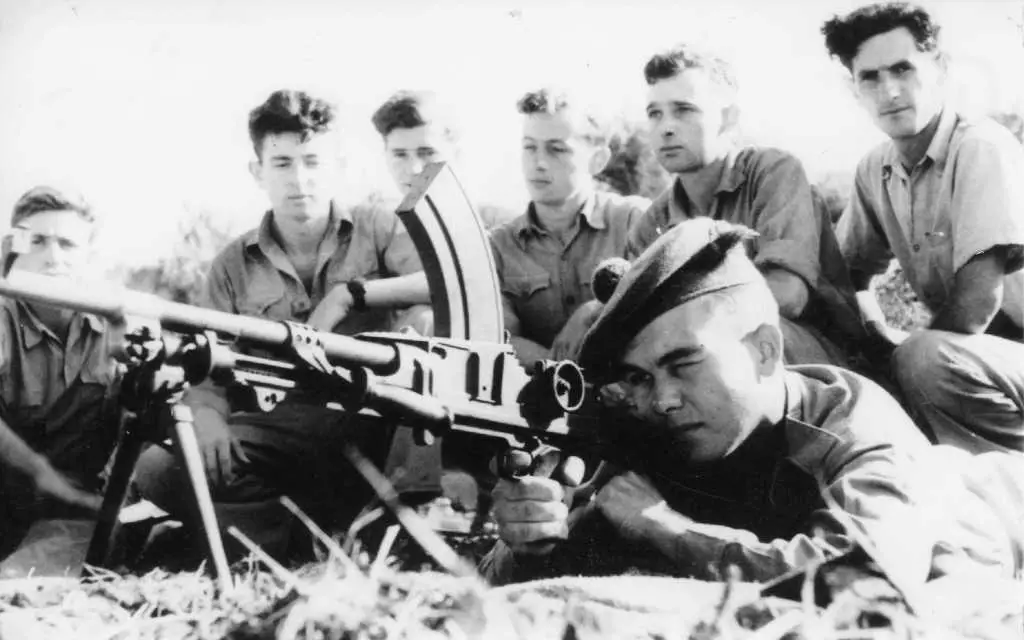
One elite branch of the Haganah became famous around the world, the Palmach.
speaker_1NARRATOR
Created in 1941 during the Second World War, the Palmach served as an elite striking force trained for difficult missions requiring exceptional physical endurance, leadership, and initiative.

Yehuda GebererHOST
The Irgun fellas...
Yehuda GebererHOST
And some Palmach people who were in the area, along with some local civilians, began assisting the disembarking procedure.
Yehuda GebererHOST
Right.
Yehuda GebererHOST
So the government instructions hadn't yet come.
Yehuda GebererHOST
matched the reality on the ground because the idf didn't have control of the area yet okay so first off of the ship are all the new immigrants we mentioned last week that there's about 930 new immigrants on the altalena so they basically all disembarked and they're out of the picture they're not part of the story as far as we're concerned um and from now on right all the immigrants are safe they got into israel they're good all the new new immigrants many survivors they all get off right away and they're in israel safe and sound okay we um so they then came the military equipment a significant portion of that was taken off as well but then began a dispute of who is going to control it once it was taken off.
Yehuda GebererHOST
At this point, the Palmach people and the Israeli civilians pulled back and stopped taking ammo off of the El Telena.
Yehuda GebererHOST
It was just the Irgun people doing it.
Yehuda GebererHOST
As we mentioned, the IDF did not initially have many troops in the area, and that the main outcome of the cabinet meeting that evening was to establish a military presence in the area of Kfar Vitkin Beach, where the Alta Lena was then unloading.

Thomas777GUEST
You know, if they say you're gonna spare these people and, and, and just cast them out into the desert, you know, to burden Arab forces, you know, with a desperate and now de-housed civilian population, you're gonna do that.
Thomas777GUEST
But what you will not do is refuse orders and question orders, uh, um, you know, related to the operational implementation of, of Plan D. Um, the Palmach, um, they were the special operations element of Haganah.
Thomas777GUEST
Um, their orders, um, their, uh, the Palmach consultancy, sort of like their general staff, they met at Ben-Gurion's home to finalize directives, um, personally.
Thomas777GUEST
Their orders were more clear and less euphemistic.
Thomas777GUEST
Quote, "The principal objective of the operation is the destruction of Arab villages and the eviction of the villagers, that they would become an economic liability for the general Arab forces." Um, and finally, the operation was novel because it's, uh, it was the first operation in which all the various Jewish military organizations like, you know, those constituted of indigenous Oriental Jewry, those constituted of the Ashkenazim, you know, those, uh, um, of Haganah, of Irgun, you know, those of, you know, the Stern Gang and what have you.

Aaron LavarcoCORRESPONDENT
So look where we've come, everyone, from 1917, when Lord Balfour, people like him, people like Ord Wingate, I don't know if you know that name, Ord Wingate, he was a British officer, who was a Christian who loved the Bible and he loved the Jewish people.
Aaron LavarcoCORRESPONDENT
He actually taught himself Hebrew, from even biblical Hebrew, and he trained up a lot of Jewish groups like the Palmach, like the Lehi, like the Stern Gang.
Aaron LavarcoCORRESPONDENT
who actually were under the ground during the British Mandate period from 1917 to 1947.
Aaron LavarcoCORRESPONDENT
Jewish people had to go under the ground.
Yehuda GebererHOST
Before we even relate the entire story from beginning to end, it's worth mentioning that that part of the story is made up and never happened.
Yehuda GebererHOST
Um, what was Rabin's role in the Altalena story? We'll see as we develop the story, because he was in Tel Aviv that day, and he was the senior officer of the Palmach, but he certainly was not the one who gave the order to blow up the Altalena or to shoot at members of the Irgun.
Yehuda GebererHOST
So what did he do and what did he not do? We'll have to see later on.
Yehuda GebererHOST
But I just wanted to say that at the outset, because I think that's a very entrenched myth as part of the story.
Yehuda GebererHOST
The main and largest of these militias was the Haganah.
Yehuda GebererHOST
The Haganah was the, was the mainstream, we'll call it, the largest, the best armed, the best trained, I guess.
Yehuda GebererHOST
The Haganah had an elite commando strike force called the Palmach.
Yehuda GebererHOST
That was essentially an independent fighting force from the Haganah.

Neve GordonGUEST
And it basically is a legal, it's a classification that provides a certain kind of legal toolkit that allows the state to do as it wishes with these fighters.
Neve GordonGUEST
We have to understand that if we look at Zionist history, then Lehi, Etzel, Haganah, Palmach, they're all unlawful combatants, okay? They're all unlawful combatants.
Neve GordonGUEST
And of course, the Palestinians that were fighting in the 1936-39 rebellion were unlawful combatants.
Neve GordonGUEST
The unlawful combatants is the one that's not fighting at the behest of a state.

Herman PoppleberryHOST
It had a government, the Jewish Agency, and Va'ad Leumi.
Herman PoppleberryHOST
It had a military, the Haganah and Palmach.
Herman PoppleberryHOST
It had an economy, a banking system, a labor federation that controlled a huge share of economic activity.
Herman PoppleberryHOST
It had schools, hospitals, courts, a university.
Herman PoppleberryHOST
A civil service.
Herman PoppleberryHOST
The Jewish Agency had departments for immigration, settlement, finance, foreign affairs, education, a military.
Herman PoppleberryHOST
The Haganah, with the Palmach as its elite strike force.
Herman PoppleberryHOST
A labor federation, the Histadrut, which wasn't just a union but an employer, a health provider, a construction company, a food distributor.

Lenny GoldbergHOST
And I'll show you what I mean, but let's first look at the Alta Lena story and try to understand why the ship was fired upon.
Lenny GoldbergHOST
We're talking about the war of independence, the 1948 war of independence, when the battle-worn Palmach and the Irgun are standing in the hills of Jerusalem holding off the Arabs, and they have almost no arms or ammunition.
Lenny GoldbergHOST
As a matter of fact, if you read the book of Ezra Yechin, El Nakam, when he describes the battle for Yerushalayim, they had to take into account every bullet that they shot.
Lenny GoldbergHOST
They didn't have any ammunition.

Avi ShilonGUEST
Now, I could tell you that Ben-Gurion invented this fear, if it was only around the Altalena Affair.
Avi ShilonGUEST
But shortly after the Altalena Affair, Ben-Gurion decided to dismantle the Palmach.
Avi ShilonGUEST
The Palmach was the best unit of the Haganah.
Avi ShilonGUEST
Because they were associated with the other, uh, stream of ideology, the, let's say, the more socialist or even communist part of the political, uh, spectrum in Israel.
Avi ShilonGUEST
The Palmach was associated with the Mapam and Ahdut HaAvoda.
Avi ShilonGUEST
Those parties were, uh, in line with the Soviet Union.
Avi ShilonGUEST
So Ben-Gurion said, "I don't want the Palmach," and he dismantled the Palmach also.
Avi ShilonGUEST
So I would say that in the eyes of Ben-Gurion, it was important, I believe, I truly believe, that it was important to set a lesson that in the new state, especially because, you know, the newcomers came from all corners of, of Earth, yeah? From Iraq, Yemen, Poland.