Paleocene–Eocene Thermal Maximum
EventWikipedia
22
MENTIONS
8
EPISODES
8
PODCASTS
Search complete. 22 mentions across 8 episodes found for "Paleocene–Eocene Thermal Maximum".
Oct 25, 2026

Dane WigingtonHOST
And that's a blip in Earth's history, but a long time for humankind.
Dane WigingtonHOST
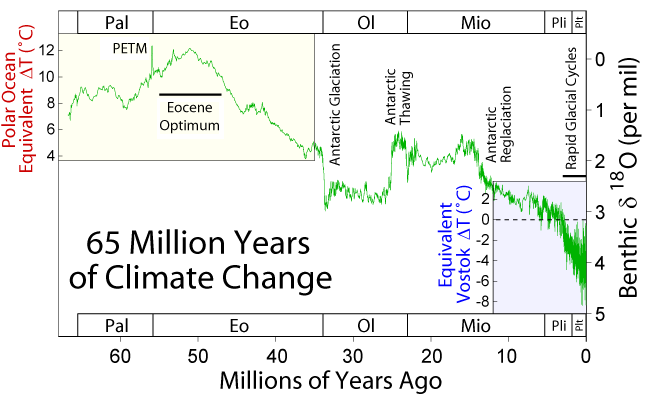
If we look at the comparable event of the PETM event, padeocene-eocene thermal maximum, 55 million years ago, which is not nearly as bad as what's happening today because what's happening today is happening literally hundreds of times faster than that event, which makes it equally worse.
Dane WigingtonHOST
The equilibrium period was about 10 to 20 million years.
Dane WigingtonHOST
So, about the unspun truth, given the fact that taken as a whole, the human species has all but sealed the fate of the current web of life in the geological blink of an eye.

Kale SnidermanGUEST
One of the most extreme ones is within one of these time periods where we see a huge diversification of pollen and spores, which was at about 56 million years ago.
Kale SnidermanGUEST
And within that broad, very warm time, there's a very relatively short extreme warming called the Paleocene-Eocene Thermal Maximum, when temperatures rose even further off the back of an already very warm planet, much warmer than today, and then rising four or five degrees or something more than that.
Kale SnidermanGUEST
And a lot of work has been done on that.
Kale SnidermanGUEST
And I think although it's still very difficult to get a firm handle on the rates at which things happened 56 million years ago.

Bill McGuireGUEST
So looking back at previous extreme temperature rises, for example, we can see that the planet has never heated up as quickly as it's doing at the moment, which is pretty extraordinary considering the planet's 4.6 billion years old.
Bill McGuireGUEST
And in fact, if we go back 56 million years to a time called the Paleocene-Eocene Thermal Maximum, which everybody who knows about these things will hold up as an example of extreme rapid heating.
Bill McGuireGUEST
We are now heating the planet ten times faster than then.
Alex SmithHOST
Yes, and we find that in a lot of natural systems, if things move too fast, then systems fail.
16 MINS LATER
Alex SmithHOST
Have you managed to really imagine what those previous hothouse worlds long, long ago were like? And does that help you to imagine what the future Earth might look like?
Bill McGuireGUEST
Well, you can imagine it, and it doesn't give us a very good picture of the future.
Bill McGuireGUEST
I mean, if we go back to 56 million years ago, for example, to the Paleocene-Eocene Thermal Maximum, you would see... widespread dead zones in the oceans because you get ocean anoxia and there's no oxygen, organisms can't survive.
Bill McGuireGUEST
You get temperatures on the continents, on land, that are 40 degrees plus on average, not just during extreme conditions.

speaker_1NARRATOR
Las antiguas todas tenían dientes, pero un subgrupo evolucionó hasta perderlos, convirtiéndose así en los primeros animales que se alimentaron por filtración.
speaker_1NARRATOR
Bien, ahora avancemos diez millones de años, cuando las temperaturas se elevaron durante lo que se conoce como el máximo térmico del Paleoceno Eoceno o PETM.
speaker_1NARRATOR
Erupciones volcánicas gigantescas esparcieron toneladas de dióxido de carbono por la atmósfera, provocando que las temperaturas subieran ocho grados Celsius en promedio.
speaker_1NARRATOR
Los polos, el norte y el sur parecían zonas tropicales.

Tom HarrisGUEST
But as you can see, when you add those permafrost emissions with the same transient climate response, then it follows the green line, which is significantly warmer and carries on warming afterwards.
Tom HarrisGUEST
And that warming afterwards is particularly interesting, certainly for me as it comes from a geology background, is that if we go back in time 56 million years to the PETM, the Paleocene-Eocene Thermal Maximum, this was a time when the world went through a similar warming spike.
Tom HarrisGUEST
driven by carbon dioxide and methane.
Tom HarrisGUEST
So it's a reasonable analogy to look at.
Tom HarrisGUEST
That map at the top shows what the world looked like in terms of where all the continents were.
Tom HarrisGUEST
And what actually caused the PETM was you notice that Greenland and Scandinavia and the UK are really quite close together in this map.
Tom HarrisGUEST
And during the PETM, they start to break apart.
Tom HarrisGUEST
And in that breaking apart, there's a massive amount of volcanic activity that puts out something called a large igneous province, which is a huge amount of volcanic rock that emits enormous amounts of carbon dioxide as it reaches the surface.

speaker_0NARRATOR
It was a forest when the continent drifted northward slowly over tens of millions of years, pulling away from Antarctica and moving toward the equator.
speaker_0NARRATOR
It was a forest through every extinction event that reshaped life on Earth during that transit.
speaker_0NARRATOR
The end-Cretaceous extinction that killed the dinosaurs, the Paleocene-Eocene Thermal Maximum that superheated the planet, the Oligocene cooling that dried out vast stretches of the Australian interior and turned them into desert.
speaker_0NARRATOR
The Daintree survived all of it, not by being tough, not by being resilient in the way we usually use that word, which implies recovery from damage.
speaker_0NARRATOR
The Daintree survived by never being interrupted.
1 HR 20 MINS LATER
speaker_0NARRATOR
The advantage is specific to daylight.
speaker_0NARRATOR
At night, when the sky's dark, a white shape is more visible than a dark one, and the advantage reverses.
speaker_0NARRATOR
But the daylight advantage is sufficient to maintain the recessive gene in the population, providing just enough selective benefit to prevent it from drifting to extinction.

Emma TeelingGUEST
And then what we've done is we also worked out, well, then how did the different groups, where did the different groups then move? So flight allowed them have this ability to colonize these different environments.
Emma TeelingGUEST
Also, the echolocating lineages, they all radiated around this time called the Paleocene-Eocene Thermal Maximum.
Emma TeelingGUEST
So what we'll see is that the different major echolocating families all diversified right at the zenith of insect diversity.
Emma TeelingGUEST
So they responded to climate change.

Dane WigingtonGUEST
And let me put this into context, and I'll leave it at this.
Dane WigingtonGUEST
Former epochs, mass extinctions, like the PETM event 55 million years ago, when you had a heating event, What's happening now is happening literally hundreds of times faster than that event, which makes it equally worse.
Dane WigingtonGUEST
So again, we are in completely uncharted territory now.
Steve KatesHOST
Well, Benny, to add to what Dane is saying, I'd just add from the astronomical and geologic side, yes, so many of the Earth in these different epochs, mass extinctions, and there weren't a lot of people around then, but one of the main contributors, other than a big asteroid impact a couple of times, 65 million years ago, twice, and one before that, volcanic activity on the Earth, incidences, high incidence of carbon dioxide, way before the humankind got into the equation.