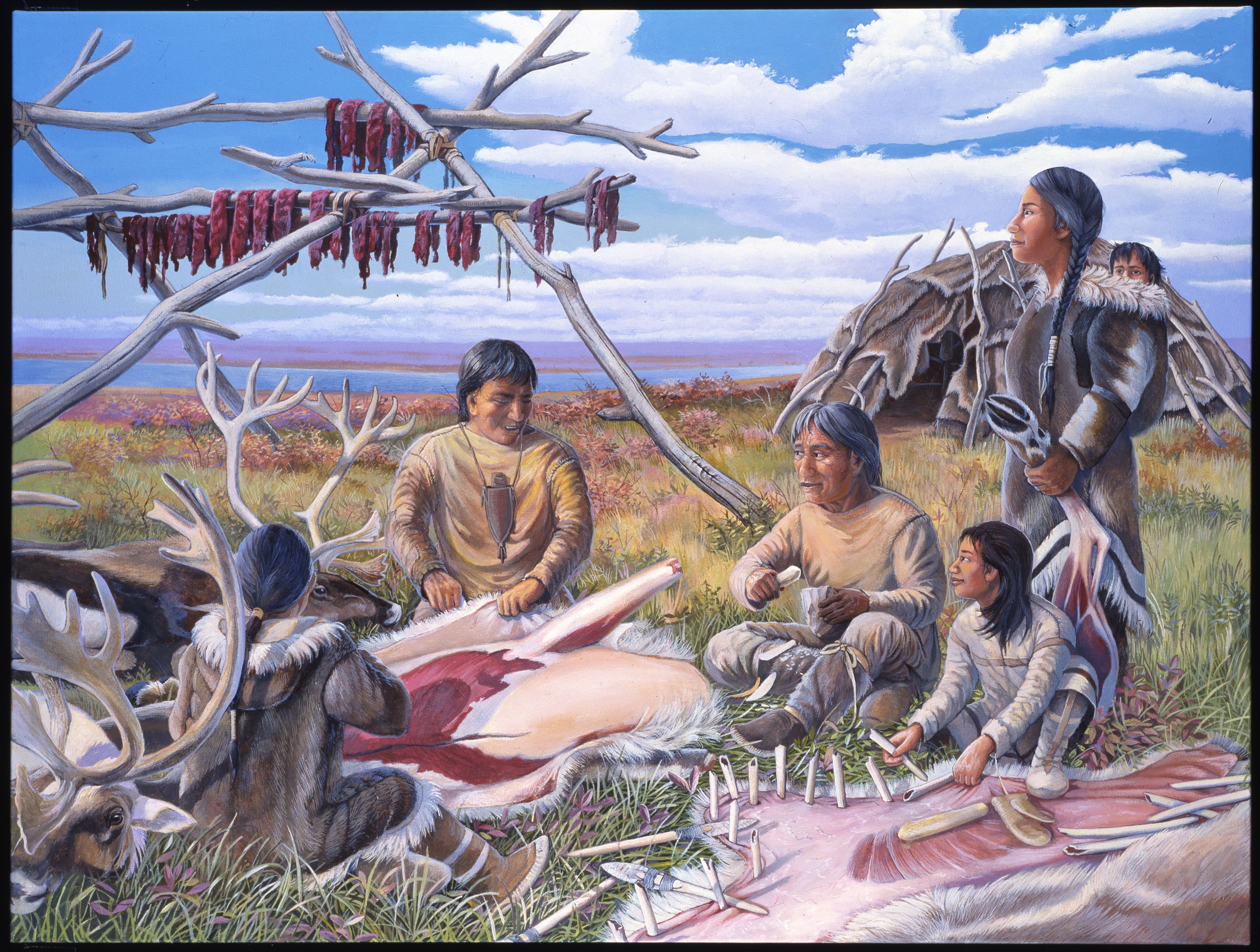
Paleo-Indians
PeopleWikipedia
9
MENTIONS
6
EPISODES
6
PODCASTS
Search complete. 9 mentions across 6 episodes found for "Paleo-Indians".
Nov 2, 2026

speaker_0NARRATOR
Human beings were present in the Great Lakes region at that time.
speaker_0NARRATOR
The Paleo-Indian cultures had entered the region as the glaciers retreated, following the megafauna that grazed on the newly exposed land.
speaker_0NARRATOR
These people did build stone arrangements.
speaker_0NARRATOR
They did depict the animals they hunted.

Sarah SportmanGUEST
And this particular artifact is what's known as a graver, which is a stone that's been worked into a teeny tiny little point that's used for working bone and other materials to make tools out of them.
Sarah SportmanGUEST
And these tools and then some of the other things that Mark found are led us to believe that the site actually dated to the earliest period of human occupation in Connecticut, which archaeologists call the Paleo-Indian period.
Sarah SportmanGUEST
And it's the first people who were ever on the landscape here.
Sarah SportmanGUEST
And

Micah HanksHOST
We attended the Paleo-American Odyssey Conference and had some excellent discussions and attended lectures with our archaeological colleagues of many years.
Micah HanksHOST
This is actually one of the largest Paleo-Indian-era archaeological conferences in the entire United States, if not the world, that we attended.
Micah HanksHOST
But after dropping the guys off at the airport...
Micah HanksHOST
I then made my way over to the National UFO Historical Records Center in Greater Albuquerque, New Mexico, and reunited with another friend, David Marler.

Steve StocktonHOST
Now, to put this into perspective, mastodons went extinct in the Great Lakes region roughly 10,000 to 11,000 years ago.
Steve StocktonHOST
So, if the carving was made by human hand, it means the monument was built by prehistoric Paleo-Indians at the very end of the Pleistocene epoch.
Steve StocktonHOST
So, how does a prehistoric stonehenge end up under 40 feet of water? To understand the mystery of the Grand Traverse Bay stones, you have to understand that the Great Lakes are a relatively recent geographical feature.
Steve StocktonHOST
Around 10,000 years ago, as the last ice age was ending, the massive glaciers that covered the Midwest began to retreat.

Jack HennemanHOST
The food crops that Spanish explorers found in the Western Hemisphere in the years after Columbus were developed by Indian botanists as long as 10,000 years ago, when settled agriculture was also only just beginning in the Fertile Crescent of the Middle East.
Jack HennemanHOST
We now know, through the miracle of genomics, that this was possible because Paleo-Indians had moved south of the ice sheets that covered much of Canada and the United States by 21,000 BC, much earlier than most of us were taught about in school when we learned about Clovis points and such.
Jack HennemanHOST
The lethal diseases of the Old World, which we will see were devastating when they arrived in the New World, evolved because of animal husbandry and dense urban civilization in the Eastern Hemisphere.
Jack HennemanHOST
When those pathogens invaded a human population that had been isolated for more than 20,000 years, the damage was incalculable.
10 MINS LATER
Jack HennemanHOST
And we should not conflate the two, either when we condemn colonization or defend it.
Jack HennemanHOST
You might be wondering why diseases did not flow from the New World to the Old.
Jack HennemanHOST
Well, the most likely explanation is that some combination of the earliest settlers across the Bering Land Bridge, known now as Paleo-Indians, and climate change did away with most of the large mammals in the Western Hemisphere, or at least those with potential for domestication.
Jack HennemanHOST
The Indians, therefore, did not have many different species of large animals to invite into their dwelling places, which meant they created many fewer opportunities for ugly diseases to evolve and jump from animals to humans.

Jim SowerNARRATOR
All other finds met with a similar fate until the discovery, in 1926, of the unique Folsom projectile points with the extinct glacial bison Antiquus near Folsom, New Mexico.
Jim SowerNARRATOR
In three years' research, 19 Folsom points were found in direct association with the 23 extinct bison, and the antiquity of the Paleo-Indian was firmly established.
Jim SowerNARRATOR
Now the long-neglected glacial strata were examined.
Jim SowerNARRATOR
Archaeologists looked for additional fulsome sites wherever man, wind, or weather had scarred the surface of the land, exposing the glacial earth levels to the human eye.
Jim SowerNARRATOR
Within a decade of the fulsome New Mexico discovery, Paleo-Indian sites were found from Alaska to Patagonia, and from coast to coast.
Jim SowerNARRATOR
These sites had been exposed to the eye of man for decades, but they were only found after man was convinced that Ice Age Indians actually existed.
Jim SowerNARRATOR
Again, it shows that man must believe before he looks, and he must look before he finds anything.