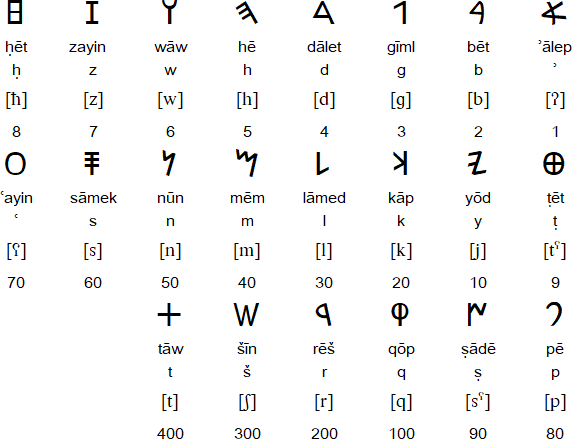
Paleo-Hebrew alphabet
Writing systemWikipedia
28
MENTIONS
17
EPISODES
16
PODCASTS
Search complete. 28 mentions across 17 episodes found for "Paleo-Hebrew alphabet".
Oct 6, 2026

Michael KrugerGUEST
What if you could sort of ascertain early Christian beliefs about Jesus' divine identity by looking at how they abbreviate the name? Now, of course, this goes back to Jewish culture.
Michael KrugerGUEST
We know that in Old Testament manuscripts, they would have their own way of setting apart the divine name in Jewish Old Testament manuscripts called the Tetragrammaton, which is a way of writing the name Lord without vowels or using Paleo-Hebrew or what have you.
Michael KrugerGUEST
So that whole concept of doing something distinctive with God's name as a way to honor it is now switched over to Jesus.
Michael KrugerGUEST
And that, I think, shows you that they view Jesus as Lord, as God, in a way that they would have viewed the Lord of the Old Testament as God.
Michael KrugerGUEST
it
Sean McDowellHOST
apart.
Michael KrugerGUEST
They would sometimes write it in what's called Paleo-Hebrew, which is an older Hebrew.
Michael KrugerGUEST
Sometimes the vowel pointing would be left out.

Shael Ben-EphraimHOST
In August 2024, the Israeli Archeologists Association published a seal from the Davidson Archeological Park right at the foot of the Temple Mount.
Shael Ben-EphraimHOST
It's black stone, and it's small enough to wear, and it's inscribed in Paleo-Hebrew.
Shael Ben-EphraimHOST
It describes it as belonging to Yeho'ezer, son of Hosha'iah.
Shael Ben-EphraimHOST
Those are two awesome names, both of them Yahwistic, built on the name of the God of Israel.

Tim ConstantineHOST
David Deal, researcher.
Tim ConstantineHOST
He's a Paleo-Hebrew scholar who has studied the Michigan relics that feature the mystic symbol, of course.
Tim ConstantineHOST
He said that these were religious and even biblical in context.
Tim ConstantineHOST
These, these are old relics found in Michigan, but they have biblical context.
Tim ConstantineHOST
And he believes that these my- the mystic symbol itself is Paleo-Hebrew, and it's using cuneiform nail.
Tim ConstantineHOST
So the, the figures are, are made of lines that look like little nails.
Tim ConstantineHOST
It's cuneiform.

Joe HeschmeyerGUEST
And tav today doesn't look anything like a cross.
Joe HeschmeyerGUEST
But in what was called Paleo-Hebrew, like the old way of writing the Hebrew letters, it was a cross.
Joe HeschmeyerGUEST
And so there's this actual pretty amazing biblical evidence, and the early Christians were aware of it, and they pointed to this as prefiguring the sign of the cross.
Joe HeschmeyerGUEST
And so when the book of Revelation talks about those being sealed on the forehead with the name of God,

Rob WattsHOST
Do you have an ancient fact to, to round us off?
Jess ZafarrisHOST
I'd say the last thing is just to, is just that it's very cool that all of these writing systems that we've talked about have influenced all of the writing systems, not just that we use now, but other older ancient languages like Greek and Aramaic and Paleo-Hebrew and Carth- Carthaginian and things like that.
Jess ZafarrisHOST
And it, it is really neat to be able to see the influence from one to the other.
Jess ZafarrisHOST
Just rotate that cow and get the letter A and things like that.

Christopher DeanHOST
Oh, that a more full language would allow the entire brain to function? That's an interesting thought.
Jason SpearsHOST
And a more precisely developed language, like Proto-Hebrew.
Christopher DeanHOST
Right.
Christopher DeanHOST
That's interesting.

Cindy Savage RiceGUEST
was doing that, okay, so at this time, I thought to myself, what I need to do is learn Hebrew.
Cindy Savage RiceGUEST
And if I can learn Hebrew, then I can look deeper into some things, right? So I start looking for Hebrew, and I find Paleo-Hebrew, and then I find Cuneiform, which is the language of Sumeria.
Cindy Savage RiceGUEST
And Sumeria was the civilization before the Bible times.
Cindy Savage RiceGUEST
So all of a sudden, I find Sumeria, and...

speaker_1HOST
The paper details the specific linguistic mechanics used by the scribes.
speaker_1HOST
Because, remember, they were bilingual in both Akkadian cuneiform and Aramaic, or Proto-Hebrew.
Darren KelamaHOST
Right, okay.
speaker_1HOST
The first mechanic is what Mitchell calls deleting the dinger.
Tim ConstantineHOST
Cyus- Cyrus Gordon goes in and says, "No, it's not Cherokee turned upside down.
Tim ConstantineHOST
It's Paleo-Hebrew." And at that point, from what I understand, the relic gets taken down from display and goes and lives in a back room because now it doesn't fit-
Mondo GonzalezGUEST
Fit
Tim ConstantineHOST
...
Mondo GonzalezGUEST
in, in, in, not just the Bible, but in the Ugaritic culture.
Mondo GonzalezGUEST
Um, and w- so for, to have Cyrus Gordon, who is a tremendously respected Bible scholar, you know, archeologist, [laughs] um, comment on it and be, and for him to recognize, 'cause he, you know, he knows his stuff.
Mondo GonzalezGUEST
Like, "Wow, that's Paleo-Hebrew." And then even, even that level of scholarship by him can't even get in foot in the door.
Tim ConstantineHOST
Yeah.

Bernard QuisumbingGUEST
Wow.
Stephen ScogginsHOST
Um, and I love the intentionality sometimes behind names, and I love it when those names translate to Hebrew or even Paleo-Hebrew.
Stephen ScogginsHOST
Now, I asked you to go a step further last night and, um, discover what Paleo-Hebrew looks like with David.
Stephen ScogginsHOST
What was the most surprising thing, um, when looking at it from a He- Paleo-Hebrew perspective, the, the physical indicator?
Bernard QuisumbingGUEST
So some-
Stephen ScogginsHOST
Mm
7 more episodes mention Paleo-Hebrew alphabet.
Create an account to see the whole feed, search across every transcript, and follow the entities you care about.