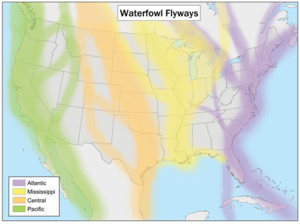
Pacific Flyway
26
MENTIONS
14
EPISODES
12
PODCASTS
Search complete. 26 mentions across 14 episodes found for "Pacific Flyway".
Sep 13, 2026

Rick TravisHOST
And we just got a report from the United States government that we have the lowest turnout of mallards in 33 years.
Rick TravisHOST
And we all realize in the Pacific Flyway, California is the place where the flyway comes to lay their eggs, get their chicks going, and then fly back north to parts of Canada and the Arctic Circle where they feed during the summer months.
Rick TravisHOST
And then they come back here and that cycle continues.
Rick TravisHOST
The Pacific Flyway depends on California to have those areas where there's habitat for them.
Rick TravisHOST
So in terms of nutria, nutria are damaging that, correct? So that's like an impact on a different thing in the ecosystem.
Steve ChildsGUEST
Yeah, a lot of these species are kind of interrelated.

Jeff McCrearyGUEST
But really it's that long term, can we get cold weather up north and force the rest of the birds that are not California-grown to come on south.
Mike BrasherHOST
That is some awesome news, and I hope all the Pacific Flyway hunters that are out in that area are hearing this and are getting excited about it.
Mike BrasherHOST
Um, you know, we've, we've given a lot of coverage to the breeding population survey results through over the past several weeks, and we talked a lot about how that number is only one part of the equation when it, uh, when it comes to what ultimately is in front of your blind.
Mike BrasherHOST
The other big ingredient is production, and that's what we're talking about here in the Klamath Basin, and what was, uh, the, the threat that was thwart- thwarted by, by some collaborative effort and, uh, and benefits of nature.

Joel BriceHOST
So I just think that's a really cool conversation.
Joel BriceHOST
Alaska North Slope and Pacific Flyway.
Joel BriceHOST
So Pacific Brandt, a good production year?
Jay Von BankGUEST
Yeah, I talked to some folks on the North Slope who said it was kind of a good to surprisingly good year.
Jay Von BankGUEST
There's some BRANT research going on there.
Jay Von BankGUEST
USGS has a few folks who are doing quite a bit of research on geese on the north slope as well.
Joel BriceHOST
Okay, so it looks like for the Pacific Flyway, you know, all the way up to Alaska, if you go BRANT, snow geese, white fronts, cacklers...
Joel BriceHOST
Kind of an up year for production pretty much all the way across the board there.

Robbie NelsonHOST
But if you go somewhere where there's a lot of numbers of ducks, I mean, I shot limits of mallards twice.
Robbie NelsonHOST
Last year, we shot a limit, two limits, because it was just two of us, of greenheads and our three Drake pintails in the Pacific Flyway over hand-cut black silhouettes.
Robbie NelsonHOST
Actually, let me take that back.
Robbie NelsonHOST
They weren't hand-cut.

Lisa D. SmithHOST
Oh
Sylke Neal-FinneganGUEST
... doing that migration, 'cause we're right on the Pacific Flyway.
Sylke Neal-FinneganGUEST
And so-
Lisa D. SmithHOST
Okay

MikeHOST
And we've been hinting around about it already this year.
MikeHOST
With this super El Nino likely coming, warmer overall in the north, cooler and wetter in the south, possibly drier in the prairies and Great Lakes region, and more wet throughout the Rockies and Pacific Flyway in general.
MikeHOST
Remember that the really good information on atmospheric cycles does not come out until around the month of October and into early November.
MikeHOST
I know that's a little late, but...

speaker_0NARRATOR
At the eastern edge of Box Elder County, where the Bear River Delta flows into the Great Salt Lake, sits the Bear River Migratory Bird Refuge, 74,000 acres of freshwater marsh established in 1928, which hosts more than 250 bird species and draws more than 100,000 human visitors a year.
speaker_0NARRATOR
The refuge sits at the intersection of the Pacific Flyway and the Central Flyway, the two great North American bird migration corridors, making it one of the most ecologically critical wetland systems in the American West.
speaker_0NARRATOR
Further into the sagebrush uplands, Box Elder County has done some of the most extensive juniper eradication work in the country, specifically to maintain habitat for the greater sage grouse, the emblem species of the Great Basin sagebrush steppe, whose population has been in decline for decades.
speaker_0NARRATOR
The stratus site drains to the same lake at its northern end.

Frank RohrerGUEST
Do the
Chris RamseyHOST
Arctic ones typically migrate down the Pacific Flyway? No, they
Frank RohrerGUEST
really
Chris RamseyHOST
split.
Frank RohrerGUEST
It's very interesting.
Frank RohrerGUEST
Most of the Pacific Flyway pintails are from Alaska, YK Delta, and the Western Arctic.
Frank RohrerGUEST
But, you know, you've got a lot of pintails breeding in the Central Arctic, Queen Mug, Gulf area, and those guys are...
Frank RohrerGUEST
That's our Texas Louisiana pin tail.

Cannon MichaelGUEST
Yeah, absolutely.
Cannon MichaelGUEST
And I would just say, you know, our farm being located where we are, our entire western border is actually part of the wetlands that are very important for the Pacific Flyway, the Grasslands Wildlife Management Area.
Cannon MichaelGUEST
And our family dedicated 650 acres into a permanent federal easement to be managed only for wetland habitat.
Cannon MichaelGUEST
So we play an active role in managing habitat that's very beneficial for the migratory birds and for the local species that we have here.

ZachHOST
That's, that's gonna be cool.
TylerHOST
Well, the Pacific Flyway has pretty liberal limits.
TylerHOST
I think you can kill seven ducks a day per person out there, and I think-
ZachHOST
Geez
4 more episodes mention Pacific Flyway.
Create an account to see the whole feed, search across every transcript, and follow the entities you care about.