Oxidative phosphorylation
4
MENTIONS
4
EPISODES
4
PODCASTS
Search complete. 4 mentions across 4 episodes found for "Oxidative phosphorylation".
Oct 12, 2026

Jay FeldmanHOST
And then here are a few studies.
Jay FeldmanHOST
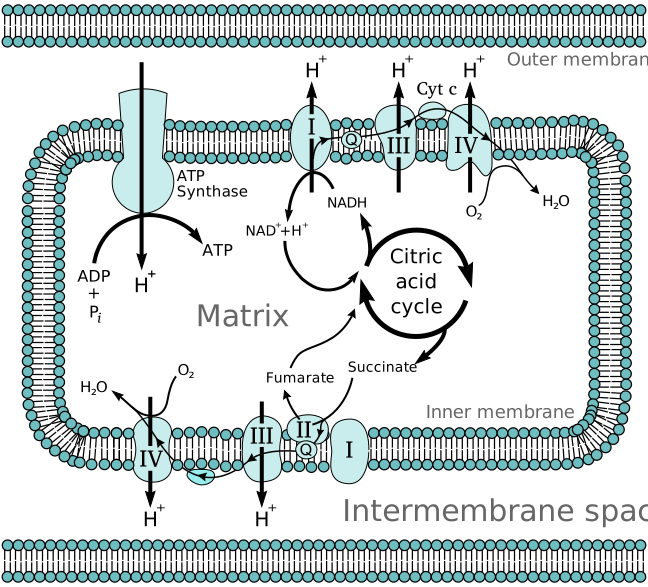
These are the last ones that we're going to go through, but they're really important to touch on because they fully confirm oxidative phosphorylation, ATP production at the electron transport chain from fatty acids in cancer cells.
Jay FeldmanHOST
The first one here is a twenty sixteen paper titled Enhanced OxPhos or Oxidative Phosphorylation, Glutaminolysis, and Beta-Oxidation Constitute the Metastatic Phenotype for Melanoma Cells.
Jay FeldmanHOST
And so they state here, "The four C one one positive cells also displayed an increased oxidative metabolism accompanied by enhanced rates of oxygen consumption coupled to ATP synthesis.
Jay FeldmanHOST
Furthermore, four C one one plus cells had a higher ATP content and increased succinate oxidation, which points to complex two activity and fatty acid oxidation." And the four C one one positive cells, these are metastatic cells, so the cells that are most concerning.

Daniel J. GuerraHOST
So, indeed, NAD is an essential coenzyme primarily regarded for its use in redox, reduction oxidation reactions.
Daniel J. GuerraHOST
And of course, those reactions are intimately linked via the ETC, OXFOS, to mitochondrial ATP synthesis.
speaker_1UNKNOWN
Now, while NAD is not permeable
Daniel J. GuerraHOST
by itself, NAM, on the other hand, nicotinamide mononucleotide, direct product, will readily cross the plasma membrane.

Thomas SeyfriedGUEST
And then it got me into what Otto Warburg had done many, many years ago in the 1920s in Germany.
Thomas SeyfriedGUEST
He showed that cancer was a mitochondrial metabolic disorder driven by glucose because OXFOS was impaired.
Thomas SeyfriedGUEST
So we started working on all these cancer.
Thomas SeyfriedGUEST
We had a big program in brain cancer anyway, but I was doing it for biochemical reasons, ganglion side biochemistry, anti-angiogenesis, the role of glycol lipids in blocking the vascularization of tumors.

Joel GreeneGUEST
And then the cells involved require a lot of rapid energy.
Joel GreeneGUEST
So they cannot rely on, they can't rely on Oxfos.
Joel GreeneGUEST
They need Warburg metabolism to spin up.
Joel GreeneGUEST
That's where they get the juice from.