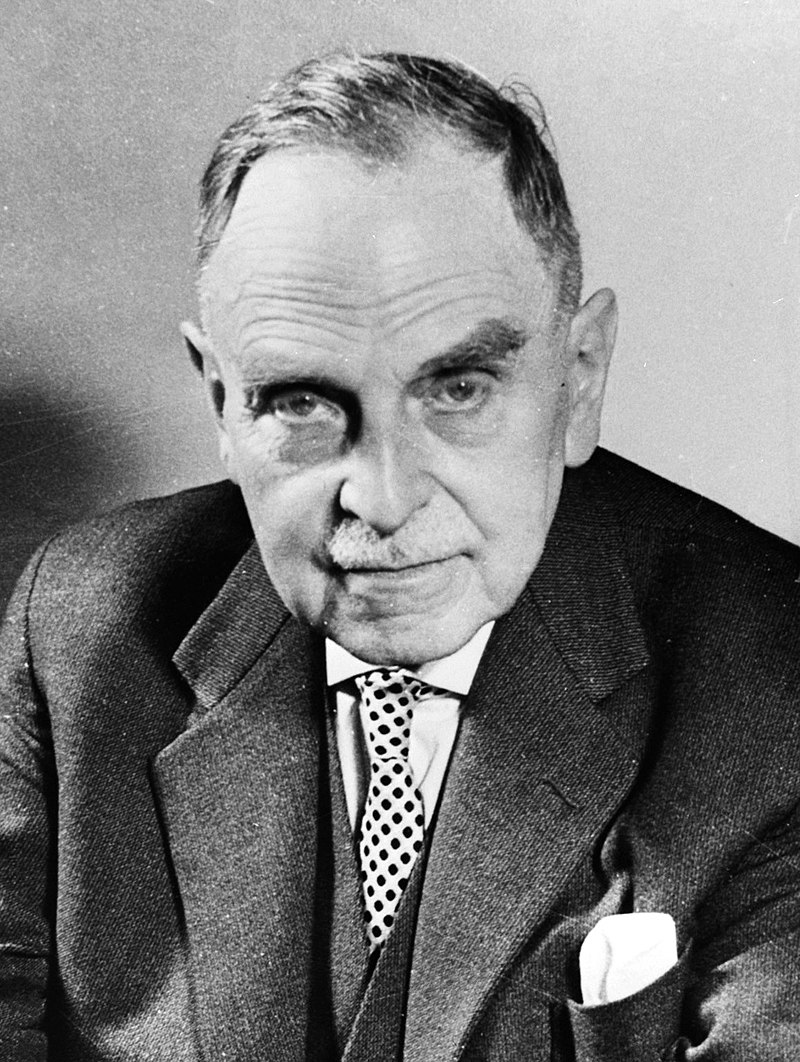
Otto Hahn
German chemistWikipedia
20
MENTIONS
7
EPISODES
7
PODCASTS
Search complete. 20 mentions across 7 episodes found for "Otto Hahn".
Sep 27, 2026

Christopher Jon BjerknesGUEST
And then Friedrich Soddy started to say that the release of atomic energy can be accelerated to make it useful.
Christopher Jon BjerknesGUEST
And then Otto Hahn came up with nuclear fission.
Christopher Jon BjerknesGUEST
And when nuclear fission appeared, that was the method that Preston, that Gustave Le Bon were trying to create that would cause the rapid decay of matter to such an extent that it could produce And then in 19, I think 1914, you had H.G. Wells literally writing books about what he called atomic bombs.
Christopher Jon BjerknesGUEST
So there is a sound physical basis for all this.

Christopher Jon BjerknesGUEST
And then Friedrich Soddy started to say that the release of atomic energy can be accelerated to make it useful.
Christopher Jon BjerknesGUEST
And then Otto Hahn came up with nuclear fission.
Christopher Jon BjerknesGUEST
And when nuclear fission appeared, that was the method that Preston, that Gustave Le Bon were trying to create that would cause the rapid decay of matter to such an extent that it could produce And then in 19, I think 1914, you had H.G. Wells literally writing books about what he called atomic bombs.
Christopher Jon BjerknesGUEST
So there is a sound physical basis for all this.

JoeHOST
The next tick of the clock occurred two years later, when Irene and Frederick Joliot-Curie created the first artificial radioactive element, demonstrating that humans could manipulate nuclear properties.
JoeHOST
But the most crucial breakthrough came in 1938, when German chemists Otto Hahn and Fritz Straussmann discovered nuclear fission, the splitting of uranium atoms which release enormous amounts of energy.
JoeHOST
Scientists worldwide immediately recognized the implications.
JoeHOST
A controlled chain reaction could create a revolutionary energy source, while an uncontrolled one might yield a weapon of unprecedented destructive power.

Abby BrinkerHOST
All of our sources, as always, will be linked in the description of this episode.
Abby BrinkerHOST
Nuclear fission was discovered in 1939 by German chemists Otto Hahn and Fritz Strassmann, with the physics interpretation provided by Lise Meitner and Otto Frisch.
Abby BrinkerHOST
Scientists realized that fission could potentially release enormous amounts of energy, and of course, soon realized that this energy could be used as a weapon.
Abby BrinkerHOST
Einstein's 1939 letter to President Franklin Roosevelt helped bring the potential military implications of nuclear research to the attention of the US government.

AmandaHOST
Yeah.
LucyHOST
Another member was a guy named Otto Hahn, who is credited with discovering nuclear fission, fission,
AmandaHOST
fission.
LucyHOST
Go Fission.
LucyHOST
So he split the atom.
LucyHOST
If you know about that, don't get pissed off at me yet because we're going to circle back to Otto Hahn.
AmandaHOST
Okay.
LucyHOST
Before we get to that, I do want to say one last thing about the KWG just to, again, give you an idea of the eventual mission and values that it had.

Thomas777GUEST
Neither was Einstein.
Thomas777GUEST
A man named Otto Hahn was.
Thomas777GUEST
And this didn't used to be controversial, okay? Who was Otto Hahn? Otto Hahn was born in 1879.
Thomas777GUEST
He died when he was quite elderly in July 1968.
Thomas777GUEST
Hahn is the father of nuclear chemistry and specifically nuclear fission, okay? Han and his assistant, a lady named, let's say, Meitner, they discovered the radioactive isotopes of radium, thorium, protactin, and most importantly, uranium.
11 MINS LATER
Thomas777GUEST
Okay.
Thomas777GUEST
Um, although obviously he ultimately endured true horrors as we got into in an earlier series, but, um, the, uh, The goal nominally, and I think this is basically true of what MI6 and the U.S. War Department both claimed independently, was that the goal was to determine how close the German Reich had come to the development of a viable atomic bomb.
Thomas777GUEST
First among the detainees was Otto Hahn.

ThomasGUEST
Neither was Einstein.
ThomasGUEST
A man named Otto Hahn was.
ThomasGUEST
And this didn't used to be controversial, okay? Who was Otto Hahn? Otto Hahn was born in 1879.
ThomasGUEST
He died when he was quite elderly in July 1968.
ThomasGUEST
Hahn is the father of nuclear chemistry and specifically nuclear fission, okay? Han and his assistant, a lady named, let's say, Meitner, they discovered the radioactive isotopes of radium, thorium, protactin, and most importantly, uranium.
9 MINS LATER
ThomasGUEST
And the other hand, you know, if they, if you wanted these men to speak, you know, London wanted these men to speak to the, you know, their own academics about the, you know, about the bomb and things.
ThomasGUEST
And if you're, and if you're just, you know, kind of like treating people, like forcing them to live, you know, like, like, you know, like abject, um, in squalor or whatever or you know or or abject prisoners um in the traditional sense that that wouldn't have happened so i mean it's um it kind of reminds me of the early days of like spear's attention okay um although obviously he ultimately endured through horrors as we got into in an earlier series but um the uh The goal nominally, and I think this is basically true of what MI6 and the U.S. War Department both claimed independently, was that the goal was to determine how close the German Reich had come to the development of a viable atomic bomb.
ThomasGUEST
First among the detainees was Otto Hahn.