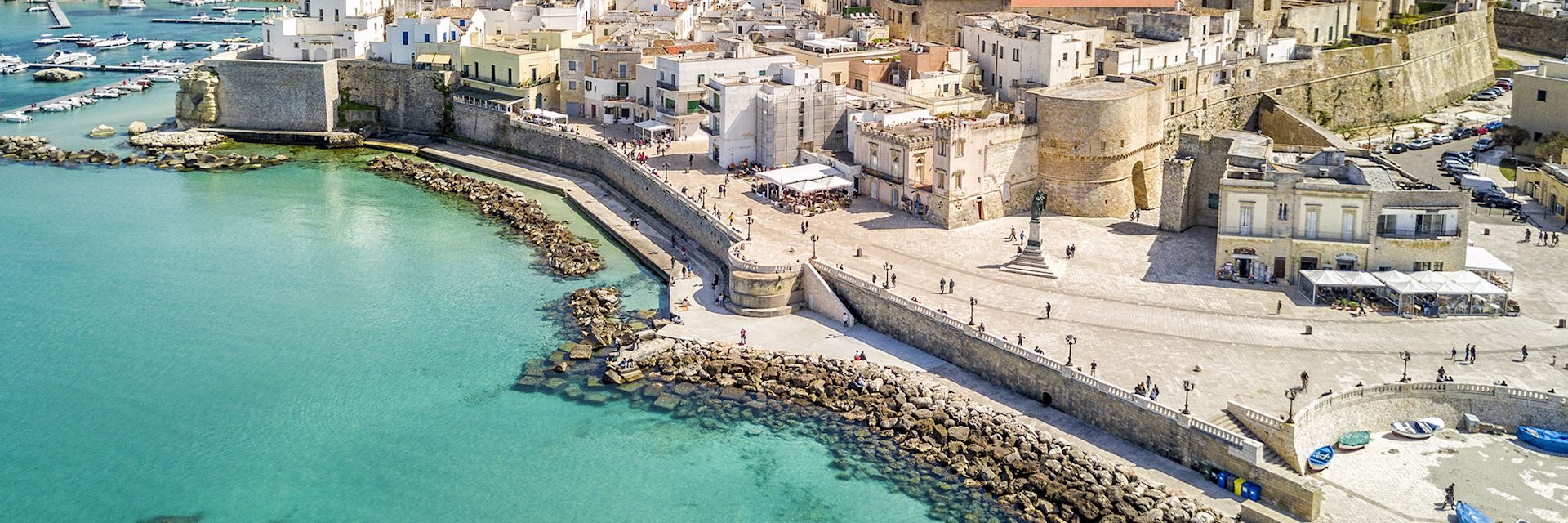
Otranto
Town in ItalyWikipedia
62
MENTIONS
16
EPISODES
15
PODCASTS
Search complete. 62 mentions across 16 episodes found for "Otranto".
Sep 10, 2026

BeauHOST
Is global church history going to be in at number one? Is it a good day? Yes, there is global church history in at number one.
BeauHOST
You say today in 1481 AD, Otranto was liberated from the Ottomans after just over one year.
BeauHOST
Yeah, Otranto, right on the heel of Italy, isn't it? Right, right on the heel of Italy.
BeauHOST
And the Ottomans took it in the 15th century.
BeauHOST
So in the ascendancy westwards.

Scott MaxwellHOST
Almost always Lecce itself.
Scott MaxwellHOST
That covers Otranto, Gallipoli, the Adriatic and Ionian coastlines, and the deep south of the hill.
Scott MaxwellHOST
Lecce also happens to be the better base logistically for anyone flying via Brindisi rather than Bari.
Scott MaxwellHOST
A shorter trip, the three or four night bolt-on at the end of a Rome or Amalfi holiday, usually only has room for one of these two bases, and the Itria Valley at the moment is the stronger choice for a first visit, especially for American travellers.
Scott MaxwellHOST
From an Itria Valley base, that might mean a morning in El Berrobelo, followed by lunch and a slow afternoon in Chile and Misapica.
Scott MaxwellHOST
Close enough to add, with almost no extra driving, where the evening passeggiato is still mostly locals rather than visitors.
Scott MaxwellHOST
it might mean swapping a Trullo stay in Alberobello for the countryside around Locorotondo instead geographically almost interchangeable and architecturally just as rewarding and considerably calmer even in August Cisternino and Martina Franca do similar work recognisably part of the same Trullo and whitewashed landscape everyone came to see without the cues that Alberobello's UNESCO status has earned it From a Salento base, the equivalent move is treating Lecce and Otranto or Gallipoli as the anchor days, and then giving at least one day to somewhere the official numbers say Americans are barely visiting yet, Galatina, Nardo, or head all the way down south to Castro, Marina Serra, Santa Maria dell'Iuca.
Scott MaxwellHOST
Matera, of course, deserves its own mention here.

David WalesNARRATOR
But it is interesting to note that nearly fifty years before her, the anonymous pilgrim of Bordeaux gives the route which she pursued and that may possibly have been Etherea's too.
David WalesNARRATOR
She went out by land, she tells us, across the north of Italy, through Noricum, Pannonia, Moesia, Dacia, and Thrace, while on her return she embarked at Olon in Epirus and crossed the south Adriatic to Hydrontum, Otranto, and reached home by Rome and Milan.
David WalesNARRATOR
End of section 1.
David WalesNARRATOR
Section 2 of The Pilgrimage of Etherea by Etherea.

Morgan ScorpionNARRATOR
Enterprises of the Turks.
Morgan ScorpionNARRATOR
They take Otranto.
Morgan ScorpionNARRATOR
The Florentines reconciled with the Pope.
Morgan ScorpionNARRATOR
Their ambassadors at the papal court.
15 MINS LATER
Morgan ScorpionNARRATOR
The Turkish emperor, Mahomet II, had gone with a large army to the siege of Rhodes, and continued it for several months.
Morgan ScorpionNARRATOR
But though his forces were numerous and his courage indomitable, he found them more than equalled by those of the besieged, who resisted his attack with such obstinate valour that he was at last compelled to retire in disgrace.
Morgan ScorpionNARRATOR
Having left Rhodes, part of his army, under the Pasha Achmet, approached Velona, and, either from observing the facility of the enterprise or in obedience to his sovereign's commands, coasting along the Italian shores, he suddenly landed four thousand soldiers and attacked the city of Otranto, which he easily took, plundered, and put all the inhabitants to the sword.
Morgan ScorpionNARRATOR
He then fortified the city and port, and having assembled a large body of cavalry, pillaged the surrounding country.

Ben TuckerNARRATOR
Gothic is here used to designate the 18th century novel of terror dealing with medieval materials.
Ben TuckerNARRATOR
There had been some use of the weird in English fiction before Horace Walpole, but the terror novel proper is generally conceded to begin with his romantic curiosity, The Castle of Otranto.
Ben TuckerNARRATOR
The Gothic novel marks a distinct change in the form of literature in which supernaturalism manifests itself.
Ben TuckerNARRATOR
Heretofore, the supernatural elements have appeared in the drama, in the epic, in ballads and other poetry, and in folktales, but not noticeably in the novel.
Ben TuckerNARRATOR
Horace Walpole, the father of the terror novel, had a fad for medievalism, and he expressed his enthusiasm in that extraordinary building at Strawberry Hill, courteously called a Gothic castle.
Ben TuckerNARRATOR
From a study of Gothic architecture was but a step to the writing of romance that should reproduce the mysteries of feudal times, for the shadows of ancient, gloomy castles and cloisters suggested the shades of ghost-haunted fiction, of morbid terrors.
Ben TuckerNARRATOR
The Castle of Otranto was the outcome of a dream suggested by the author's thinking about medieval structures.
Ben TuckerNARRATOR
The Gothic castle itself is represented as possessing all the antique glooms that increase the effect of mystery and awe, and its secret passageways, its underground vaults and dungeons, its trapdoors, its moldy spectral chapel form a fit setting for the unearthly visitants that haunt it.

speaker_3NARRATOR
CHAPTER I.
speaker_3NARRATOR
THE SUPERNAL VOCATION Copertino, the birthplace of our saint, is situated on the peninsula of Apulia, halfway between the Gulf of Taranto and the Strait of Otranto.
speaker_3NARRATOR
In the 17th century, the town belonged to the province of Otranto, kingdom of Naples.
speaker_3NARRATOR
But few particulars are recorded regarding the parents of St. Joseph, Felix Disa and Francis Panata.
speaker_3NARRATOR
Felix was a carpenter, kind of heart he had given security for the debts of others.

Raymond IbrahimHOST
Not content with being the conqueror of New Rome, greedy Muhammad was determined to fulfill the second half of that prophecy by conquering Old Rome as well.
Raymond IbrahimHOST
So he spent 27 years terrorizing and expanding into the Balkans, until 1480, when his forces crossed into Italy and seized the city of Otranto.
Raymond IbrahimHOST
The sack was horrific.
Raymond IbrahimHOST
More than half of the city's 22,000 Christian inhabitants were massacred, and 5,000, the unlucky ones, mostly women and children, were enslaved.
Raymond IbrahimHOST
Their families, the now enslaved women and children, were forced to watch the carnage of their husbands and fathers as a reminder of the price of defiance.
Raymond IbrahimHOST
As for their archbishop, he was slowly sawn in half to triumphant cries of Allahu Akbar.
Raymond IbrahimHOST
The bodies and heads of the Christians were left to rot atop the hill for over a year, until the Italians managed to liberate and kick the Muslims out of Otranto.
Raymond IbrahimHOST
The skulls of some of these martyrs are still displayed in the cathedral of Otranto, silent witnesses to the horror of that day.

David WalesNARRATOR
But it is interesting to note that nearly fifty years before her, the anonymous Pilgrim of Bordeaux gives the route which she pursued and that may possibly have been Etheria's too.
David WalesNARRATOR
She went out by land, she tells us, across the north of Italy, through Noricum, Pannonia, Moisi, Dacia, and Thrace, while on her return she embarked at Orléans in Epirus and crossed the south Adriatic to Hydruntum, Otranto, and reached home by Rome and Milan.
David WalesNARRATOR
End of Section 1 Section 2 of The Pilgrimage of Etheria by Etheria This LibriVox recording is in the public domain.
David WalesNARRATOR
Introduction, Resume of Her Journeyings The narrative, as we now possess it, opens in the middle of a sentence at the point where the pilgrim had already reached the megalithic remains at Kibroth-hataavah, in sight of the mountain range of Sinai.

David WalesNARRATOR
But it is interesting to note that nearly fifty years before her, the anonymous Pilgrim of Bordeaux gives the route which she pursued and that may possibly have been Etheria's too.
David WalesNARRATOR
She went out by land, she tells us, across the north of Italy, through Noricum, Pannonia, Moisi, Dacia, and Thrace, while on her return she embarked at Olan in Epirus and crossed the south Adriatic to Hydrontum, Otranto, and reached home by Rome and Milan.
David WalesNARRATOR
End of section one.
David WalesNARRATOR
Section two of The Pilgrimage of Etheria by Etheria.

Jeffrey EdwardsNARRATOR
a etheria speaks of the three bishops whom she came across in mesopotamia at bathne edessa and haran as conspicuous for their holiness being both monk and confessor in each case she does not apply this word confessor to any other of the bishops although she has several times noted that they were or had been monks formerly while the still vigorous old priest whom she saw on mount sinai had been both a monk from an early age and as they say here an ascete according to monseigneur duquesne we know that the three bishops who are called confessors were victims of the persecution under valens a d three sixty seven three seventy eight page five forty seven we can hardly be said to know this but only that this is more likely that they were other things being considered than that they were those whom the emperor anastasius favouring the monophysites drove out in the early years of the sixth century as meister maintains is it however altogether certain that confessor in these three cases means more than a stricter ascete than an ordinary monarchus duquesne himself recognizes that this is a frequent meaning of the title in those days see christian worship page one forty two one seventy three two eighty four and four twenty and bradesol east du brel rome page fifty seven still eulogius bishop of edessa died three eighty eight seems to have suffered persecution and this would no doubt fit in with our date for the pilgrimage b etheria quotes the bishop of haran's statement to her that at that time the persians held the district of nisibis and ur and the romans had no place there page thirty nine as the emperor jovian had yielded the district to king sapphor in three sixty three that seems to be the explanation of the statement on the other hand in the years five forty five forty five the romans under balisarius regained their supremacy in the east so that meister allows that the pilgrimage must have taken place before then for that reason among others he assigns it to five thirty four or thereabouts c dr bernard has drawn our attention to another point in favor of the earlier date which meister seems to have overlooked it is this when we come to the pilgrimages which are admittedly of the sixth century e g the so-called breviarum and the pilgrimage of theodosius both of which may be dated about five thirty we find among the churches in jerusalem visited by pilgrimage st peter in the house of caiaphas saint sophia in the praetorium etheria knows nothing of these she names only the martyrium the anastasis and the church of zion and as her description of the holy city is rich in detail it may be reasonably concluded that these were the only churches which she saw and that her visit was prior to the erection of those named by theodosius meister uses a similar argument to prove that the pilgrimage must be prior to the building by justinian of the church of st mary de in five forty three as it certainly was but this reasoning is equally conclusive to establish its priority to the breviarium and the peregrinatio the present edition and its editors that part of the text which relates to jerusalem had been translated for the english version second edition of duquesne's origines du which mrs mcclure published in nineteen o four for it she was mainly indebted as she tells us to her brother the rev george herbert who had the advantage of many criticisms and suggestions from so eminent a scholar as the late canon charles evans formerly headmaster of king edward's school birmingham mr herbert also translated the rest of the text which now appears with the same assistance moreover he read through k meister's book on the subject and made a careful resume of his conclusions for her of which use has been freely made in this introduction most of the footnotes were added to the text by mrs mcclure herself a few by the present writer but though the results of their joint labors had been set up in print for some time and she had spent a good deal of time in further research and thought over them with a view to writing the introduction she had to lay the work aside while she was completing the fifth edition of christian worship and seeing it through the press this she had hardly done when she was called away just as she was intending to resume her work on the pilgrimage of etheria last summer nineteen eighteen there are many reasons why we mourn her loss and surely among them we must reckon this that we are not now permitted to share with her the joy of seeing the fruits of her long study brought to completion she left very few materials for the introduction behind among her papers and though the present writer has in all cases done his best to utilise what there was and to reproduce what he thought to be in her mind on various points yet he has had very largely to start de novo in drawing up the introductory sections and to treat the text more or less independently he must be forgiven therefore if he has failed sometimes to do justice to her ideas and to the researches on which she had so long been engaged and if there is a certain amount of confusion in arrangement and of discrepancy between her part of the volume and his mrs mcclure had frequently discussed points with friends of considerable expert knowledge like archbishop bernard monseigneur duquesne professor flinders petrie and others and sometimes mentions them by name in her notes as having told her this or that the first named of these had written a short forward to the volume in september nineteen sixteen but he has requested the present writer to withdraw it as being no longer suitable to its purpose and to use the additional facts that he there gave in his own introduction this he has been very glad to do and begs to acknowledge his indebtedness to his grace for them as well as to others who have contributed to the production of the book in its present form and in particular to the rev a d rigby who has read through the proofs and made several valuable suggestions which he has been able to adopt etheria's route to and from constantinople we have of course no hint of the route taken by etheria from her home in the extreme west of europe as far as constantinople and back again unless her mention of the river rhone be taken as indicating that she crossed it in her journey possibly at arles but it is interesting to note that nearly fifty years before her the anonymous pilgrim of bordeaux gives the route which she pursued, and that may possibly have been ethereus too.
Jeffrey EdwardsNARRATOR
She went out by land, she tells us, across the north of Italy, through Noricum, Pannonia, Moesie, Dacia, and Thrace, while on her return she embarked at Olan, in Eperus, and crossed the south Adriatic to Hydrunthum, Otranto, and reached home by Rome and Milan.
Jeffrey EdwardsNARRATOR
End of section 1 section two of the pilgrimage of etheria by etheria this librivox recording is in the public domain introduction resume of her journeyings the narrative as we now possess it opens in the middle of a sentence at the point where the pilgrim had already reached the megalithic remains at kibbroth atava inside of the mountain range of sinai it may reasonably be assumed that the missing part contained the account of her journey from her western home to constantinople from thence through what is now asia minor to antioch and on to jerusalem the events of her stay there apart from the description of the services which she gives later on page forty five and following and her journey from thence towards mount sinai by way of now suez and pharan or paran she had just before probably ascended the mountain of pharan where the hands of moses were uplifted during the battle with amalekite exodus seventeen ten following and came down again into the plain see page twenty two below by this time the mountains lie only four miles distant and passing along the wide flat valley that lies between they soon arrive at their foot on the western side sir c w wilson has no doubt that the peak which she calls the mount of god and made a point of ascending was jebel moosa the traditional site seven thousand three hundred and sixty three feet high though it would actually be impossible for her to see what she was told she saw from the top paid six like so many tourists she was misinformed she went also to what she was told was mount oreb where elijah's cave was and there she specially mentions the very earnest prayer with which they made the oblation thence they descended on the eastern side to the place of the burning bush where the present convent of st catherine is and after visiting tabara and several other sites she returned down the valley again to faran and so back after two days rest by a toilsome route across the desert to where she was again glad to rest for a while when she had been in egypt before she had seen something of goshen as well as of the tebed and alexandria but she was now desirous to explore the route of the exodus more carefully she found it was no easy journey of four stations across the desert to what she calls the city of arabia identified by experts with the dhow of roman official documents or possibly and the district was apparently at the time unsettled and in military occupation however she was allowed an escort of soldiers and set out the route lay past a where there was a roman garrison then through two other forts migdol and baal zephon and onwards by way of etham succoth pithom another fort to heropolis then only a large village on a branch of the nile and within the borders of egypt the remainder of the journey into goshen was then accomplished it took her past rameses which was only four miles from her goal the city of arabia which she reached on the eve of the epiphany in time for the services here she sent back her military guard as she was now on the high road from the tebid to pelusium and would have no difficulty when she resumed her journey towards palestine at rameses saf el hene which was once a great city she found nothing but ruins remaining except two great statues cut out of one great theban stone and an ancient sycamore famous for its healing virtue which they called the tree of truth according to the bishop of arabia who had come out to meet her there his account also was that pharaoh had burnt the place to the ground in anger at the israelites escape etheria's route lay for two days right through the land of goshen along the banks of the nile and she was greatly struck with the fertility and beauty of this district in an article by miss amelia betham edwards which appeared in harper's magazine october eighteen eighty six we read the following interesting comments on this this was before the submerging of the field of zoan by lake mazoudi the arab traveller and historian of the tenth century thus describes it the place occupied by the lake was formerly a district which had not its equal in egypt for fine air fertility and wealth gardens plantations of palms and other trees vines and cultivated fields met the eye in every direction in short there was not a province in egypt except the to be compared with it for beauty this district was distant about one day's journey from the sea but in the year two fifty one of the era of diocletian a d five thirty five the waters of the sea flowed in and submerged that part of the plain which now is called the lake of tennis and every year the inundation increased so that at last it covered the whole province
Drew McIntyreADVERTISER
Drew McIntyre here from WWE.
6 more episodes mention Otranto.
Create an account to see the whole feed, search across every transcript, and follow the entities you care about.