Otoacoustic emission
Diagnostic signWikipedia
20
MENTIONS
4
EPISODES
4
PODCASTS
Search complete. 20 mentions across 4 episodes found for "Otoacoustic emission".
Oct 6, 2026

Laura SinnottGUEST
So when a musician comes in, and maybe they have some undiagnosed hearing disorders, um, but they just get a pure tone audiogram.
Laura SinnottGUEST
Even if they get extended high frequencies or, uh, even if they get speech and noise testing and OAEs done, if the audiologist or the ENT doesn't know how to talk and probe, or really doesn't have the time, very often the musician or sound engineer, music industry pers- professional, they leave the unsatisfied and often feeling unheard.
Frank WartingerHOST
I completely agree.
Frank WartingerHOST
Um, it's the, right, the medical model of treatment is treating problems, um, or, or diagnosing problems, but we forget about that third leg of clinical care, of prevention, right? Uh, dentistry has that down, but we are, uh, working on it steadfast.
1 HR LATER
Laura SinnottGUEST
And again, one of the main authors here is Rob Shepherd, who's also, um, on the governance board of HELLA, the HELLA Initiative, and one of the things that is strikingly different is their recommendations for hearing screening and hearing testing is that the f- initial testing, they recommend pure tone audiometry and otoacoustic emission testing.
Frank WartingerHOST
Mm-hmm.
Laura SinnottGUEST
But then for their follow-up, which they s- suggest should be every one or two years, um, and if they can get both, fantastic, but otherwise, they actually recommend that, th- to have the OAEs tested over the pure tone, o- over pure tone audiometry, which I think is interesting, and I personally don't feel like it's necessarily right or wrong, but I just think it's cool to have a diff- different opinion.
Laura SinnottGUEST
So yeah, I would just highly recommend reading.

Lawrence LustigGUEST
Well, it's sort of like that.
Lawrence LustigGUEST
But the problem with these otoferalin kids is that the outer hair cells, which is what we measure when we do OAEs, are normal.
Lawrence LustigGUEST
So if you're a center that uses otoacoustic emissions, you're going to miss these kids.
Lawrence LustigGUEST
And you're going to miss other kids with other forms of auditory neuropathy.

Dana GuggenheimGUEST
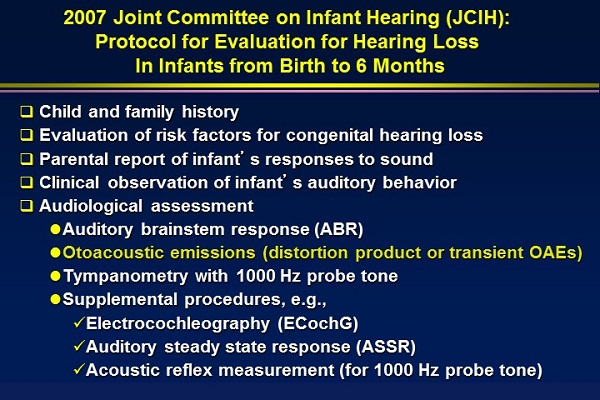
And in that recommended guidance that's established federally and also by the Joint Committee on Infant Hearing, which is further implemented by the Early Hearing Detection and Intervention Guidance, specifies two really primary types of newborn hearing screening modalities.
Dana GuggenheimGUEST
So the first is otoacoustic emissions, or OAE, and the second is automated auditory brainstem response, or AABR.
Dana GuggenheimGUEST
And these two screenings have two different functions.
Dana GuggenheimGUEST
OAEs measure outer hair cell function, and AABRs actually measure the electrical response through the auditory nerve and the brainstem pathway, so it's able to identify problems with the auditory nerve.
Dana GuggenheimGUEST
And right now, in the current guidance, it's recommended to do either of those two screenings at birth.
Dana GuggenheimGUEST
And today, well-baby nurseries commonly screen with either one of the modalities.
Dana GuggenheimGUEST
More commonly, it's actually the otoacoustic emissions, and it's rare to use both up front.
Dana GuggenheimGUEST
Often, if an infant fails an OAE test, then they'll be referred to a diagnostic ABR or they'll receive an ABR subsequently.

Dana GuggenheimGUEST
And in that recommended guidance that's established federally and also by the Joint Committee on Infant Hearing, which is further implemented by the Early Hearing Detection and Intervention Guidance, specifies two really primary types of newborn hearing screening modalities.
Dana GuggenheimGUEST
So the first is otoacoustic emissions, or OAE, and the second is automated auditory brainstem response, or AABR.
Dana GuggenheimGUEST
And these two screenings have two different functions.
Dana GuggenheimGUEST
OAEs measure outer hair cell function, and AABRs actually measure the electrical response through the auditory nerve and the brainstem pathway, so it's able to identify problems with the auditory nerve.
Dana GuggenheimGUEST
And right now, in the current guidance, it's recommended to do either of those two screenings at birth.
Dana GuggenheimGUEST
And today, well-baby nurseries commonly screen with either one of the modalities.
Dana GuggenheimGUEST
More commonly, it's actually the otoacoustic emissions, and it's rare to use both up front.
Dana GuggenheimGUEST
Often, if an infant fails an OAE test, then they'll be referred to a diagnostic ABR or they'll receive an ABR subsequently.