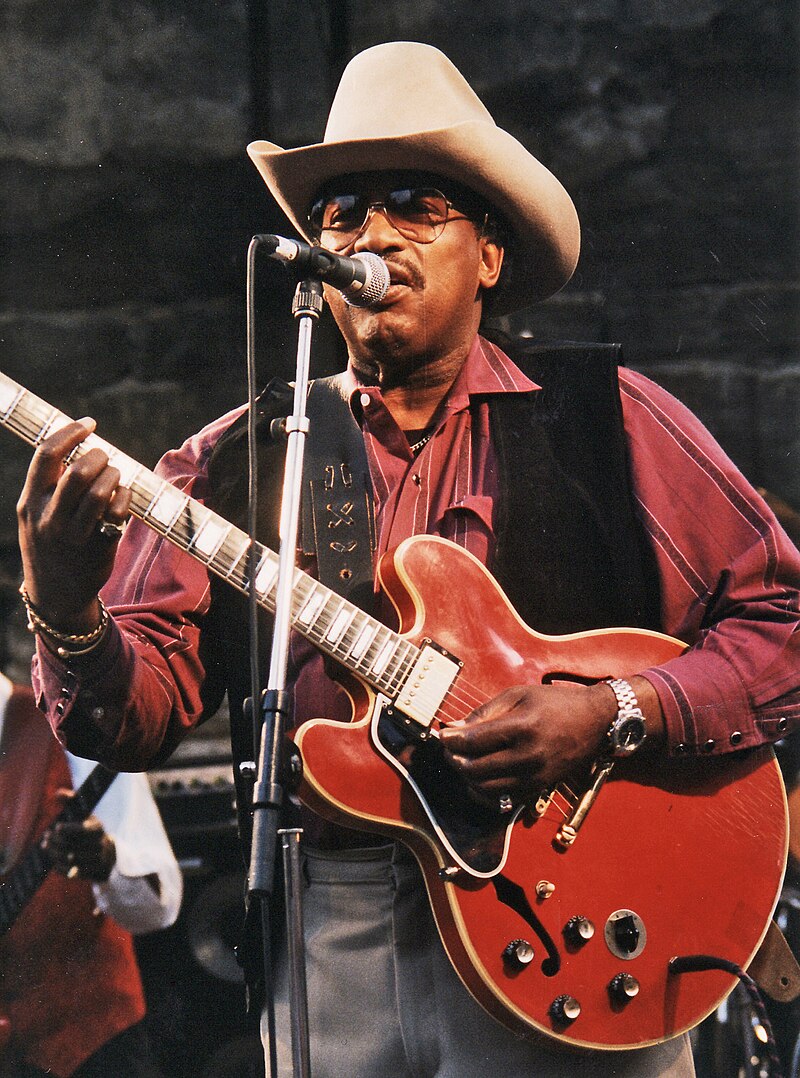
Otis Rush
American guitarist and singer-songwriterWikipedia
19
MENTIONS
10
EPISODES
9
PODCASTS
Search complete. 19 mentions across 10 episodes found for "Otis Rush".
Sep 6, 2026

Matt the CatHOST
I'm Matt the Cat, and we're featuring the legendary Ike Turner on this week's Juke in the Back, your weekly source for 1940s and 50s rhythm and blues.
Matt the CatHOST
Up next is an early Otis Rush record, released on Cobra in 1958.
Matt the CatHOST
Chess Records' own Willie Dixon, who played bass on that last number, is producing and playing bass on this one.
Matt the CatHOST
The Great Little Brother Montgomery is on piano, Jackie Brenston and Harold Ashby are on saxes, and Billy Gales, who we heard sing and lead a couple of records ago on I'm Tore Up, is playing drums on this one.
Matt the CatHOST
Stevie Ray Vaughan would name his band Double Trouble after the title of this song.
Matt the CatHOST
And it's believed that it's Ike Turner playing the guitar licks throughout this entire record and not Otis Rush.
Matt the CatHOST
Here's a true blues classic that's become a standard.
Matt the CatHOST
Otis Rush and his band with Double Trouble as we feature Ike Turner this week on The Juke in the Back.

Jimbo "Big Train" MadsenHOST
Born on August 31, 1962, she quickly immersed herself in Chicago's legendary blues music scene and built a reputation for fiery performances and exceptional slide guitar work.
Jimbo "Big Train" MadsenHOST
Throughout her career, Connor has shared stages with blues greats including Buddy Guy, Junior Wells, Coco Taylor, Otis Rush, and Magic Slim.
Jimbo "Big Train" MadsenHOST
Recorded by Muddy Waters at Chess Records on September 1, 1954, I'm Ready became one of the signature songs of the Chicago blues era.
Jimbo "Big Train" MadsenHOST
Written by Willie Dixon and inspired by a playful exchange between Muddy Waters and harmonica player Willie Foster, the song showcased the confidence and larger-than-life imagery that defined many classic blues recordings.

Nick TabariasGUEST
The 2016 Blues Music Awards when he won Guitar Player of the Year.
Nick TabariasGUEST
We played, I think it was 2019, at the Chicago Blues Fest when they honored Otis Rush.
Nick TabariasGUEST
Otis was there.
Nick TabariasGUEST
I got to meet Otis and his family.
23 MINS LATER
Nick TabariasGUEST
Yes.
Nick TabariasGUEST
So I recently acquired a beautiful, one-of-a-kind Ebony Gibson ES-335, and It's a very special guitar because it belonged to one of my biggest inspirations, the great Bobby Murray.
Nick TabariasGUEST
And as you may know, Marco, Bobby played with the legendary Etta James for many, many years, along with countless other inspirational figures in the blues industry, including Otis Rush.
Nick TabariasGUEST
And I've known Bobby for quite some time.

Sleazy THOST
regret.
Sleazy THOST
So let the room get a little smokier, the smiles a little more crooked, and let's dive into Double Trouble with Otis Rush.
Sleazy THOST
Thank you.
speaker_2SOUNDBITE_SPEAKER
I lay waking nights, folks in love, just so troubled.
Sleazy THOST
All right, Sleaze Wings.
Sleazy THOST
We're taking a turn for the creepy and sad.
Sleazy THOST
And that was kicked off with Otis Rush and his band, Double Trouble.
Sleazy THOST
Now brace yourselves for Tony Clark, They Call Me a Wrong Man.
speaker_8GUEST
way of turning into regret.
speaker_8GUEST
So let the room get a little smokier, the smiles a little more crooked, and let's dive into Double Trouble with Otis Rush.
speaker_8GUEST
Thank you.
speaker_2SOUNDBITE_SPEAKER
I lay waking nights, folks in love, just so troubled.
Sleazy THOST
All right, Sleaze Wings.
Sleazy THOST
We're taking a turn for the creepy and sad.
Sleazy THOST
And that was kicked off with Otis Rush and his band, Double Trouble.
Sleazy THOST
Now brace yourselves for Tony Clark, They Call Me a Wrong Man.

Mike WelchGUEST
It's, uh, "I Me Mine," which is a George Harrison song.
Mike WelchGUEST
Uh, and I would listen to it, and I heard the version in my head that was kind of like a minor key Otis Rush, West Side Chicago take on it.
Mike WelchGUEST
Um, and once I heard that in my head, it became so obvious that that's the way I would do it, that I immediately Googled to see if there had been 10 other blues bands that had covered it.
Mike WelchGUEST
Because once I had that idea, it's like, "This is too obvious." Um, and I couldn't find anyone having covered it.

speaker_2SOUNDBITE_SPEAKER
The father of country music learned from a Black man to play the blues.
speaker_2SOUNDBITE_SPEAKER
Little Walter, Otis Rush, and Muddy, they all left their mark.
speaker_2SOUNDBITE_SPEAKER
Me, me, Bobby Rush and Buddy, they kept the blues right on track.
speaker_2SOUNDBITE_SPEAKER
We sure did, man.

Greg RasheedHOST
That particular cut that he did of Casanova, that was his only 45 in name mentioned on any album or anything.
Greg RasheedHOST
He was basically a background guitar player, played for Bobby Brubland, Otis Rush.
Greg RasheedHOST
He was in the house band of the Royal Theater in Chicago, did a lot of session work in Chicago.
Greg RasheedHOST
But that was his only one that, his only song that he actually put his name on it.

Jim SamariaHOST
Well, we're going to stay with blues just for a second here.
Jim SamariaHOST
Just tell us about your connection with the great late blues man from Chicago, Otis Rush.
Jim SamariaHOST
And, you know, fortunately, he died about eight years ago or something like that.
Jim SamariaHOST
Tell us about you and Otis Rush.
Melody AngelGUEST
Yeah, I mean, it was kind of a weird thing because I didn't know he was a legend in the blues.
Melody AngelGUEST
Like, my whole life, I just, I never knew that.

Barney HoskinsHOST
I mean, who else would be able [laughs] to bring those two together and seat them next to each other? Tell us about getting to know Big Joe and his wife.
Brian CullmanGUEST
Well, I lived, um, on 16th Street, around the corner from Tramps, and the guy who ran Tramps, uh, wonderful, uh, big Irishman named Terry Dunn, very clever guy, because he loved, you know, Big Joe Turner, Johnny Copeland, James Booker, uh, Otis Rush, uh, Charles Brown, and he would hire people to do a residency.
Brian CullmanGUEST
And Tramps was this wonderful, you know, crazy little bar, uh, with a back room.
Brian CullmanGUEST
But you could sit at the bar, you know, literally 10 steps away from the stage, uh, and not have to pay a cover, and just sit at the bar and have a drink and hear any of those guys.