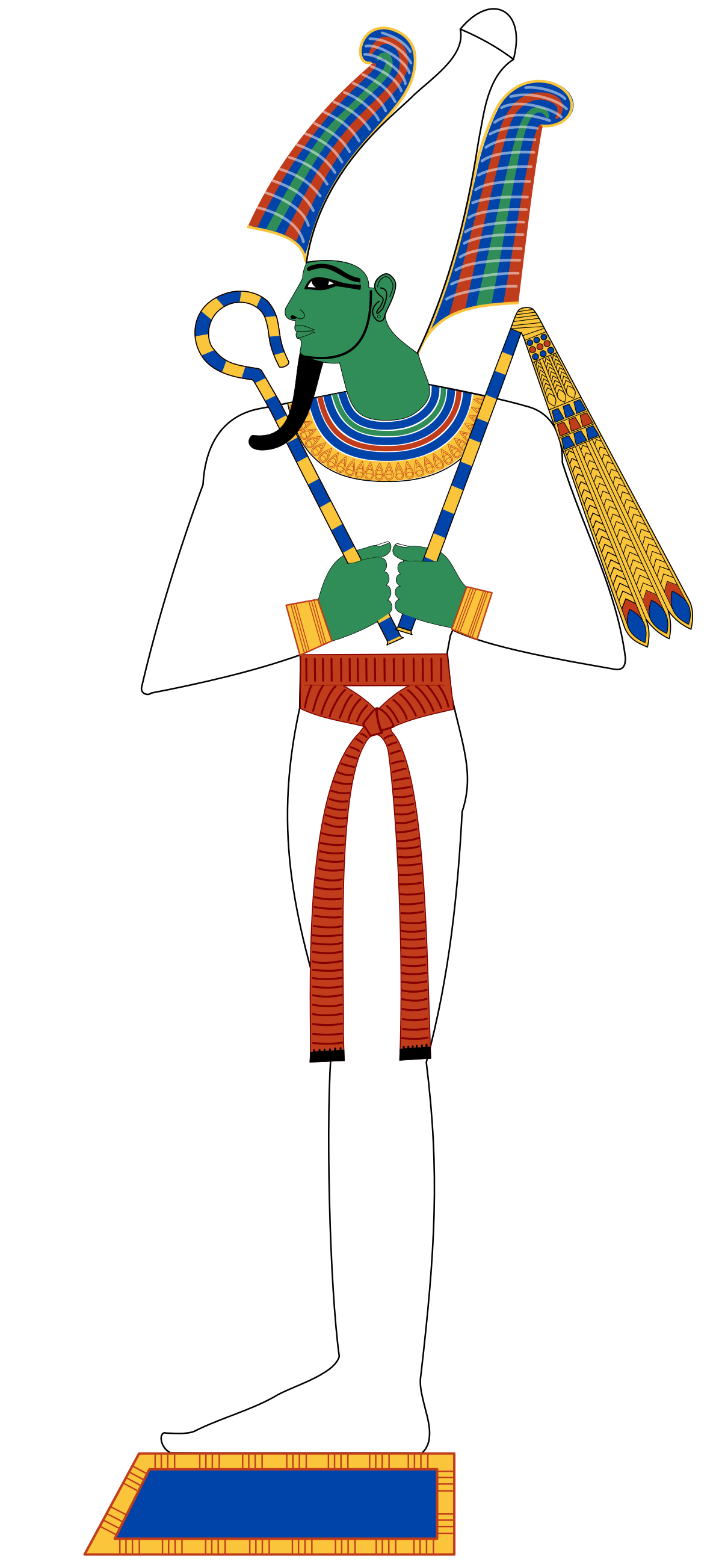
Osiris
GodWikipedia
564
MENTIONS
47
EPISODES
39
PODCASTS
Search complete. 564 mentions across 47 episodes found for "Osiris".
Oct 28, 2026

Mark GagnonHOST
And then at the end of the journey came a final exam.
Mark GagnonHOST
You would basically stand in the hall of judgment before Osiris, the god who had himself been murdered and brought back to rule the dead.
Mark GagnonHOST
And your heart would be placed on a scale and weighed against a single feather.
Mark GagnonHOST
This is a feather of Mahat, which literally means like truth and justice and like the right order of the universe.
28 MINS LATER
Mark GagnonHOST
If I say, Christos, I curse you... with an illness and then two weeks later you get a fever what's the difference there
Christos PapadopoulosHOST
that's more god
Mark GagnonHOST
not a mummy's curse yeah the mummy's curse has to consult osiris like what what's a king to a god what's a god to a king What's a god to a non-believer? Is that how it goes? You get what I'm saying, okay? They got to go to Osiris, and Osiris is the one that actually doles out all the punishment.
Mark GagnonHOST
If you know anything about the Ra tapes, maybe Ra's involved as well.

Rebecca SheirHOST
And thanks to the whole hieroglyph missing vowel thing, we can only guess how those Egyptian names truly sound.
Rebecca SheirHOST
But our best historical guess starts on day one, with the birth of Usuri, now known as Osiris.
Rebecca SheirHOST
He would become god of the underworld, the afterlife, and rebirth.
Rebecca SheirHOST
Day two brought Heru'ur, or Heru'ir, aka Horus, the Elder.
speaker_2VOICE_ACTOR
You're so very beautiful.
Rebecca SheirHOST
All five of you! So, now that Ra's curse had been reversed, which of these five sweet little ones do you think would go on to fulfill Toth's prophecy and take over Ra's supreme throne? The answer is...
Rebecca SheirHOST
Usuri or Osiris.
Rebecca SheirHOST
Though in truth, it was a peaceful and gradual takeover.

Joseph DumondGUEST
So they begin to light candles.
Joseph DumondGUEST
And the lighting of candles they would put in the window for Osiris, or for Tammuz, which is the same name, to remember that he was dead.
Joseph DumondGUEST
And the candles would always go out.
Joseph DumondGUEST
But they would put the candle in the window or on a table overnight.
Joseph DumondGUEST
they give out these treats so the treats is part of the fall festival stuff that's brought into or amalgamated into the halloween stuff
Ryan NallHOST
right
Joseph DumondGUEST
the whole idea behind it is you got to think about it the whole idea about it is taking a dismembered body dismembered in 14 pieces rotting brought back put back together re-mummified buried and having a conversation with it at this time that Osiris or Isis talking to Osiris that's what this is about and by you taking part in this festivity you know it's it's a harmless little tradition it's not harmless That's what everybody says.
speaker_0NARRATOR
Oh, you know, what's the

Tony RobinsonHOST
The ancients would have tackled this using spells, rituals.
Tony RobinsonHOST
They would also have made extra offerings to specific deities, most notably Osiris's brother, the god Seth, the god of turbulence, the god of storms, the god of red-headed individuals who were seen as somewhat turbulent too.
Tony RobinsonHOST
Can't imagine why.
Tony RobinsonHOST
I'm seeking shelter in this shrine cut into the mountain by Pai's son Taharqa, which is currently undergoing major restoration by an Italian mission.
13 MINS LATER
Tony RobinsonHOST
And so there's a real progression.
Tony RobinsonHOST
The cult of the Apis bull dates right back to the beginning of Egyptian history, and it's closely linked to the Pharaoh.
Tony RobinsonHOST
It was believed that when the sacred bull died, it became one with Osiris, the god of the afterlife, and so became an Osiris Apis, or Serapis for short.
Tony RobinsonHOST
And these sacred bulls became hugely important under the Saites.
Tony RobinsonHOST
And Horus, the god of kingship, wearing the joint crowns of Upper and Lower Egypt.
Tony RobinsonHOST
Then Seti makes the strongest connection with Egypt's past in the portrayal of the ultimate deity in the tomb, Osiris, god of the underworld.
Tony RobinsonHOST
He represents every single pharaoh that's gone before Seti.
Tony RobinsonHOST
He represents the accumulated powers of the royal ancestors.
Tony RobinsonHOST
And Seti is keen to show himself in the company of Osiris.
Tony RobinsonHOST
He's tapping in to that greatness that made Egypt such a strong nation.
Tony RobinsonHOST
Every image, every hieroglyph in Seti's tomb harks back to the golden age of Amenhotep III.

JamesHOST
And what makes it so interesting is that it doesn't begin with the familiar historical pharaohs.
JamesHOST
It begins with divine rulers, including Geb, Osiris, Horus, Seth, and Maat, before continuing into the reigns of human kings.
JamesHOST
So you have this ancient Egyptian document that actually places divine kingship before historical kingship in its account of the country's past.
JamesHOST
I mean, the Egyptians themselves understood their royal traditions as having originated in an earlier sacred world.
33 MINS LATER
JamesHOST
He also compared the Nile with the Milky Way, suggesting that the monumental landscape was intended to reproduce a relationship between Earth and sky.
JamesHOST
And this isn't a completely arbitrary constellation to choose, because Orion was deeply important in Egyptian religion.
JamesHOST
The Egyptian celestial figure, Sa, was associated with Orion, and Orion became closely connected with Osiris, the god of death and resurrection.
JamesHOST
The pyramid texts, which survive from the late 5th dynasty onward, repeatedly associate the dead king with the heavens, the stars, and divine transformation.

Andrew M. HenryHOST
As the tenth member of a supposed group of nine, Horus stands out a bit because he doesn't seem to belong.
Andrew M. HenryHOST
But as the son of Isis and Osiris, two prominent members in the group, he was an honored firstborn among the most powerful gods in the Egyptian pantheon.
Andrew M. HenryHOST
In this video, we'll consider the various identities and myths associated with Horus in order to better understand why he was so important to ancient Egyptian religion, culture, and politics.
Andrew M. HenryHOST
The name Horus comes via Latin from the Greek horos, which in turn comes from the ancient Egyptian language.
6 MINS LATER
Andrew M. HenryHOST
His power and protection cover not only the pharaoh himself, but also the pharaoh's supporters and the elite of the royal palace.
Andrew M. HenryHOST
In other words, Horus was the divine embodiment of a stable and effective royal government.
Andrew M. HenryHOST
According to Egyptian mythology, Horus obtained this position by inheriting it from his father, the former king Osiris.
Andrew M. HenryHOST
But this path to rule was not smooth.
Andrew M. HenryHOST
Just like real-life crocodiles, Sobek would eat nearly anything he could get a hold of.
Andrew M. HenryHOST
In the story of the murder of Osiris, the trickster god Seth cut up his brother's body and scattered the pieces throughout Egypt.
Andrew M. HenryHOST
Always hungry for anything edible that might float by, Sobek ate a piece of Osiris's body.
Andrew M. HenryHOST
He was punished for the crime by having his tongue cut out.
Andrew M. HenryHOST
The story serves as an etiology, or mythical explanation, for the fact that crocodiles don't seem to have tongues.
9 MINS LATER
Andrew M. HenryHOST
Even after he became connected with the king and the royal court, Sobek remained accessible to people from all walks of life.
Andrew M. HenryHOST
Texts from the Middle Kingdom throughout Egypt reveal that common people prayed to Sobek for aid and protection.
Andrew M. HenryHOST
One prayer from the late period has fishermen calling out to Sobek for protection from crocodiles, saying, The prayer is a clear reference to the story of Sobek eating part of Osiris, warning him of the punishment that awaits him if a crocodile eats the speaker of the spell, who has identified himself as Osiris.

speaker_0HOST
It's around 1330 BC and we are standing beside the mighty River Nile in ancient Egypt.
speaker_0HOST
The sun shines over the desert, boats glide along the river, farmers tend their crops and enormous temples rise above the landscape.
speaker_0HOST
Their walls are covered in colourful paintings and mysterious symbols called hieroglyphs.
speaker_0HOST
Ancient Egypt was one of the great civilizations of the ancient world.
speaker_0HOST
Tutankhamen was born around 1341 BC, during a time of major change in Egypt.
speaker_0HOST
His father was probably Pharaoh Akhenaten, a ruler who dramatically changed Egyptian religious practices.
speaker_0HOST
Ancient Egyptians worshipped many gods, including Ra, which they associated with the sun, Osiris, connected to the afterlife, and Anubis, associated with mummification and the dead.
speaker_0HOST
But Akhenaten promoted the worship of Aten, represented by the sun disk, above the traditional gods.

Dan SnowHOST
which I do I
Campbell PriceGUEST
had one certainly you would think after she passed on she would be your kind of conduit so why worship a kind of impersonal great god like the god Osiris or the god Amun and Who haven't appeared on the scene yet in the pre-dynastic period, I should say.
Campbell PriceGUEST
Why do that when you could actually have a relationship with your deceased great aunt who could, as you said, lobby the other divine beings and who could do things of benefit to you?
Dan SnowHOST
So the dead are, you're laying them at rest, hoping to ease their journey into this afterlife.
21 MINS LATER
Campbell PriceGUEST
Yeah, where do we get the word? So the term mumia is this Persian Arabic word for the black substance, which occurs naturally in the area of modern Iran.
Campbell PriceGUEST
but which dead actually, tests have shown, form part of the black goo that was applied to the mummified dead as a means of turning them into gods.
Campbell PriceGUEST
So sometimes you'll see the god Osiris has this jet black skin, a sign of his power and his rejuvenation, and so all the mummified dead want to look like Osiris.
Campbell PriceGUEST
So this becomes very fashionable.
37 more episodes mention Osiris.
Create an account to see the whole feed, search across every transcript, and follow the entities you care about.