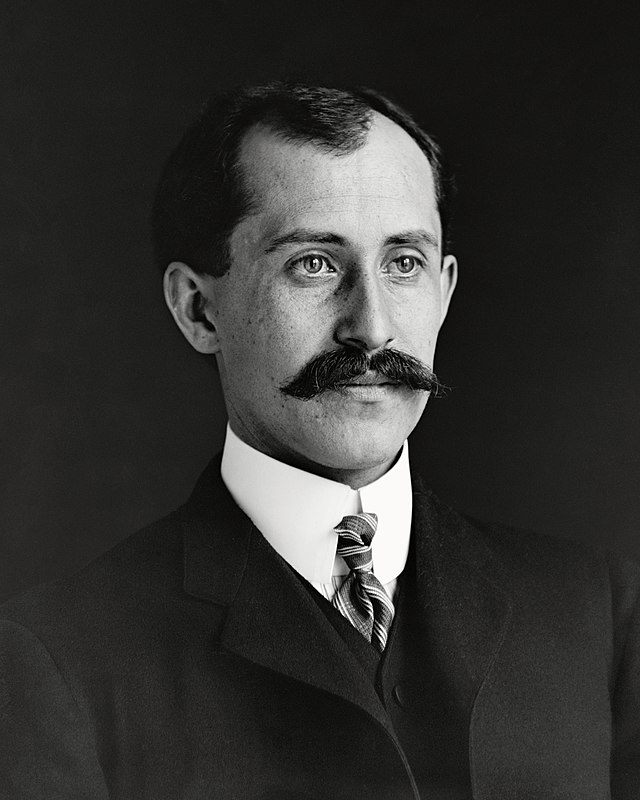
Orville Wright
AviatorWikipedia
27
MENTIONS
6
EPISODES
6
PODCASTS
Search complete. 27 mentions across 6 episodes found for "Orville Wright".
Nov 17, 2026

Aoife WilsonPANELIST
and Orville.
Aoife WilsonPANELIST
Named after Orville Wright, one of the Wright brothers.
Aoife WilsonPANELIST
He is a green duckling who wears a nappy with a large safety pin on the front.
Aoife WilsonPANELIST
He speaks with a falsetto, Lancashire accent.

Jill BohaboyHOST
So a lot of big events for the Wright brothers happened here.
Jill BohaboyHOST
Orville and his sister Catherine were born there.
Jill BohaboyHOST
And unfortunately, Wilbur died there in 1912.
Jill BohaboyHOST
So the house is no longer there.
Nina VasiliuGUEST
not only were they living in the same neighborhood, they were
Jill BohaboyHOST
working out of the same printing location.
Jill BohaboyHOST
And that's part of what you're really getting here, I think, in the Wright Dunbar Interpretive Center is a bit more of the background that Orville and Wilbur Wright were just not inventing flight or just not solving for flight.
Jill BohaboyHOST
They had really always been different types of inventors or entrepreneurs.

speaker_3NARRATOR
CHAPTER I.
speaker_3NARRATOR
OF THE EARLY HISTORY OF THE AIRPLANE the wright brothers aeroplane by orville and wilbur wright though the subject of aerial navigation is generally considered new it has occupied the minds of men more or less from the earliest ages our personal interest in it dates from our childhood days late in the autumn of eighteen seventy eight our father came into the house one evening with some object partly concealed in his hands and before we could see what it was he tossed it into the air instead of falling to the floor as we expected it flew across the room till it struck the ceiling where it fluttered awhile and finally sank to the floor it was a little toy known to scientists as a helicopter but which we with sublime disregard for science at once dubbed a bat it was a light frame of cork and bamboo covered with paper which formed two screws driven in opposite directions by rubber bands under torsion a toy so delicate lasted only a short time in the hands of small boys but its memory was abiding several years later we began building these helicopters for ourselves making each one larger than that preceding but to our astonishment we found that the larger the bat the less it flew we did not know that a machine having only twice the linear dimensions of another would require eight times the power we finally became discouraged and returned to kite-flying a sport to which we had devoted so much attention that we were regarded as experts but as we became older we had to give up this fascinating sport as unbecoming to boys of our ages it was not till the news of the sad death of lilienthal reached america in the summer of eighteen ninety six that we again gave more than passing attention to the subject of flying we then studied with great interest chernut's progress in flying machines langley's experiments in aerodynamics the aeronautical annuals of nineteen o five nineteen o six and nineteen o seven and several pamphlets published by the smithsonian institution especially articles by lilienthal and extracts from muillard's empire of the air the larger works gave us a good understanding of the nature of the flying problem and the difficulties in past attempts to solve it while muillard and lilienthal the great missionaries of the flying cause infected us with their own unquenchable enthusiasm and transformed idle curiosity into the active zeal of workers in the field of aviation there were two schools the first represented by such men as professor langley and sir hiram maxim gave chief attention to power flight the second represented by lilienthal muillard and chanute to soaring flight our sympathies were with the latter school partly from impatience at the wasteful extravagance of mounting delicate and costly machinery on wings which no one knew how to manage and partly no doubt from the extraordinary charm and enthusiasm with which the apostles of soaring flight set forth the beauties of sailing through the air on fixed wings deriving the motive power from the wind itself The balancing of a flyer may seem, at first thought, to be a very simple matter, yet almost every experimenter had found in this one point which he could not satisfactorily master.
speaker_3NARRATOR
Many different methods were tried.
speaker_3NARRATOR
Some experimenters placed the centre of gravity far below the wings in the belief that the weight would naturally seek to remain at the lowest point.
29 MINS LATER
speaker_3NARRATOR
Later, when a successful flight had been made with a motor, we gave up the business in which we were engaged, to devote our entire time and capital to the development of a machine for practical uses.
speaker_3NARRATOR
As soon as our condition is such that constant attention to business is not required, we expect to prepare for publication the results of our laboratory experiments, which alone made an early solution of the flying problem possible.
speaker_3NARRATOR
CHAPTER II OF THE EARLY HISTORY OF THE AIRPLANE by Orville and Wilbur Wright.
speaker_3NARRATOR
How We Made the First Flight by Orville Wright the flights of the nineteen o two glider had demonstrated the efficiency of our system of maintaining equilibrium and also the accuracy of the laboratory work upon which the design of the glider was based we then felt that we were prepared to calculate in advance the performance of machines with a degree of accuracy that had never been possible with the data and tables possessed by our predecessors before leaving camp in nineteen o two we were already at work on the general design of a new machine which we proposed to propel with a motor immediately upon our return to dayton we wrote to a number of automobile and motor builders stating the purpose for which we desired a motor and asking whether they could furnish one that would develop eight brake horse power with a weight complete not exceeding two hundred pounds Most of the companies answered that they were too busy with their regular business to undertake the building of such a motor for us, but one company replied that they had motors rated at 8 horsepower, according to the French system of ratings, which weighed only 135 pounds, and that if we thought this motor would develop enough power for our purpose, they would be glad to sell us one.

Bill HemmerHOST
Now the machine stood ready on a single wooden launch rail.
Bill HemmerHOST
At 10.35 a.m., a toss of a coin put Oroville in the pilot's seat, lying flat on his stomach alongside a 12-horsepower gasoline engine.
Bill HemmerHOST
Wilbur steadied the wingtip as the engine roared to life and the machine began to move.
Bill HemmerHOST
The Wright Flyer lifted into the air, wobbling through the gusts just 12 feet above the sand before touching down 120 feet away.

Robert LeddyGUEST
Gates, he said, you're a real pioneer.
Robert LeddyGUEST
And I'm paraphrasing, but Gates looked at him, he said, a pioneer? Gates said, you know how many people it took for me to exist? He goes, how many hundreds had to accomplish staggering things for me to exist? And again, he was so self-deprecating and he goes, the only two pioneers I know in the world are Wilbur and Orville Wright.
Robert LeddyGUEST
He goes, you cannot pinpoint anything close, scientifically impactful, anything that is so pinpointable to two sole human beings without anybody doing anything.
Robert LeddyGUEST
He said, period, nothing, nothing close.
Robert LeddyGUEST
Muhammad Ali and Jesus are above them.
Robert LeddyGUEST
You know what I mean? Literally.
Robert LeddyGUEST
In the first and second world, you can go to anybody and say Wilbur Norville Wright.
Robert LeddyGUEST
They'll say, oh, they invented the airplane.

speaker_0NARRATOR
440.
speaker_0NARRATOR
The early history of the airplane by Orville Wright and Wilbur Wright Table OF links the early history of the airplane by Orville Wright and Wilbur Wright is part of the Hacker Noon book series.
speaker_0NARRATOR
Read this book online for free on Hacker Noon, 441.
speaker_0NARRATOR
The Great Mars Problem Certain other difficulties have also to be met, as, for instance, the relative coldness of the climate of Mars, 442.