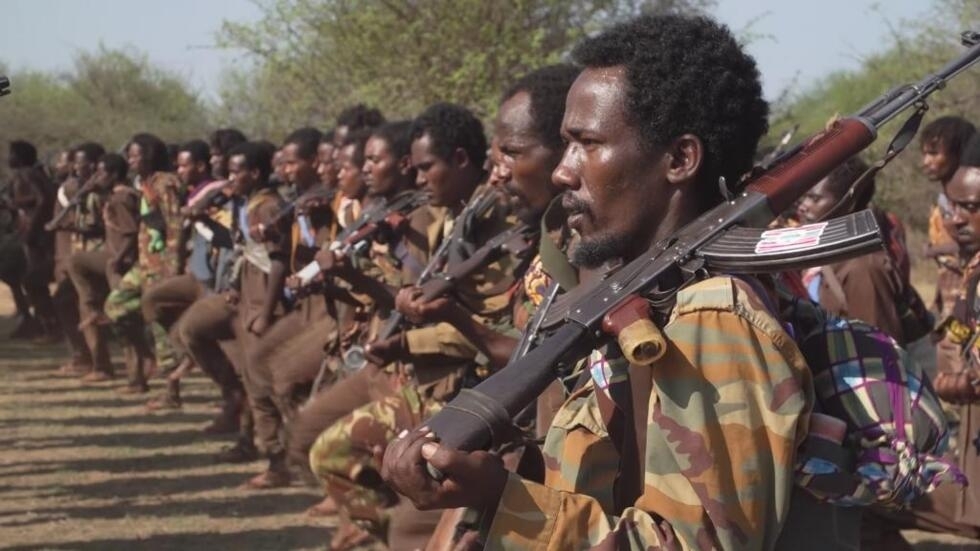
Oromo Liberation Army
28
MENTIONS
23
EPISODES
21
PODCASTS
Search complete. 28 mentions across 23 episodes found for "Oromo Liberation Army".
Oct 9, 2026

Derek DavisonHOST
Uh, quite the opposite.
Derek DavisonHOST
Uh, and the Oromo Liberation Army.
Derek DavisonHOST
So these are three of the largest, um, anti-government, paramilitary, militant, whatever you want to call them, rebel, uh, groups in Ethiopia, uh, uniting to form, along with four other smaller groups, to form what they're calling the Ethiopian People's Forces Alliance for Survival.
Derek DavisonHOST
Uh, the conflict bro- broke out, uh, a few days after the announcement of that group's creation, which was on September twenty-first.

Derek DavisonHOST
And that's what happened late last month after the TPLF and a number of other anti-government militant-type groups in Ethiopia, in particular the Fano militia in the Amhara region, which is interesting because the Fano and the TPLF have not in the past worked together, shall we say, quite the opposite.
Derek DavisonHOST
And the Oromo Liberation Army, so these are three of the largest anti-government, paramilitary, militant, whatever you want to call them, rebel groups in Ethiopia, uniting to form, along with four other smaller groups, to form what they're calling the Ethiopian People's Forces Alliance for Survival, The conflict broke out a few days after the announcement of that group's creation, which was on September 21st.
Derek DavisonHOST
It has progressed quite a bit since then.
Derek DavisonHOST
The Ethiopian government and its militia proxy allies are now in control of Mekelle, which is the capital of the Tigray region.

Yonas Ashine DemisseGUEST
Uh, before this survivor for an alliance, there was also another, uh, alliance which is called the Tsamdu, uh, Tsamdu in Tigrinya, which is, uh, similar to an alliance, which also involve, uh, the TPLF regime, the, the EPLF, the Eritrean regime, which was a sh- very short-lived, uh, experiment on an alliance But wh-while we were following that, then a new alliance under, under the survival and an extension survival, uh, topic, like seven, seven pa- uh, military groups, at least three ones are very core.
Yonas Ashine DemisseGUEST
The TPLF, uh, leadership and its army, the Fano, uh, army, uh, rebel army, and the OLA, Oromo Liberation Army.
Yonas Ashine DemisseGUEST
The three of them at least, uh, came into, into an agreement and onto an alliance to wage a war against the common enemy, which they perceived the, the federal government, the central government.
Aaron StanleyGUEST
Yeah.
Yonas Ashine DemisseGUEST
It is a, a marriage of convenience in which, uh, not ethnic alliance, not ethnic affiliations, not the classic, um, uh, ideological, uh, convergence, but convenience, pragmatic, uh, ideologies to win, uh, the common enemy, which they, they call the federal government.
Yonas Ashine DemisseGUEST
And also, they also imagined, uh, or aspire toward this, uh, uh, transitional government in their, in their first, um, uh, declaration of this alliance.
Yonas Ashine DemisseGUEST
Uh, uh, to remind you, two of these armies, especially the, the TPLF leadership, which is now the, the rebel leadership, and is also the OLA, the Oromo Liberation Army, were classic guerrilla armies in the past.
Yonas Ashine DemisseGUEST
They were-- They, we can trace their history back to the 1960s, '70s, '80s, and so on.

Simon WhistlerHOST
But in broad strokes, the two organizations agree that their interests are aligned right now.
Simon WhistlerHOST
The alliance also includes the Oromo Liberation Army and ethnic insurgent movement from the Oromia region, as well as militant groups from the regions of Afar and Benishangul-Gumuz.
Simon WhistlerHOST
Those groups aren't all as active in the conflict as the TPLF, but the Fano, in particular, have taken full advantage of their opportunity.
Simon WhistlerHOST
For now, it appears that each of the rebel factions understands that by focusing on the federal government and staying out of the way of each other, they can all get closer to bringing down Abiy Ahmed and his government.

Andrew MuellerHOST
The TPLF, who have clearly not disarmed as they were supposed to, have announced the formation of the Alliance for Survival, a coalition of seven largely ethnically organized rebel groups from six of Ethiopia's 12 provinces.
Andrew MuellerHOST
Aside from the TPLF, the most prominent are the Amhara Fano National Liberation Movement, the Oromo Liberation Army, and the Ogaden National Liberation Front.
Andrew MuellerHOST
Ironically, this is in itself an almost impressive endeavour in peace forging, given that a few of these outfits have previously fought each other.
Andrew MuellerHOST
Even more ironically, their mission statement speaks solemnly of a concern that Ethiopia is in danger of disintegrating, i.e. precisely the outcome for which many of the alliance's survival have long been agitating.

Negash MohammedGUEST
They fought each other, but this time around they came together to officially announce that they are fighting or trying to fight to overthrow the federal government led by Prime Minister Abiy Ahmed.
Negash MohammedGUEST
So that means that this alliance includes also the Oromo Liberation Army, OLA, uh or guardian national liberation front which has um i mean it used to have a fighting force but this time around um it's just a kind of a splinter group from another uh faction um it also includes um other two three factions from uh gumus or benshangul gumus So AFAR also, in fact, Eritrea, not officially, but they are also helping.
Negash MohammedGUEST
So it is wider because they have prepared to attack or to fight against the government from every direction.
Eddy Micah Jr.HOST
Right.

Jalale Getachew BirruGUEST
And out of the three, two or three of them have an armed group or an armed wing or they are already armed.
Jalale Getachew BirruGUEST
These are the Tigray People Liberation Front, the TPLF, OLA, the Oromo Liberation Army.
Jalale Getachew BirruGUEST
It has been fighting the government since 2019.
Jalale Getachew BirruGUEST
So it has been active in Oromare region, far away from the north, where we see the current violence.
Jalale Getachew BirruGUEST
But they have stated that they have no interest in starting violence in Somali region of Ethiopia.
Jalale Getachew BirruGUEST
So, we can see their intentions.
Jalale Getachew BirruGUEST
OLA, the Oromo Liberation Army, which has been active in Oromia region since 2019, they have also kind of indicated, they didn't say out loud, but kind of indicated that they don't have a collaborated operations in plan, but they have agreed to remove the current government.
Jalale Getachew BirruGUEST
So you can see that there is no coordinated operation plan and only a couple of them or three of them agreed to start a new escalation in northern Ethiopia.
Simon WhistlerHOST
One wing denies joining and has reaffirmed its 2018 peace deal with the government, while the other wing says it is a member but has no interest in restarting the armed struggle.
Simon WhistlerHOST
And the Oromo Liberation Army, or OLA, which is one of the strongest members of the alliance, has indicated that its main goal is removing Abi Ahmed, not running joint operations.
Simon WhistlerHOST
In fact, while the TPLF, Fano, and ARDUF were losing ground in the Afar, Tigray, and Amhara regions, members of the OLA were being filmed not tooling up with weapons, but celebrating Irreecha, the Oromo equivalent of Thanksgiving.
Simon WhistlerHOST
This seeming indifference from other members of the alliance stems, at least in part, from the decades of bad blood between them.

Derek DavisonHOST
The long-festering possibility of conflict became full-blown conflict after a group of seven broadly anti-government entities announced the formation of a coalition, the Ethiopian People's Forces Alliance for Survival, on September twenty-first.
Derek DavisonHOST
The group features three large regional militias, the Tigray People's Liberation Front, the Fano militia in Amhara, and the Oromo Liberation Army, alongside four smaller entities.
Derek DavisonHOST
That the TPLF and Fano are now officially formally allied is interesting inasmuch as those groups were on opposite sides of Ethiopia's twenty-twenty to twenty-twenty-two civil war, the Fano fighting alongside the Ethiopian Federal Military.
Derek DavisonHOST
They are still not on the same page with respect to the status of the region known as Western Tigray, which Amhara also claims.
Simon WhistlerHOST
the removal of Abiy Ahmed from office.
Simon WhistlerHOST
Alongside the TPLF and Fano, the members of the Oromo Liberation Army , the Ogada National Liberation Front, the Afar Revolutionary Democratic Unity Front, the Beneshagul People's Liberation Front, and the Gmuz People's Democratic Movement.
Simon WhistlerHOST
The most remarkable thing about this alliance is the fact that it exists at all, because most of these groups, and I'll use the technical term here, they fucking hate each other.
Simon WhistlerHOST
We've already mentioned the territorial dispute between the Tigray and the Amhara, but that is, oh, just the tip of the iceberg.
13 more episodes mention Oromo Liberation Army.
Create an account to see the whole feed, search across every transcript, and follow the entities you care about.