Orisha
122
MENTIONS
51
EPISODES
47
PODCASTS
Search complete. 122 mentions across 51 episodes found for "Orisha".
Sep 15, 2026

Catherine A. JohnGUEST
So displacement means that we were cut off from the roots and the sources of our power.
Catherine A. JohnGUEST
In some instances, there were certain spiritual practices that survived, right? Hoodoo in Louisiana, Obeah throughout the Caribbean, Santeria and Lucumi in Cuba, um, Voodoo in Haiti, Kumina, Zion Revival in Jamaica, um, what's referred to as Orisha and Shango Baptist practice in Trinidad, um, Candomble in Brazil.
Catherine A. JohnGUEST
A lot of those all have sort of Yoruba, Yoruba sort of diasporic foundations.
Catherine A. JohnGUEST
The Sanctified Church in the US, right? So the forms that have survived in the diaspora are displaced Africanized forms, right? Much of formal academia and everyday culture has disconnected our diaspora realities from the continental African realities, and often demonized these diaspora forms as country, savage, deviant, devilish, right? And they're not that thing.

Joy GiovanniHOST
The traditional religion of the Yoruba people, uh, mostly what is now Nigeria, also Benin and Togo, uh, so that whole area of West Africa, there is a religious practice called Yoruba.
Joy GiovanniHOST
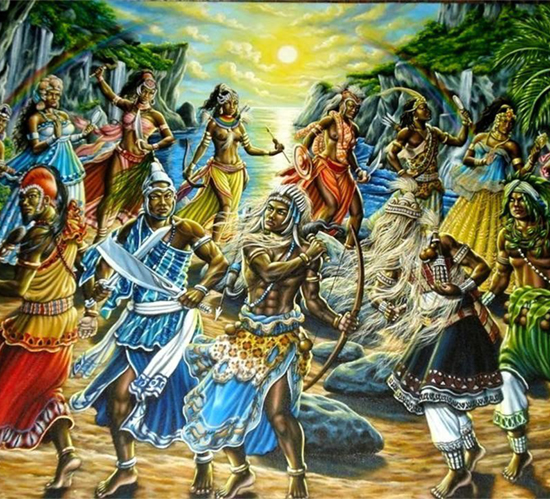
And at the center of it is essentially a supreme creator and then there are what are called Orishas, which are divine spirits to focus on different areas of our human life.
Joy GiovanniHOST
And there's a whole divination system around this belief system and system of religion, and some of it involves, uh, r- like reading bones, divination, read by trained priests.
Joy GiovanniHOST
So the Yoruba tradition doesn't treat spiritual work as one simple thing.
Joy GiovanniHOST
It is, uh, more of a pop culture image of where that comes from.
Joy GiovanniHOST
Most of the religion of Yoruba is devotional prayer offerings, restoring balance in our body, in our lives, in the world.
Joy GiovanniHOST
Practitioners that I know personally, I know several practitioners of this religion, and they have a really devoted relationship to typically one or two specific Orishas for many, many years, specific, um, of these, like, divine beings.
Joy GiovanniHOST
Uh, or even they could be devoted to that Orisha for their entire life, and they're gonna do devotions and prayers and offerings and all of that as part of their relationship.

JoVia ArmstrongGUEST
And, um, he pretty much just started showing me how to play congas.
JoVia ArmstrongGUEST
He started showing me how to play bata drums and teaching me about all of these rhythms and the, the people of Cuba and teaching me about the Orishas.
JoVia ArmstrongGUEST
And, um, yeah, still to this day, he encourages me to play this hybrid kit.
JoVia ArmstrongGUEST
You know, I, I sometimes get kind of discouraged.

Kirk ZieglerNARRATOR
Olorun had two sons.
Kirk ZieglerNARRATOR
The elder's name was Orisha.
Kirk ZieglerNARRATOR
The name of the younger son was Adudoa.
Kirk ZieglerNARRATOR
They were living together in the sky.
Kirk ZieglerNARRATOR
Olorun called Orisha to him.
Kirk ZieglerNARRATOR
He gave him a handful of earth and a hen with five claws.
Kirk ZieglerNARRATOR
Olorun said to him, "Go down and make land upon okun, the ocean." Orisha went.
Kirk ZieglerNARRATOR
On the way, he found some palm wine.

Grace FreelyGUEST
And the Ori is like your personal godhead that you have.
Grace FreelyGUEST
So like before your prayers go to any other Orisha or deity, they go into your Ori.
Grace FreelyGUEST
And so developing an alignment with your Ori is like of utmost importance.
Grace FreelyGUEST
And so I feel like In doing this O-Rework for this past few weeks, I've been really, like, expanding my perspective.

David Dylan ThomasGUEST
Um, I am so glad that they had a lot of, uh, scenes in New Orleans, because that's the one place I have been to where I've been able to at least visit the Museum of Voodoo in New Orleans, which is amazing.
David Dylan ThomasGUEST
And learn a lot of the history I did learn I learned there, right? And all the stuff about disguising African deities as saints in order to keep it under the nose of the slave owners, like all of that stuff is, there's literally a chart in the, in the museum that sort of tells you which saints map to which, you know, Orisha to which, uh, uh, deities.
David Dylan ThomasGUEST
So, yeah, so it's a bit, so anyone, if you're going to New Orleans, make sure you stop there.
David Dylan ThomasGUEST
It's like right by, uh, Louis Armstrong park.

Isaac HillGUEST
So that tradition is living, but there's a level of the Jyotish lineage that I'm studying within Freedom Cole's lineage, and I've been studying very in-depth in that lineage for four years where it's just like – it's mind-boggling.
Isaac HillGUEST
This is like the royal astrologers of Orisha, Freedom Cold's teacher, Sanjay Roth, who is also my teacher now.
Isaac HillGUEST
His grandfather was the last royal astrologer for the king of Orisha before it, you know, wasn't a kingdom anymore.
Isaac HillGUEST
So there's like, you know, that's what they did all day.
Isaac HillGUEST
Like they just studied Jyotish and, you know.

Aunt M.HOST
So you're doing an energy exchange, but taking on things that are outside of your culture or practice are not great.
Aunt M.HOST
I just use the example of if you're using a love spell, you're using Santeria for a love spell, you're calling upon one of the Orishas, you most likely will draw in a Cuban man because that's their version of love.
Aunt M.HOST
And you have to be very careful with Cuban men because I'm not saying all of them, but a lot of them are highly critical and they're village bicycles.
Aunt M.HOST
You always have to be careful that when you are taking elements of a closed practice, you're also taking on parts of the culture.

VictorHOST
Yeah.
Richard VoogtGUEST
You know, it's about Orishas.
VictorHOST
Yeah.
Richard VoogtGUEST
It's about Yoruba-

speaker_0HOST
We followed a single guardian out of Eden's gate today and found an entire throne room waiting on the other side of that gate.
speaker_0HOST
Cherubim with four faces in a single body, seraphim shielding their own eyes from the glory too bright to look at directly, ophanim covered in eyes of their own, seven named archangels standing ready before that same glory, and beyond scripture entirely, an entire world full of Hermes and Valkyries and Xian and Orishas, each culture reaching for its own name for the same populated space between heaven and earth.
speaker_0HOST
There's one more pattern worth naming before we close, and it runs through nearly every encounter we've covered today.
speaker_0HOST
Almost every single time one of these throne room or messenger beings appears directly to a human being, their first words are some version of fear not or be not afraid.
41 more episodes mention Orisha.
Create an account to see the whole feed, search across every transcript, and follow the entities you care about.