Ordovician
Geologic periodWikipedia
68
MENTIONS
20
EPISODES
15
PODCASTS
Search complete. 68 mentions across 20 episodes found for "Ordovician".
Oct 28, 2026

speaker_2HOST
They were the first truly dominant group of complex animals, and it seemed as though they would rule forever.
speaker_2HOST
If you took a time machine and travelled back to the Ordovician period, a few hundred million years after the Cambrian explosion, you would see oceans absolutely packed with life.
speaker_2HOST
Fish were beginning to appear.
speaker_2HOST
Primitive vertebrates, simple creatures with barely a basic skeleton and an elementary brain.
speaker_2HOST
Again.
speaker_2HOST
Around 440 million years ago, another extinction event wiped out 86% of all species on Earth.
speaker_2HOST
The Ordovician extinction was probably caused by sudden climate change, possibly triggered by glaciation in the southern hemisphere.
speaker_2HOST
When glaciers form, they trap water, When water becomes trapped in glaciers, sea level falls.

speaker_0HOST
And so this, compiled with its Talon-like appendages, made Omnidens the undisputed apex predator of its realm, and it likely spent its day on the floorbed of shallow waters off the coast of present-day China, just patiently waiting for its next victim.
speaker_0HOST
So yeah, the Omnidens was a sure step up from whatever the heck the Dickinsonia was, no offense, but even this upgrade wouldn't hold the preceding Ordovician, with life pushing limits quite a bit once more.
speaker_0HOST
And actually, it wasn't so long after the Omnidense that a new, even larger Deinochiridida emerged, the Agerocassus, potentially the biggest member of the order to ever live.
speaker_0HOST
Because not only was it as long as the Omnidense, but it was also bulkier, and being completely covered by a hard exoskeleton, with this filter feeder having weighed about as much as a large male German Shepherd.
speaker_0HOST
Impressive, no doubt, but in these days the big hitters were actually no longer the Dinoceridida, but rather a group you guys are definitely more familiar with, cephalopods, those tentacly mollusks which still roam our oceans and seas today.
speaker_0HOST
And while still successful now, the Ordovician was these guys' golden age, being about the only time when cephalopods were at the top of the totem pole in nearly all senses, size included.
speaker_0HOST
And the group leading the way for cephalopods was no doubt the Endocerida, a nautiloid order of global cephalopods that were distinguished by small body chambers, external shells, and relatively large cephuncles.
speaker_0HOST
Yet in spite of their relation all being part of the same order, members couldn't look quite different from one another, with some having possessed long straight cones, others short ones, and then a few even possessing curved shells, making them look almost like musical instruments.

Ally BaumgartnerGUEST
There were also a lot of environmental changes that happened in the early Paleozoic.
Ally BaumgartnerGUEST
So between the Precambrian into the Ordovician.
Ally BaumgartnerGUEST
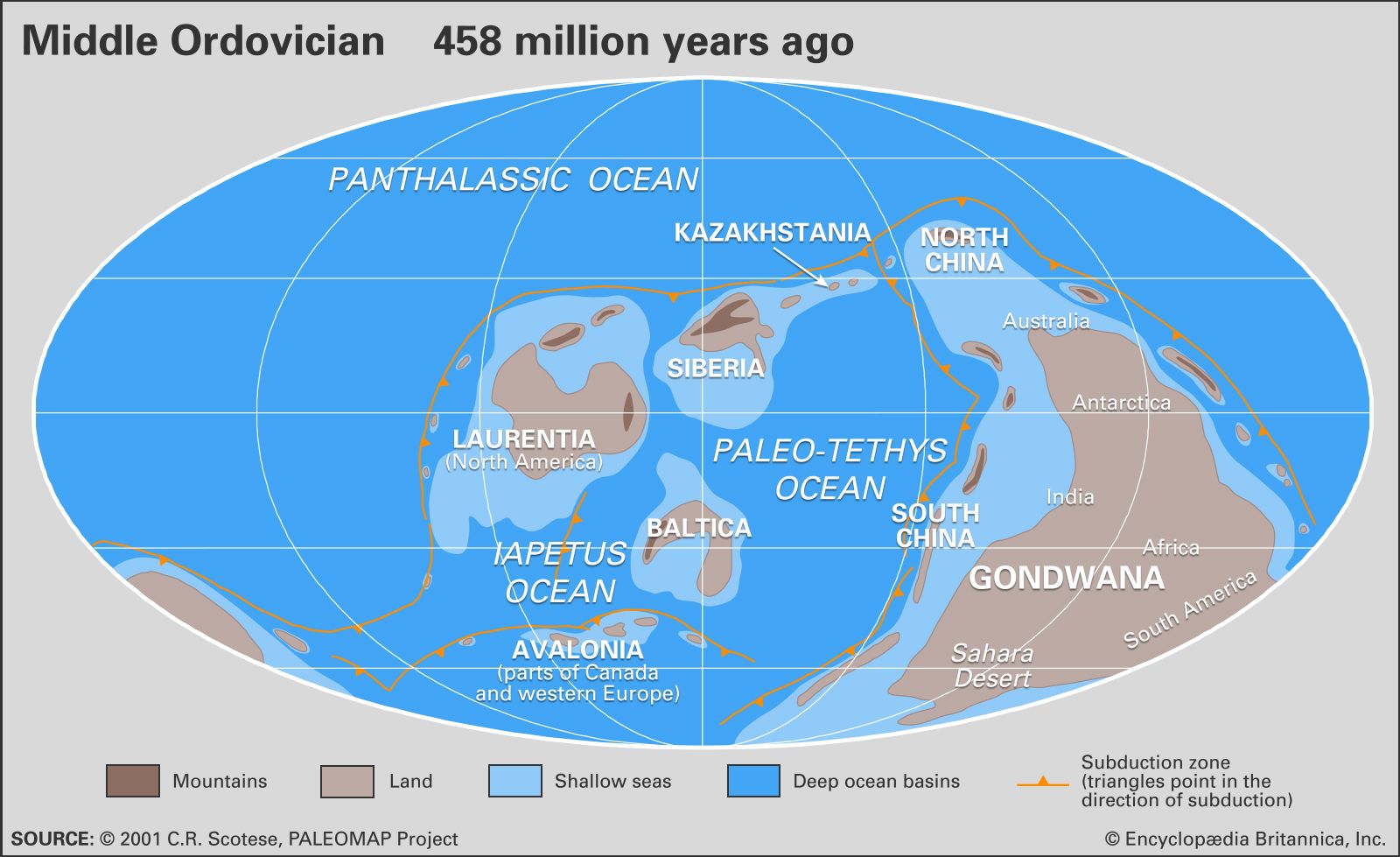
So numero uno, there is a major continental reorganization with the breakup of Rodinia.
Ally BaumgartnerGUEST
Yes,
DavidHOST
Yes, that's episode 124 and or 252.
DavidHOST
We've talked about ice a couple of times.
Ally BaumgartnerGUEST
Once we get through the Cambrian and into the Ordovician, the landscape becomes much more habitable.
DavidHOST
OK, which is interesting because this is also when we start seeing animals taking their first tentative steps up onto the land.

PeterHOST
It was a time of creatures like trilobites, brachiopods, and early coral reefs.
PeterHOST
During the Ordovician extinction, Earth suddenly cooled down and then warmed up again.
PeterHOST
This violent climate swing disrupted ocean chemistry and oxygen levels, collapsing ecosystems.
PeterHOST
In the end, it wiped out 85% of all species.

RedHOST
love to.
RedHOST
But first, I'd love to mention that one of the coolest things I learned about the geology history of the Earth is that one of the theories that caught about, I believe it's the, there's a massive period of glaciation and ice age stuff after the Ordovician.
RedHOST
It's one of the, I think it's the first documented mass extinction, although it's after the Great Oxygenation Event, which doesn't count for whatever reason.
RedHOST
and there's a theory that part of the reason why this ice age was so bad is because the the uplifts of the mountains that would erode into the Appalachians was happening around that time which would have exposed a ton of new rock to the surface which is a massive sink for co2 it dramatically changes the carbon cycle because it just sucks a ton of co2 out of the atmosphere which generally produces global cooling which could not have helped with the rest of the glaciation that was happening and that might have killed a whole bunch of stuff so that's pretty cool anyway thank you all so much for listening to this episode of the Everly Sarcastic Podcast we will be back in two weeks with another episode talking about our most two recent videos because that's the that's the format of things during chill year um if you miss us before then we will have another video going up shortly before halloween yes that'll be exciting i wonder what that's about uh and perhaps if you want to find clues for what that's about i'm sure there might be sprinkled in the after after show show which we're about to record a new episode of right now uh patrons go check that out um and that is everything so until next time i've been red

Günter BechlySOUNDBITE_SPEAKER
The phenomenon of sudden appearances in the fossil record is not just an exceptional case, but actually is a pattern that is found everywhere.
Günter BechlySOUNDBITE_SPEAKER
The origin of life, the origin of photosynthesis, the Avalon explosion, the great Ordovician biodiversification event, the Silurio-Devonian Terrestrial Revolution, the Devonian Nekton Revolution and the Odontoid Revolution, the Carboniferous Insect Explosion, the Triassic Explosions, the Origin of Flowering Plants, the Origin of Butterflies, the Neo-Avian Revolution of Modern Birds, the Placental Mammal Radiation, the Origin of the Genus Homo and finally the Upper Paleolithic Human Revolution.
speaker_36NARRATOR
Now that is a serious list of big jumps in the fossil record.
Casey LuskinSOUNDBITE_SPEAKER
If you look at the technical literature, we can see references to a fish explosion, a bird explosion, a dinosaur explosion, a mammal explosion, and even the origin of our own genus Homo has been referred to as a big bang theory of human evolution because we see throughout the fossil record different types of organisms appearing abruptly without this gradual change that Darwin's theory predicted.

RicoNARRATOR
It was the time of creatures like trilobites, brachiopods and early coral reefs.
RicoNARRATOR
During the Ordovician extinction, the earth suddenly cooled down and then warmed up again.
RicoNARRATOR
This intense climate change brought the chemistry of the oceans and the oxygen content together and let the ecosystems collapse.
RicoNARRATOR
In the end, it eliminated 85% of all species.
15 MINS LATER
RicoNARRATOR
The most famous of all were the exoplanet-looking trilobites.
RicoNARRATOR
About 440 million years ago, there was a sudden climate change and a drastic change in sea temperature.
RicoNARRATOR
The Earth experienced its first mass extinction, also known as the Ordovician mass extinction.
RicoNARRATOR
A large part of the life forms that had spread across the planet disappeared.

CurtisHOST
So anyway, things I want to remember that I talked about, because, like, there are bigger things that I think we'll be able to discuss just in case.
CurtisHOST
But most of my day on the things that I saw that wasn't like James and I seeing the same things, most of what I saw, a lot of the cool things were all, could all be related back to the Ordovician, and in particular the Ordovician mass extinction thing.
CurtisHOST
My day started with a talk at that mass extinction section in the ballroom way over on the other side of the conference center with a worker that was looking at Ordovician Reef collapse.
CurtisHOST
And finding that like post late Ordovician mass extinction, they were claiming they were seeing a reemergence of like microbial matte textures.
CurtisHOST
Kind of similar to some of the recovery intervals you see in the Permian mass extinction.
CurtisHOST
Which is kind of cool.
CurtisHOST
It's especially cool because sort of building off of research that is coming out, there's a paper in PNAS in 2025 about the possibility that complex composite reefs, and by composite reefs I mean these reefs we see in the middle, Paleozoic, of tabulate corals and stromatoporoids growing into each other to make arguably what might be the largest reef structures in Earth's history, that this type of interaction was happening in parts of China in the Middle Ordovician.
CurtisHOST
And I think the cool thing about that is like you, one way, one way you could take that as like, oh, so then they were much earlier and they were everywhere, or probably more likely this kind of interaction starts somewhere.

Andy AmanGUEST
Like, flash forward some 50, 100 million years in the future.
Andy AmanGUEST
Now we're deeper in the Cambrian, starting to wanna turn the page into the Ordovician era, and what we find ourselves in, our, our ancestor, right, our little Haikouichthys fleshy fishy ancestor, found himself in a fully stratified ecosystem, you guys.
Andy AmanGUEST
What do I mean by that? What I mean by that is there was predators around, okay?
JoshHOST
Hmm.
Andy AmanGUEST
This was after a long winter, you guys, hundreds of millions of years where vertebrates were kind of at the bottom.
Andy AmanGUEST
In the meantime, vertebrates were evolving more and more brains, more and more sophisticated eyes than armor.
Andy AmanGUEST
Then the next step is jaws and teeth and predation, and from there we had this explosive radiation of fishes, right? This is the Ordovician radiation.
Andy AmanGUEST
As soon as these guys had jaws, they've ruled the seas ever since.

speaker_0NARRATOR
In the shape of the valley, in the smoothed and polished rock surfaces exposed at higher elevations, in the moraines of unsorted gravel and clay that dam some of the smaller tributary valleys, and in the pattern of the river which follows a course that was established by meltwater from the retreating ice, and that has remained essentially unchanged since.
speaker_0NARRATOR
The bedrock here is Ordovician and Silurian in age, which means it is between 440 and 480 million years old.
speaker_0NARRATOR
These are not numbers that the human mind processes easily.
speaker_0NARRATOR
450 million years ago, there were no land animals.
10 more episodes mention Ordovician.
Create an account to see the whole feed, search across every transcript, and follow the entities you care about.