Optogenetics
40
MENTIONS
22
EPISODES
20
PODCASTS
Search complete. 40 mentions across 22 episodes found for "Optogenetics".
Oct 13, 2026

speaker_5HOST
How exactly does optogenetics work?
speaker_6HOST
It is arguably the most revolutionary technique in modern neuroscience.
speaker_6HOST
Optogenetics allows researchers to turn specific individual neurons on or off using literal flashes of light.
speaker_5HOST
Light.
speaker_5HOST
Like a laser.
speaker_6HOST
It explores happily.
speaker_6HOST
It has no memory of the threat.
speaker_6HOST
Optogenetics provided the absolute definitive causal evidence that these specific neuronal ensembles are the physical substrate of memories.

Rachel FeltmanHOST
This year's award went to Karl Deisseroth at Stanford University, Peter Hegemann at Humboldt University of Berlin, and Georg Nagel at the University of Würzburg in Germany.
Rachel FeltmanHOST
They were recognized for their discoveries around light-gated ion channels and optogenetics.
Rachel FeltmanHOST
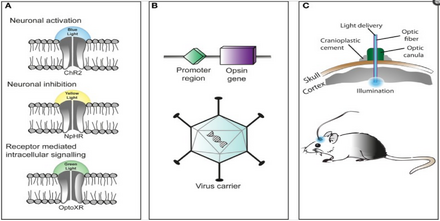
Optogenetics allows scientists to switch individual brain cells on and off.
Rachel FeltmanHOST
Because neurons use electrical signals to communicate with one another, scientists realized almost a century ago that they could use electrical stimulation to activate brain cells.
Rachel FeltmanHOST
Optogenetics combines this idea with genetic engineering to allow for more targeted, less invasive, safer cell stimulation than used to be possible.
Rachel FeltmanHOST
After genetically modifying neurons to make proteins that react to light, researchers can control those cells with a flash of light instead of an electrode.
Rachel FeltmanHOST
Hegemann and Nagel contributed to the field by studying a single-celled alga that swims toward light, which they found had to do with a particular protein that opened up pores in the cell membrane when exposed to light.

Julian MorrowHOST
Karl Deisseroth is Professor of Bioengineering and Psychiatry and Behavioral Studies at Stanford University.
Julian MorrowHOST
Together with German scientists Peter Hegemann and Georg Nagel, he received the Nobel Prize for Optogenetics, a method for controlling nerve signals with light that the Nobel Assembly said has laid the foundation of a new era of neuroscience.
Julian MorrowHOST
Dr Karl Dyseroth, congratulations and welcome to Sunday Extra.
Julian MorrowHOST
Thank you very much.

Karl DeisserothSOUNDBITE_SPEAKER
And we're now playing in different patterns of activity into a kind of cell called the dopamine neuron, and we're determining that some patterns of activity, but not others, turn out to control feelings of reward or motivation, and that may help us understand these psychiatric diseases.
Rachel RalphCORRESPONDENT
Researchers since have been able to use optogenetics to reveal how neural circuits lay down memories and behaviors, and clinicians are now even exploring the method as a way to restore sight in people with visual impairment and as an alternative to drugs to dial down electrical activity and stop epileptic seizures.
Rachel RalphCORRESPONDENT
The Nobel Assembly praised the work for laying the foundations of a new era in neuroscience, saying, "Optogenetics has fundamentally altered our understanding of the brain.
Rachel RalphCORRESPONDENT
Every day brings new discoveries, helping to solve one of humanity's greatest mysteries, how our incredible brain works." For Deisseroth, the recognition was both personal and professional.
Rachel RalphCORRESPONDENT
He described receiving the prize as absolutely wonderful and said it was an honor to share the accolade with his friends.

Alex GrindelandHOST
The first view comes from the Nobel Prize's official account.
Alex GrindelandHOST
Optogenetics has transformed neuroscience by turning neural circuits from theoretical maps into experimentally testable systems.
Alex GrindelandHOST
Its emerging clinical applications, including efforts to restore vision, demonstrate how fundamental discoveries can translate into therapies.
Alex GrindelandHOST
They also open new possibilities for treating complex brain diseases.
Alex GrindelandHOST
The second view comes from Owen Gregorian, who posts news and opinion stories on X. Optogenetics may represent a remarkable scientific breakthrough, but its therapeutic promise remains unproven.
Alex GrindelandHOST
Early findings do not yet establish that these approaches can safely deliver consistent, meaningful benefits for patients.
Alex GrindelandHOST
Significant research is still required to determine whether experimental results can completely treat blindness.

Tom WhippleHOST
Um, but the next one i-i-is for a tool as well.
Tom WhippleHOST
Let's hear what optogenetics is from Gyorgy Nagy.
Georg NagelSOUNDBITE_SPEAKER
Optogenetics is the manipulation of a cell or a complete animal by illuminating it with the correct wavelengths.
Georg NagelSOUNDBITE_SPEAKER
So for example, in our case, it was the blue light.
Georg NagelSOUNDBITE_SPEAKER
In red light it would not respond, but with blue light it responds, and you can do this only via genetically modifying this cell or animal or plants.

speaker_0HOST
The two comments on the post were brief, but both celebrated optogenetics as a powerful research tool.
speaker_0HOST
The award does not mean that light-based control is ready for routine treatment in people because the method still depends on specialized genetic and optical access to the targeted cells.
speaker_0HOST
Optogenetics made causal experiments on defined neurons practical at the scale of modern brain research.
speaker_0HOST
BioRxiv presents a preprint on how dopamine neurons communicate reward prediction signals to the basal forebrain.
speaker_0HOST
In recordings from freely moving rats, activity in ventral tegmental area dopamine neurons consistently led bursts in a separate basal forebrain population by about ten milliseconds.

Mike BelkowskiHOST
So let's get into the headliner, where light has just won the Nobel Prize.
Mike BelkowskiHOST
The 2026 Nobel Prize, again, in Physiology or Medicine, was awarded to Karl Deisseroth, Peter Hegemann, and George Nagel for discoveries involving light-gated ion channels and optogenetics.
Mike BelkowskiHOST
Optogenetics is one of the most extraordinary technologies to emerge from modern neuroscience.
Mike BelkowskiHOST
Very simply, researchers can introduce genes encoding light-sensitive proteins into particular cells, most famously neurons, and those proteins can then function like microscopic light switches.
Mike BelkowskiHOST
Illuminate the cell with appropriate wavelength of light, and you can alter ion flow across the cell membrane and either activate or inhibit cellular activity.
Mike BelkowskiHOST
Now, I want to make something extremely clear.
Mike BelkowskiHOST
This is not a Nobel Prize for red light therapy.
Mike BelkowskiHOST
Optogenetics and photobiomodulation are different technologies with different mechanisms.

Elaine ChenHOST
the award went to.
Elaine ChenHOST
So we learned this week that the Nobel Prize in Medicine was awarded to a trio of scientists who have worked on discoveries related to optogenetics.
Elaine ChenHOST
Optogenetics essentially uses light combined with genetic modifications of neurons to switch on or off cells in the brain.
Elaine ChenHOST
This makes it possible to show how nerve cells function, shape memories, feelings, behavior.
Elaine ChenHOST
One professor likened it to going from a Rand McNally road atlas to something more like Google Earth.
12 more episodes mention Optogenetics.
Create an account to see the whole feed, search across every transcript, and follow the entities you care about.