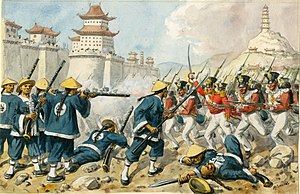
Opium Wars
WarWikipedia
83
MENTIONS
52
EPISODES
46
PODCASTS
Search complete. 83 mentions across 52 episodes found for "Opium Wars".
Sep 11, 2026
Gavin Healy, "A Guide to Mao’s China: Showing the Nation to Foreign Guests" (Cornell UP, 2026)
G
4:12Gavin HealyGUEST
But as I did my coursework, I kind of became increasingly drawn to the more modern era.
G
4:19Gavin HealyGUEST
And as I did a lot of reading in Qing and Republican era history in the course of my PhD work, I really came to see sort of this period from, say, the Opium Wars into the PRC period into the Mao era as kind of sort of a long sort of dynastic tradition.
G
4:39Gavin HealyGUEST
And, you know, when we look at sort of this survey of Chinese history, we see these kinds of dynastic transitions, you know, take like a century or more to really kind of like really, you know, kind of reached their fruition and and so when i looked at that i was kind of drawn to to to the prc period and really interested i was interested a lot in communications and and the way that sort of networks of communication you know worked like across across cultures across nations across regions and And, and I was kind of fascinated by the way that tourism was, you know, part of that.
G
5:17Gavin HealyGUEST
And so reading some, reading a few travel logs of people who had visited China during that period sort of led me to start like questioning, like sort of what's the, what's the sort of backstory, like what are, you know, these people are coming and visiting, but like, what are the people on the other side sort of thinking about this process and how are they preparing, preparing for that?
Gavin Healy, "A Guide to Mao’s China: Showing the Nation to Foreign Guests" (Cornell UP, 2026)
G
4:42Gavin HealyGUEST
But as I did my coursework, I kind of became increasingly drawn to the more modern era.
G
4:49Gavin HealyGUEST
And as I did a lot of reading in Qing and Republican era history in the course of my PhD work, I really came to see sort of this period from, say, the Opium Wars into the PRC period into the Mao era as kind of a long sort of dynastic tradition.
G
5:09Gavin HealyGUEST
And, you know, when we look at sort of this survey of Chinese history, we see these kinds of dynastic transitions, you know, take like a century or more to really kind of like, really, you know, kind of reached their fruition and and so when i looked at that i was kind of drawn to to to the prc period and really interested i was interested a lot in communications and and the way that sort of networks of communication you know worked like across across cultures across nations across regions And I was kind of fascinated by the way that tourism was part of that.
G
5:48Gavin HealyGUEST
And so reading a few travelogues of people who had visited China during that period sort of led me to start questioning what's the sort of backstory? These people are coming and visiting, but what are the people on the other side sort of thinking about this process and how are they preparing for that?
There Are More Things In Heaven & Earth Horatio, Than Are Dreamt Of In Your Philosophy
A
11:02Ann-Louise HollandHOST
And we've gotta think of that 180 years, it included the Belle Époque in sort of mostly in Paris, but more than just in Paris, where people were drinking and drugging and having a lovely time, dancing and all those things of the Belle Époque, which I love the fashions from then.
A
11:21Ann-Louise HollandHOST
And then remember the absinthe fe- fairies, and that is also in this last 180 years, the opium trade, the Opium Wars as well, the growth of pubs and bars, especially when they stuck them outside factories.
A
11:36Ann-Louise HollandHOST
We had the Roaring '20s.
A
11:38Ann-Louise HollandHOST
We had the Swinging '60s.
Deadly Intentions - EP08 - North American Drug Trade 1565-1989
P
13:00PeteGUEST
Chinese government pushes back.
P
13:02PeteGUEST
This is what triggers the opium wars.
P
13:05PeteGUEST
So now Britain goes to war with China.
P
13:06PeteGUEST
They have two of these opium wars where they defeat the Chinese, force the Chinese government to legalize it.
P
13:13PeteGUEST
This is when Britain takes Hong Kong.
B
13:16Bubba the Love SpongeHOST
And now they're supplying opium.
I’m the House Now: Treasury Policy, a Volatile Central Bank Week, and Xinbi Guarantee
C
26:05Cameron OtsukaHOST
Number one, Madagascar, uh, you know, another one of these African countries definitely has some, uh, you know, I'm not going to claim that they are directly interrelated with, uh, you know, China specifically, but there's definitely certain things going on there that, you know, you might want to look into later, but, um, the treasury department's press release only specifies that準備 guarantee is a Chinese language, uh, application right so that one is more broad lots of southeast asian countries speak chinese understand it right it is effectively a lingua franca if you think about english and then chinese is probably pretty close there to number two But the DOJ specifically says Chinese-run scam compounds.
C
26:47Cameron OtsukaHOST
I'm not going to say that this is Opium Wars V2 or maybe it's V3, whatever it is, but I do think that you're seeing this large economy being built around this kind of economic extraction, social damage, and that's going to obviously be a point of conflict between the United States and China broadly.
C
27:08Cameron OtsukaHOST
And then the second piece here is that they specifically thank Tether for proactively assisting in their investigation.
C
27:15Cameron OtsukaHOST
So, you know, dollar stablecoin issuers have, you know, an interest, a vested interest, ensuring they have access to dollar rails, working directly with the U.S. government to make sure that, you know, they're safe.
#1020: The Octopus Of Population Control With Charlie Robinson
X
35:25XGHOST
Yeah.
C
35:25Charlie RobinsonGUEST
The opium wars of China, if you r- have, have ever heard of those, that was what was going on.
C
35:30Charlie RobinsonGUEST
What was going on there was that the British had gotten the Chinese hooked on drugs.
C
35:34Charlie RobinsonGUEST
The Chinese were tired of it.
Why is the blockbuster Bayeux exhibition so important?
R
28:21Rana MitterPANELIST
Essentially, the Chinese were under siege from a variety of imperial powers.
R
28:26Rana MitterPANELIST
Britain and France had certain rights that they'd got in the Opium Wars, the late 19th century.
R
28:30Rana MitterPANELIST
But the really major pressure in the 1930s came from Japan, who had invaded Manchuria, the northeastern part of China in 1931.
R
28:37Rana MitterPANELIST
They'd already had big presence.
57. Knotted Threads
A
4:31ApprenticeVOICE_ACTOR
If there had been no East India Company.
A
4:34ApprenticeVOICE_ACTOR
No Opium Wars.
A
4:37ApprenticeVOICE_ACTOR
Maybe then...
A
4:38ApprenticeVOICE_ACTOR
Nobody has talked about those things.
Scott Kurashige on American Peril [rebroadcast]
S
9:39Scott KurashigeGUEST
Of course, folks know that immigrants from China came for the gold rush to California.
S
9:45Scott KurashigeGUEST
But I would say, even to understand their experience, we have to go back to the opium wars.
S
9:50Scott KurashigeGUEST
So Britain had a trade imbalance with China once.
S
9:58Scott KurashigeGUEST
Again, the U.S.'s trade imbalance with China, of course, is not the first because the British were voracious consumers of tea.
Emily Matson, "China’s Date Debate: How Manchurian Scholars Rewrote World War II" (U Michigan Press, 2026)
E
23:44Emily MatsonGUEST
It really started under the nationalists, Chiang Kai-shek as well, who, if you go see his diary at Stanford University today, you can see he starts out every diary entry during the war with Never Forget National Humiliation, Wu Wang Guo Chi in Chinese.
E
24:00Emily MatsonGUEST
But the CCP's legitimizing narrative today is pretty much this century of humiliation in which the Chinese people were humiliated by foreign powers, starting with the Opium Wars.
E
24:13Emily MatsonGUEST
And then, of course, the French and the British and the Americans and all these different, and of course, the Japanese, all these different foreign powers were involved.
E
24:21Emily MatsonGUEST
This century of humiliation weakens China and culminates in World War II in the Japanese invasion of China.
42 more episodes mention Opium Wars.
Create an account to see the whole feed, search across every transcript, and follow the entities you care about.