Operation Ivy Bells
8
MENTIONS
4
EPISODES
4
PODCASTS
Search complete. 8 mentions across 4 episodes found for "Operation Ivy Bells".
Oct 5, 2026

Daven HiskeyHOST
And perhaps the most daring and successful such feat of naval espionage took place in the early 1970s, when a US Navy submarine snuck into a Soviet naval base to tap an underwater communications cable.
Daven HiskeyHOST
This is the extraordinary story of Operation Ivy Bells.
Daven HiskeyHOST
So our story begins in the late 1960s at Petropavlovsk Naval Base on the west coast of Kamchatka Peninsula, home of the Soviet and today Russian Pacific Nuclear Submarine Fleet.
Daven HiskeyHOST
To connect the base to the Pacific Naval headquarters at Vladivostok and the rest of the Soviet military communications network, the Soviets laid a submarine cable more than 1,500 kilometers across the Sea of Okhotsk.
Daven HiskeyHOST
The cover story for the mission was that Glomar Explorer was constructed by eccentric billionaire Howard Hughes to mine manganese nodules off the ocean floor, a scheme crazy enough to be plausible.
Daven HiskeyHOST
Incredibly, in July 1974, Glomar Explorer succeeded in recovering the forward section of K-129 from a depth of 4.9 kilometers, but, well, that's a story for a different video.
Daven HiskeyHOST
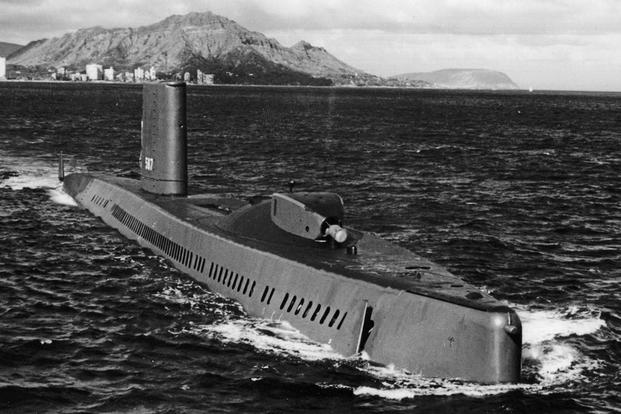
In October 1971, Halibut sailed from Hawaii on a covert mission to find and tap the submarine cable between Petropavlovsk and Vladivostok, codenamed Operation Ivy Bells.
Daven HiskeyHOST
While finding a single 12-centimeter wide cable in thousands of square kilometers of ocean should have been an insurmountable task, Captain Bradley, the architect of the mission, had come up with a laughably simple solution.

Josh GelernterHOST
But I wanna go back to Halibut again.
Josh GelernterHOST
The reason I call it the greatest of all of our spy subs was because of Operation Ivy Bells.
Josh GelernterHOST
Um, a guy named James Bradley, uh, who is, uh, one of the heads of naval intelligence, was sitting in his office in the Pentagon pondering how we could figure out what the Soviets were doing.
Josh GelernterHOST
Navy wise.
Josh GelernterHOST
Uh, a huge amounts of intelligence were recovered from this, including the fact that the Soviets were genuinely not planning a first nuclear strike, but were genuinely concerned that the Americans were planning a first nuclear strike.
Josh GelernterHOST
Also revealed the fact that they couldn't follow our submarines, but even though they were deeply afraid that we could follow their submarines.
Josh GelernterHOST
Unfortunately, these Operation Ivy Bells, uh, the tapping of the cable, and the sound signatures that we had recorded for their submarines and sound signatures for our own submarines were all leaked by the so-called Walker spy ring.
Dan GelernterHOST
I was gonna make a joke and say, "Were leaked to the press," but these were also leaked? Um-

Brandon WeichertHOST
Yeah, that's been going down since the 80s.
Brandon WeichertHOST
We've been doing that since Operation Ivy Bells before the internet when it was just undersea cable communicators.
Brandon WeichertHOST
Um, that's something that both the United States and the Soviets and now the Russians have always done or contemplated doing.
Brandon WeichertHOST
Okay, fine.

TeddyHOST
Boom.
TeddyHOST
Operation Ivy Bells.
TeddyHOST
This was actually, this actually worked for, for damn near a decade.
TeddyHOST
Uh, during the Cold War, United States wanted to learn more about Soviet submarine and missile technology, specifically the IC- ICBM tests and nuclear, uh, first-strike capability.