Open RAN
9
MENTIONS
6
EPISODES
4
PODCASTS
Search complete. 9 mentions across 6 episodes found for "Open RAN".
Sep 11, 2026

Ray DolanGUEST
We wrote that.
Ray DolanGUEST
We wrote that and contributed that to the Open RAN form.
Ray DolanGUEST
Right.
Ray DolanGUEST
Okay.

Louis RosenbergSOUNDBITE_SPEAKER
You can see it lands on Nyquist.
UrbanHOST
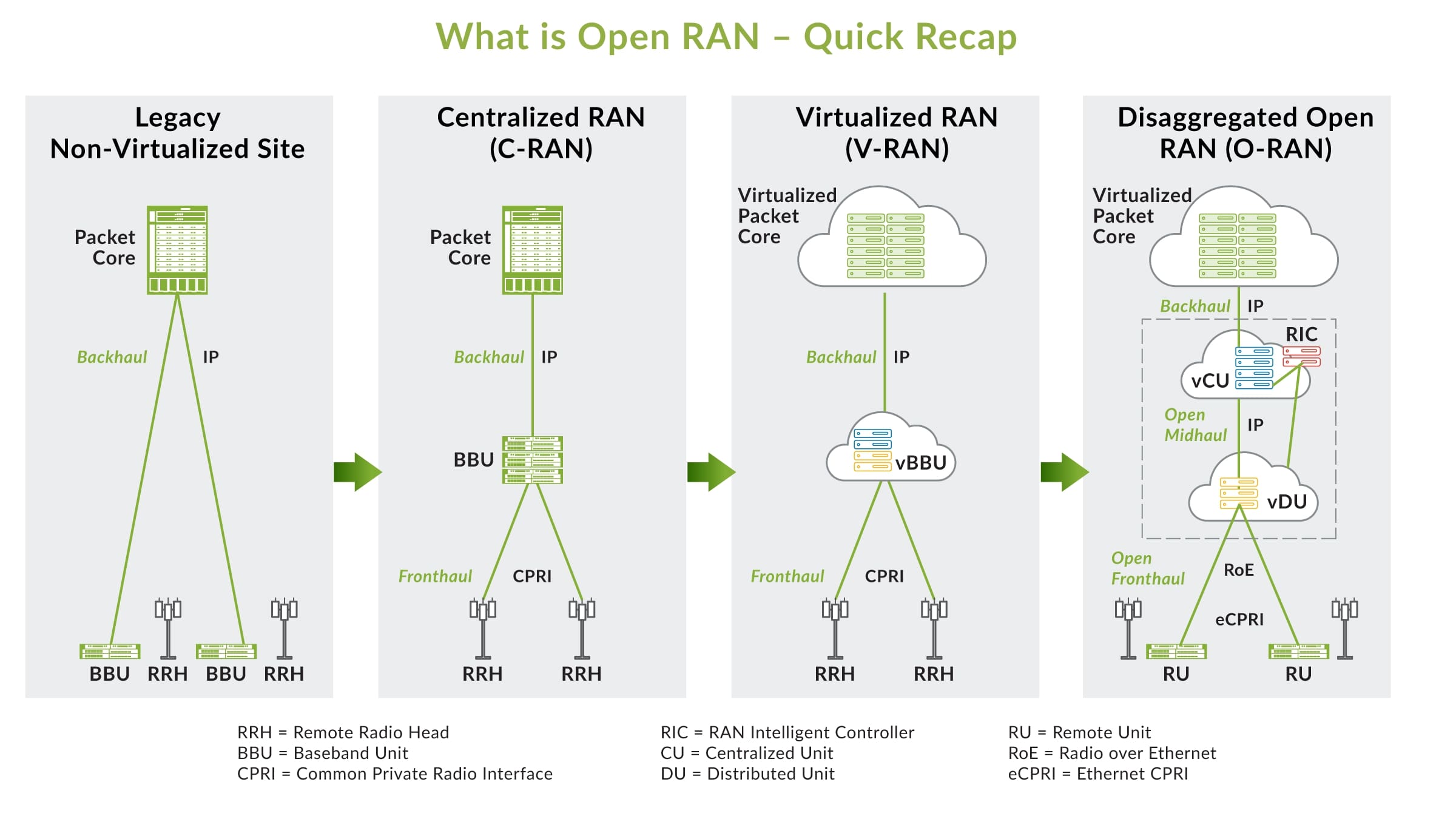
And again, so when we talked about predictive markets, when we talked about the O-RAN RIC, I can actually put the definition of that up real quick.
UrbanHOST
It'd probably be a good idea.
UrbanHOST
Try to do that.
speaker_1UNKNOWN
Sorry, one second.
speaker_1UNKNOWN
Here we go.
UrbanHOST
the O-RAN RIC.
UrbanHOST
We talked about this in some previous videos.
Ian MorrisHOST
It's interesting you mentioned Dish because they have that charlie ergen had the idea a few years ago i can come along i mean perhaps he had the idea perhaps all this was about driving up you know the value the value of spectrum i don't know and then eventually selling it i know there's people who sort of wonder if he was doing some sort of 3d chess thing all along but right actually if you look at it if you take it at face value they thought they could come along and build a fourth um competing network With these radical new technologies, you know, taking some cloud computing principles, you know, running it in the cloud as much as you could, you know, it's all based on sort of AWS and putting a lot of the computing that happens in the network into the cloud and trying to keep the costs down that way, or certainly have a very different cost profile, bringing in new companies to do it that we hadn't seen involved before, like Mavenir and Samsung and Fujitsu.
Ian MorrisHOST
You know, they were the big US kind of champion of Open RAN.
Ian MorrisHOST
And the whole thing is to allow them to do this at a really low cost.
Ian MorrisHOST
And it completely failed.

Mike DanoHOST
They also make some networking equipment.
Mike DanoHOST
They s- actually have a f- my understanding, they have a fairly extensive deal for Open RAN network radios in places like Vietnam and elsewhere.
Mike DanoHOST
So yeah, to get a, a boots on the ground view of what Qualcomm is saying about the future of 6G, I just, I don't think you can get really a better source than them and what they have to say about it.
Mike DanoHOST
So that, that's great to hear.

Earl LumGUEST
The locations are already out there.
Earl LumGUEST
It would be easy to repopulate those towers with macro cell equipment from a vendor or from whoever, or Open RAN, whatever it-
Dan JonesHOST
Right
Earl LumGUEST
... needs to be.
Earl LumGUEST
And then what is the power consumption? Obviously they don't have a B100 or B200 GPU or a more advanced GPU on these cards because the power envelope would not be able to handle that.
Dan JonesHOST
Right
Earl LumGUEST
So they have a much stripped down version of that GPU, but I would argue it's a processor, and ASIC always wins out over a processor, and that was the problem with Open RAN, in that you were trying to catch up with Open RAN off-the-shelf processors that could never keep up or, uh, pass an Ericsson or a Huawei or a ZTE or-
Dan JonesHOST
Right.
UrbanHOST
Microsecond channel state information pings grounded, multimodal perception capture.
UrbanHOST
the two layers, the logistical layer here on the left at the local physical layer, the O-RAN near real time RIC executes trading algorithms as a purely mathematical high speed optimization mechanism.
UrbanHOST
So it's a simulation.
UrbanHOST
By modeling resource scheduling as a combinatorial prediction market, the network solves the resource allocation bottleneck in under 100 microseconds, bypassing the latency overhead of traditional centralized routers.