Oort cloud
Trans-neptunian regionWikipedia
769
MENTIONS
48
EPISODES
18
PODCASTS
Search complete. 769 mentions across 48 episodes found for "Oort cloud".
Sep 11, 2026

speaker_5HOST
They were the gravitational engines.
speaker_4HOST
Yeah, flinging ancient icy comets inward from the Kuiper Belt and the Oort Cloud, delivering the water that now makes up the Atlantic Ocean, the rain falling outside your window, and even the water inside your own cells.
speaker_5HOST
And that observation provides empirical physical backing to what was mostly a theoretical mathematical model of our own history.
speaker_5HOST
We are no longer just running computer simulations guessing that Jupiter might have flung comets at early Earth.

PeterHOST
And then the fireworks would really start.
PeterHOST
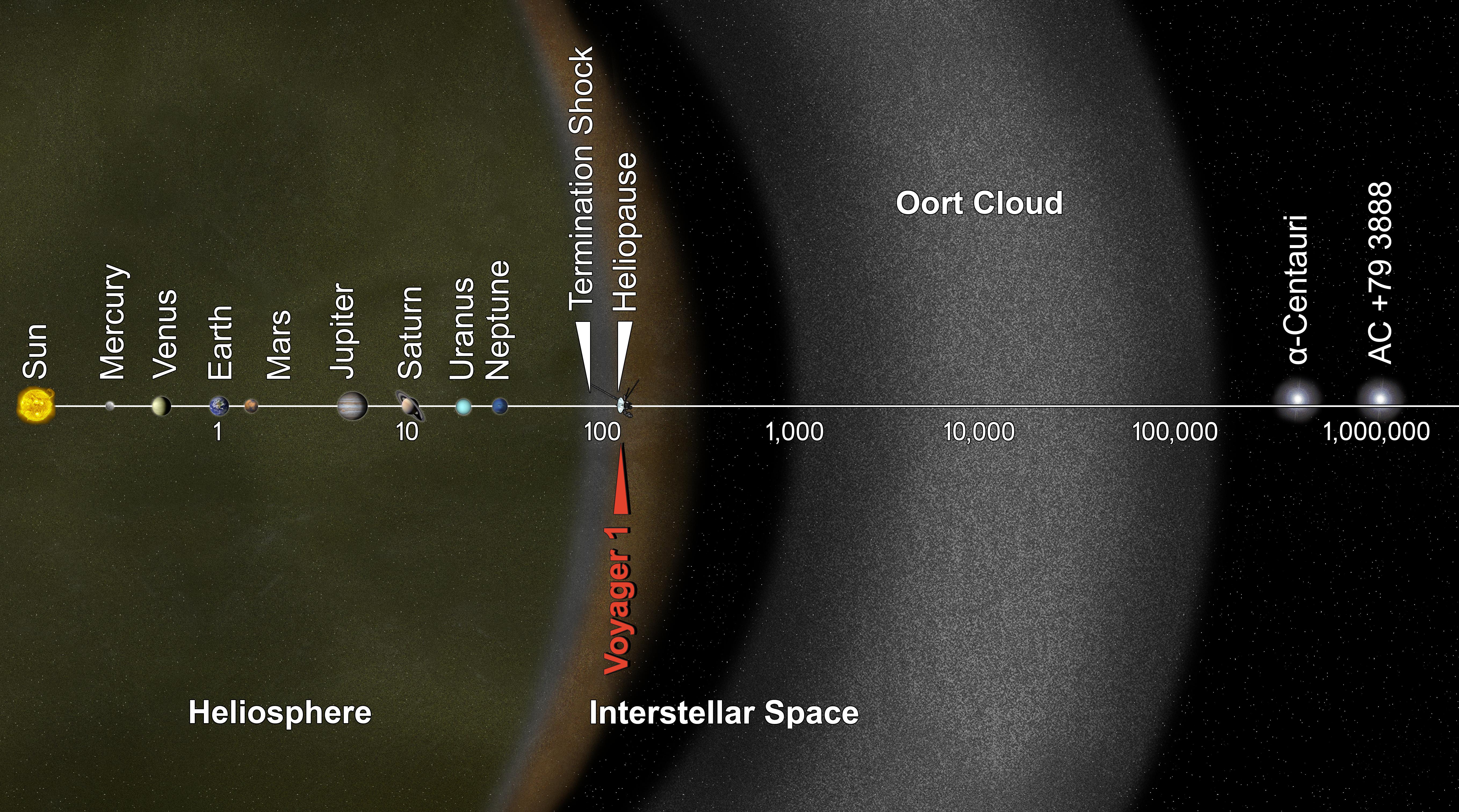
The action would begin way way out in the Oort Cloud, which is an almost impossibly huge bubble of icy debris that surrounds our solar system.
PeterHOST
It sits between 300 billion kilometers and 750 billion kilometers away.
PeterHOST
To give you an idea of how extremely far that is, NASA's Voyager 1 spacecraft won't enter the Oort Cloud for another 300 years.
PeterHOST
And it's traveling 1 million miles a day.
PeterHOST
Even more mind-blowing, once Voyager 1 gets to the Oort cloud, it'll take around 30,000 more years to get through to the other side.
PeterHOST
So it's way out there, and it's huge.
PeterHOST
The approaching star's gravity would act like a bull in a china shop in the Oort cloud, scrambling the ice chunks and planetesimals that make up the cloud.

speaker_1HOST
Mm-hmm.
speaker_2HOST
In this case, an alien species that humans encounter in the Oort Cloud, known as the Scramblers.
speaker_1HOST
The Scrambler.
speaker_2HOST
The Scramblers are highly intelligent.

Kyle WoodHOST
And our fifth and final fun fact for today, the edge of our solar system has a massive shell of icy objects stretching nearly a light year into space.
Kyle WoodHOST
Most people think Neptune or Pluto marks the edge of our solar system, but gravitational influence extends much further to the Oort cloud.
Kyle WoodHOST
The Oort cloud is a spherical bubble of billions, possibly trillions, of icy bodies left over from the formation of the planets.
Kyle WoodHOST
It begins about 2,000 astronomical units from the Sun.
Kyle WoodHOST
Now, an astronomical unit is the distance from the Earth to the Sun, about 93 million miles or 150 million kilometers.
Kyle WoodHOST
Its outer boundary stretches between 100,000 and 200,000 astronomical units away, which is halfway to the nearest neighboring star system, Alpha Centauri.
Kyle WoodHOST
The Oort Cloud is named for the Dutch astronomer Jan Oort, who proposed the existence of this region in 1950 to explain where long-period comets came from.
Kyle WoodHOST
These icy bodies take thousands or even millions of Earth years to complete an orbit around the Sun.

David KippingHOST
Of course, that also means that the main belt is slowly depleting, evaporating away about half of its objects every couple of billion years or so.
David KippingHOST
So NEOs are largely former main belt asteroids and they pose one of two main threats to the Earth, the other source of peril being the Oort cloud, but we will come back to that later.
David KippingHOST
A NEO is defined as an object which has a perihelion of less than 1.3 AU and remember perihelion means the point in its orbit where it's closest to the Sun.
David KippingHOST
Now 99% of Neos are in fact asteroids.
5 MINS LATER
speaker_2SOUNDBITE_SPEAKER
Maybe a little late, but we'll be there, sir.
David KippingHOST
But NEOs are not our only worry.
David KippingHOST
Long-period comets hypothesized to be sourced from some distant population on the outskirts of the solar system, a population that we call the Oort cloud, also strike the Earth with about the same frequency as NEOs.
David KippingHOST
But in many ways, these are much more dangerous.

Pamela GayHOST
At their most fundamental level comets are blobs of ice, rocks, and complex molecules that change over time.
Pamela GayHOST
As we'll discuss in more detail in future episodes they originate in the outer solar system either in the Kuiper Belt which starts near Neptune's orbit and extends outward or in the much more distant Oort Cloud.
Pamela GayHOST
These regions of our solar system are so cold that materials we're used to experiencing as gases are able to exist as ice.
Pamela GayHOST
From carbon dioxide and monoxide to molecular nitrogen, ices come in a lot of different forms other than the water ice we're used to.

Al GrauerHOST
The comets we observe generally start out as icy, dirty snowballs of frozen gases like water and frozen carbon dioxide in the Oort cloud.
Al GrauerHOST
This halo of potential comets extends from two to 100,000 times further from the Sun than we are.
Al GrauerHOST
Its members take from tens of thousands to millions of years to orbit the Sun The European Space Agency's Gaia mission discovered that approximately 2.5 million years ago, the star HD 7977, now in the constellation of Cassiopeia, passed through the outer Oort cloud at some 4,000 to 25,000 times our distance from the Sun.
Al GrauerHOST
In a recent study of the orbits of long-period comets, Dr. Nathan Kayeb of the Planetary Science Institute and Dr. Sean Raymond of the University of Bordeaux have found evidence suggesting that HD 7977 passed between 6 and 10,000 times our distance from the Sun, producing a shower of comets to enter the inner solar system that persists to this day.
Al GrauerHOST
They arrived at this result by noting that over billions of years the gravity of the more distant stars in the Milky Way changed an initial disk of material into a roughly spherical Oort cloud we see today.
Al GrauerHOST
These scientists analyzed the orbits of newly discovered long-period comets and found that the passage of HD 7977 had perturbed the Oort cloud making some of its members much more likely to pay us a visit.
Al GrauerHOST
We can check their prediction as the new Vera Rubin Observatory discovers large numbers of comets in the next decade.
Al GrauerHOST
If the analysis of these researchers is correct, we are now witnessing a parade of comets produced by the passage of a star when our first ancestors began to roam the Earth in Africa.
38 more episodes mention Oort cloud.
Create an account to see the whole feed, search across every transcript, and follow the entities you care about.