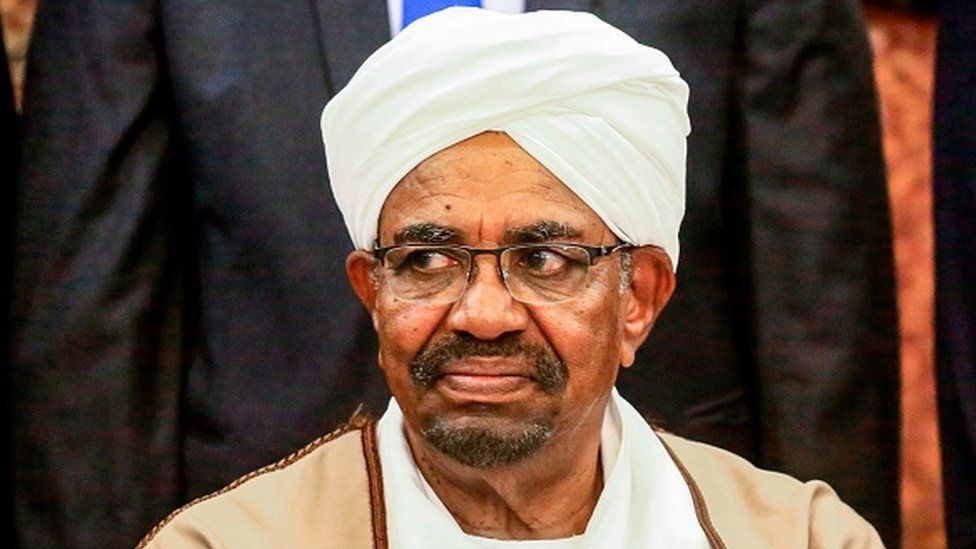
Omar al-Bashir
Former President of SudanWikipedia
46
MENTIONS
32
EPISODES
28
PODCASTS
Search complete. 46 mentions across 32 episodes found for "Omar al-Bashir".
Oct 28, 2026

ColtonHOST
Nope, not Assad.
ColtonHOST
It was al-Bashir.
ColtonHOST
Okay.
ColtonHOST
Out of Syria? Yes.

speaker_0NARRATOR
Sudan also reported unreliable infection numbers in early 1995, largely due to war.
speaker_0NARRATOR
Later that year, Qatar secured a six-month ceasefire between Sudanese President Omar al-Bashir and rebel leader John Garang.
speaker_0NARRATOR
The truce, called the Guinea Worm Ceasefire, allowed health workers to deliver clean water to millions in remote, affected areas.
speaker_0NARRATOR
In a statement, President Carter said, "...the ceasefire has provided an unprecedented opportunity and challenge to advance health programs through the tireless endeavors of the Sudanese and humanitarian organizations.

Asad KiyaniGUEST
There's lots of reasons to think that those states will find it more complicated or it will be more complicated than it seems on the surface, in part because of what Larissa said, domestic law matters, constitutional rules matter, but also because civil society domestically matters and people are answerable to their domestic constituencies.
Asad KiyaniGUEST
And one example that we can think of in relation to this is, of course, the litigation that arose when Omar al-Bashir visited South Africa while under an arrest warrant from the ICC.
Asad KiyaniGUEST
And of course, he was not arrested.
Asad KiyaniGUEST
He was allowed to go back home.
5 MINS LATER
Asad KiyaniGUEST
This is a link in a system, a system that is worth preserving in many ways for many different reasons.
Asad KiyaniGUEST
And I think the issuance of the warrants in the Israel-Gaza situation more emblematic of the changing understanding of the importance of the ICC.
Asad KiyaniGUEST
To see it as a court that is less likely to produce tangible results in the form of arrests of Netanyahu and Putin and even Omar al-Bashir, who still has not been arrested by the ICC or put on trial.
Asad KiyaniGUEST
So what is a court doing if it's not arresting and putting people on trial? Well, it's signaling to the rest of us, right? It's motivating and moving domestic apparatuses.
speaker_0NARRATOR
However, a pivotal incident in the late 90s altered his trajectory.
speaker_0NARRATOR
During this period, Darfur experienced aridity, poverty, and lawlessness due to neglect by President Omar al-Bashir's government, although details remain unclear.
speaker_0NARRATOR
An armed group reportedly attacked Hemeti's family's commercial caravan, stole their camels, and killed about 60 members of his extended family and clan.
speaker_0NARRATOR
This event profoundly affected Hemeti, motivating him to protect his family and property.
21 MINS LATER
speaker_0NARRATOR
They chanted, please keep your money, and criticized the Gulf state's involvement in Sudanese affairs.
speaker_0NARRATOR
Hanan al-Sadiq, a university student interviewed by Al Jazeera at the time, questioned the motives behind the offer, to quote, "...the timing of their aid says a lot about their intentions.
speaker_0NARRATOR
Why did they wait until now? Why did they not call on Omar al-Bashir to stop when he was killing our people? Their money will only create problems for us." Despite public opposition, the military accepted the agreement, resulting in a $500 million injection into the central bank to ease pressure on the Sudanese pound and stabilize the exchange rate.
speaker_0NARRATOR
Subsequently, the military council, which initially portrayed itself as a protector of protesters and the revolution, changed its stance.

Tony PearceHOST
A bit of history for you.
Tony PearceHOST
In 2019, there was mass pro-democracy protests in Sudan, which led to the overthrow of the brutal president, a man called Omar al-Bashir, in April 2019, ending 30 years of authoritarian rule.
Tony PearceHOST
This was a vicious dictatorship in which basically Muslim Arabs in the north subjugated and killed black Africans in the south.
Tony PearceHOST
The Africans were largely Christian of some form or other, or animist.

Kelsey NormanGUEST
So probably the worst case example that we examine of the four cases we look at in the book, so not necessarily the worst case globally or even in North and South Saharan Africa, but within the four that we look at, was Sudan.
Kelsey NormanGUEST
And part of that is because Sudan was a country that the EU really didn't have any business providing funding to from the get-go in that they couldn't work directly with the government of Sudan because there was an ICC indictment against former President Omar Bashir for his committing a genocide in the earlier part of the 2000s.
Kelsey NormanGUEST
So they had to be kind of crafty in how they even worked at all with Sudanese institutions and provided funding to the country.
Kelsey NormanGUEST
And some of the domestic programs were well-intentioned.

Cynthia FarahatGUEST
The death toll of the Muslim Brotherhood, by the way, is in the millions because they directly ruled the country of Sudan.
Cynthia FarahatGUEST
Omar al-Bashir, the Sudanese president, was a card-carrying member of the Muslim Brotherhood.
Cynthia FarahatGUEST
Well, Khomeini
ErskineHOST
went and visited him in Cairo in 1938.

AlsarahGUEST
Well, Sudan has been in, in a, in a long-term war at this point, 30 years, and it's like a proxy war, and it's had so many phases that it has gone through, from the coup in '89 to, um-
Amy GoodmanHOST
That was Omar al-Bashir.
AlsarahGUEST
Yeah, that was Omar al-Bashir.
AlsarahGUEST
And then you had, um, I mean, then we had the revolution because he stayed in power that whole time, and the country just progressively shut down more and more.
AlsarahGUEST
And then Sudan split into two, S- uh, Sudan and South Sudan.
AlsarahGUEST
Well, Sudan has been in, in a, in a long-term war at this point, 30 years, and it's like a proxy war, and it's had so many phases that it has gone through, from the coup in '89 to, um-
Amy GoodmanHOST
That was Omar al-Bashir.
AlsarahGUEST
Yeah, that was Omar al-Bashir.
AlsarahGUEST
And then you had, um, I mean, then we had the revolution, 'cause he stayed in power that whole time.
AlsarahGUEST
And the country just progressively shut down more and more, and then Sudan split into two, S- uh, Sudan and South Sudan.

Nick McGeehanGUEST
Back in 2019, it was the UAE that withdrew funds from the country.
Nick McGeehanGUEST
And that's what led to the toppling of Omar al-Bashir.
Nick McGeehanGUEST
who the UAE thought had too many people from within the Muslim Brotherhood in its government and felt that Bashir had taken the side of Qatar in that UAE-Qatari split rift that is still ongoing.
Nick McGeehanGUEST
So they withdrew money, they caused him to topple, and then they reinvested money once he left.
22 more episodes mention Omar al-Bashir.
Create an account to see the whole feed, search across every transcript, and follow the entities you care about.