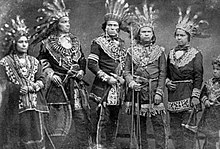
Ojibwe

Ojibwe

PeopleWikipedia

Search complete. 649 mentions across 213 episodes found for "Ojibwe".

Sep 11, 2026

William TomkoNARRATOR
120:51
Finding that supplies had not been sent to the Falls of St. Anthony, Carver returned to Prairie du Chien in order to get sufficient stores to enable him to reach Lake Superior, whence he hoped to be able to cross the continent from Grand Portage.
William TomkoNARRATOR
121:04
Obtaining such supplies, he proceeded up the Mississippi to the Chippewa River, and, after ascending to its head, made portages to the St. Croix and reached Lake Superior, possibly by the river now known as the Bois Brule.
William TomkoNARRATOR
121:20
From this point, Carver, in his canoe, skirted the coast of Lake Superior to the Grand Portage, where he awaited the arrival of the Hudson Bay or Northern Traders, from whom he anxiously hoped to obtain supplies that would enable him to journey west.
William TomkoNARRATOR
121:35
But he was destined to disappointment, as nothing could be obtained from them.

1 HR 42 MINS LATER

William TomkoNARRATOR
223:27
Their inferior arms put them at the mercy of the militaries of Knife River, who mercilessly stole their horses and killed their braves.
William TomkoNARRATOR
223:36
They seemed an adventurous and courageous people, and Kameo Waite's vehement declaration that, with guns, they would never fear to meet their enemies did not seem boastful.
William TomkoNARRATOR
223:48
Their common arms are bow and arrow, shield, lance, and a weapon called by the Chippewas, by whom it was formerly used, the pogamogan.
William TomkoNARRATOR
223:58
Their method of producing fire was by an arrow and a dry prepared stick, which, being rubbed together vigorously and dexterously for a few minutes, first creates a fine dust, then bursts speedily into flame.
Steve StocktonHOST
87:55
The hairy man of Vergas Swamp, which is in Minnesota.
Steve StocktonHOST
87:59
This legend, originating from the Ojibwe people, tells, here we go, a large hairy creature that dwells in the swamps of northern Minnesota.
Steve StocktonHOST
88:07
Hairy man is said to be mischievous and sometimes dangerous.
Steve StocktonHOST
88:10
Known for playing tricks on travelers and occasionally even attacking those who wander too close to his territory.
JennyHOST
51:33
Because I recently read, or recently, a couple years ago, I read for Book Club a book called Firekeeper's Daughter by Angeline Boulay.
JennyHOST
51:45
Bule, which is about an 18-year-old Ojibwe woman that is from a Native tribe who uses knowledge of chemistry and traditional medicine to investigate a lethal drug ring in her community.
JennyHOST
51:59
Why we need an 18-year-old as a secret agent to do all these things? Besides me.
JennyHOST
52:05
But it was very interesting because it also brought about Native American culture to an audience and provided some nuance in terms of how communities engage with each other, outsiders, insiders, nuances in who belongs to a Native community, who doesn't.
Nora SperlingHOST
2:29
Ally, where are you?
Ally BaumgartnerHOST
2:30
I'd like to acknowledge that I am recording on the traditional territory stewarded by the Anishinaabeg, Ojibwe, Ottawa, and Potawatomi, and Wyandot people as part of the Treaty of Detroit.
Ally BaumgartnerHOST
2:39
Their relationship with the land continues today.
Nora SperlingHOST
2:42
Thanks, Ally.
Chris La TrayGUEST
0:45
That's how you say, my name is Chris Latre, but you can call me Chris in Anishinaabemowin and then Michif, which are the two languages of my people.
Chris La TrayGUEST
0:55
I'm a citizen of the little shell Chippewa tribe, and we are, uh, Anishinaabe, so we speak Anishinaabemowin.
Chris La TrayGUEST
1:02
And Michif, we're largely comprised of Métis people, which Michif is the language of.
Chris La TrayGUEST
1:07
And the Métis people, for those of your tens of thousands of listeners who don't know, are an indigenous cultural group recognized in Canada as one of the three indigenous peoples who predate the existence of Canada as a country.

14 MINS LATER

Chris La TrayGUEST
15:03
And I met her when I was young, you know.
Chris La TrayGUEST
15:07
So if my grandmother's mother only spoke whatever it was, it could have been Michif, it could have been, it could have been Cree for all I know.
Chris La TrayGUEST
15:16
It could have been Anishinaabemowin or Ojibwe or Chippewa, whatever.
Chris La TrayGUEST
15:20
They're all, they all mean the same thing.
speaker_23NARRATOR
287:43
They live in tents of dressed leather, which they transport by means of horses and dogs, and ramble from place to place during the greater part of the year.
speaker_23NARRATOR
287:52
They are friendly to their traders, but the inveterate enemies to such as supply their enemies, the Chippewas, with merchandise.
speaker_23NARRATOR
288:00
They also claim the country in which they hunt, commencing at the entrance of the river St. Peter's and extending upwards on both sides of the Mississippi to the mouth of the Crow River.
speaker_23NARRATOR
288:10
Wapakuta.

9 MINS LATER

speaker_23NARRATOR
297:22
Are the descendants of the Sioux, and partake of their turbulent and faithless dispositions.
speaker_23NARRATOR
297:27
They frequently plunder, and sometimes murder their own traders.
speaker_23NARRATOR
297:31
The name by which this nation is generally known was borrowed from the Chippewas, who called them Assiniboine, which literally translated is Stone Sioux, hence the name of Stone Indians, by which they are sometimes called.
speaker_23NARRATOR
297:46
The country in which they rove is almost entirely uncovered with timber, lies extremely level, and is but badly watered in many parts.
speaker_7NARRATOR
42:11
The Algonquins were divided into a great many tribes, some of whose names are still familiar among the Indians of to-day.
speaker_7NARRATOR
42:18
The Micmacs of Nova Scotia, the Malasite of New Brunswick, the Naskapi of Quebec, the Chippewa of Ontario, and the Crees of the Prairie are of this stock.
speaker_7NARRATOR
42:29
It is even held that the Algonquins are to be considered typical specimens of the American race.
speaker_7NARRATOR
42:34
They were of fine stature, and in strength and muscular development were quite on a par with the races of the old world.

10 MINS LATER

speaker_7NARRATOR
52:45
Gambling and theft flourished among them, except indeed for the tradition of courage in fight, and of endurance under pain we can find scarcely anything in them to admire.
speaker_7NARRATOR
52:56
North and west from the Algonquins and Huron-Iroquois were the family of tribes belonging to the Athapascan stock.
speaker_7NARRATOR
53:03
The general names of Chippewan and Tean are also applied to the same great branch of the Indian race.
speaker_7NARRATOR
53:09
In a variety of groups and tribes, the Athapascans spread out from the Arctic to Mexico.
Roger MelinNARRATOR
5:10
Strange spirits were abroad at night, howling, shrieking, cracking and groaning in voices of ice and flood.
Roger MelinNARRATOR
5:19
Her Indian nurse told her of them all, of Monobocho the Good, of Ninobocho the Evil, in her lisping Ojibwe dialect that sounded like the softer voices of the forest.
Roger MelinNARRATOR
5:33
At last, the sudden subsistence of the waters, the splendid eager blossoming of the land into new leaves, lush grasses, an abandon of sweetbrier and hepatica.
Roger MelinNARRATOR
5:46
The air blew soft.

1 HR 15 MINS LATER

Roger MelinNARRATOR
80:49
You have said enough.
Roger MelinNARRATOR
80:52
Mehengan glided into the room.
Roger MelinNARRATOR
80:55
Galen Albret at once addressed him in the Ojibwe language, gaining control of himself as he went on.
Roger MelinNARRATOR
81:03
Listen to me well, he commanded.
Sam LeesonHOST
74:34
It's Indigenous land, rich with story, relationship, and meaning, and my community benefits from that legacy every single day.
Sam LeesonHOST
74:44
This territory is held under the Dish with One Spoon Wampum Belt Covenant, a powerful agreement between the Iroquois Confederacy, the Ojibwe, and allied nations to share and care for the resources of the Great Lakes region together, peacefully.
Sam LeesonHOST
75:03
I also want to specifically recognize that I am on the treaty lands and territory of the Mississaugas of the Credit.
Sam LeesonHOST
75:11
As a queer person, I find myself coming back to the land as a teacher.
Allan ArmitageHOST
2:25
It turns out the plant, particularly the roots, were quite useful when medicinally employed to treat problems of the gallbladder and liver, and was also useful for constipation and colitis.
Allan ArmitageHOST
2:41
Native American tribes in Missouri and Delaware, such as the Ojibwe and the Chippewa tribes and the Seneca Indians, used the plant for medicinal and purification rituals.
Allan ArmitageHOST
2:55
The use of this herb as a laxative and detoxifying agent was adopted early by European settlers.
Allan ArmitageHOST
3:04
Later, the herb was used as a remedy against liver disease and to stimulate bioproduction.

203 more episodes mention Ojibwe.

Create an account to see the whole feed, search across every transcript, and follow the entities you care about.

We value your privacy

We use cookies to understand how you use our platform and to improve your experience. Click “Accept All” to consent, or “Decline non-essential” to opt out of non-essential cookies. Read our Privacy Policy.