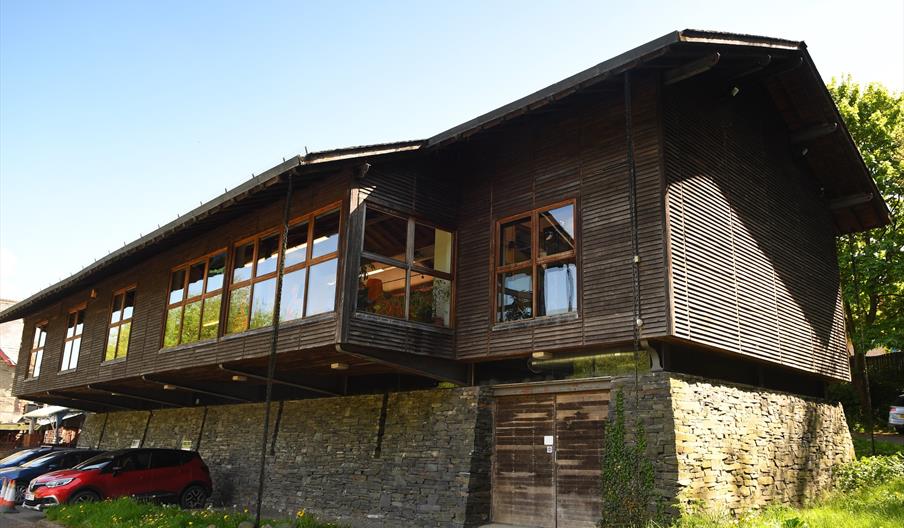
Offa's Dyke
Historical place museum in Knighton, WalesWikipedia
13
MENTIONS
10
EPISODES
10
PODCASTS
Search complete. 13 mentions across 10 episodes found for "Offa's Dyke".
Nov 1, 2026

Calum StottGUEST
And he said he saw two people in the whole village and they were near the church and he was just trying to get some history.
Calum StottGUEST
And outside the Western gate of the church on the right on Offa's Dyke, which was built as a boundary for Wales to keep the English triangles out.
Calum StottGUEST
There's a stone sits outside and apparently that stone gave its name to the village.
Calum StottGUEST
So name in Welsh means stone and stone in English is stone.

Pamela NagamiNARRATOR
Note.
Pamela NagamiNARRATOR
Offa's Dyke, between Wales and England.
Pamela NagamiNARRATOR
End of note.
Pamela NagamiNARRATOR
His daughter, named Edburga, was married to Bertrick, king of the West Saxons, who immediately, having the king's affections and the control of almost all the kingdom, began to live tyrannically like her father, and to execrate every man whom Bertrick loved, and to do all things hateful to god and man and to accuse all she could before the king and so to deprive them insidiously of their life or power and if she could not obtain the king's consent she used to take them off by poison as is ascertained to have been the case with a certain young man beloved by the king, whom she poisoned, finding that the king would not listen to any accusation against him.

AmyHOST
Yeah, it was nice.
AmyHOST
So I think I did Offa's Dyke going up it and then coming down, it was quite steep, but also it had all those, you know, those like little, I don't know what they are that fall from trees, like seeds or nuts or something was completely covering the floor.
AmyHOST
Pine cones? No, they weren't pine cones.
AmyHOST
They were really, they were circular and very hard.

Sarah HartleyHOST
You know what? Don't stay tuned.
Rick KelseyHOST
Is he go- or is he just taking, you know, a flat route along Offa's Dyke?
Sarah HartleyHOST
We'll let you know later on in the episode.
Rick KelseyHOST
Well, there we go.

John RobinsHOST
... not a chance in hell.
Elis JamesHOST
I needed John to know that despite him being from the other side of Offa's Dyke, perhaps you could start a new feature to bring together other members of the PRS club.
Elis JamesHOST
Diolch yn fawr, Dylan.
Elis JamesHOST
So there we go.

Larry HanksGUEST
Of course, he was a very keen Welshman.
Larry HanksGUEST
And I said, "Two bloody useless things that was built in bloody England." He said, "What was that?" I said, "Hadrian's Wall and, uh, Offa's Dyke." He said, "How do you mean?" I said, "Well, Hadrian's Wall was meant to keep the bloody Scots out, which it didn't." I said, "And Offa's Dyke was meant to keep you bloody Welsh out.
Larry HanksGUEST
And that's," I said, "They were two bloody things that were completely and utterly useless." So...
Larry HanksGUEST
And, uh, his wife used to smile, you know.

John CurticeGUEST
Uh, i.e. the Burnham bounce seem-- certainly seems to have stopped at Hadrian's Wall.
John CurticeGUEST
Indeed, I mean, other data suggests that it a- it's also stopped at O- at Offa's Dike.
John CurticeGUEST
Um, uh, you know, it's worth remembering both in Scotland and in Wales, you have to go back to before the First World War to find a worst Labour performance in either of those two countries.
John CurticeGUEST
In other words, basically, it was Labour's worst ever performance since they've become a significant national party in both those parts of the UK, and there isn't any clear evidence so far that Labour are recovering from that.

Doug MetzgerHOST
Between 600 and 700, the Anglo-Saxon kingdoms converted to Christianity.
Doug MetzgerHOST
A century later, one of these kingdoms, Mercia, under their ruler Offa, commissioned the creation of a massive earthwork called Offa's Dyke, a one hundred and thirty-nine-mile surveillance barrier between what is today England and Wales.
Doug MetzgerHOST
By the year 800 then, Wales was physically cordoned off from Mercia.
Doug MetzgerHOST
Wales was neither sealed off nor out of contact and commerce with common Brittonic culture in the Old North, but the construction of Offa's Dyke marks the moment when historians generally begin calling Wales Wales.
Doug MetzgerHOST
The 800s also begin to give us our first physical evidence of literature in the Welsh language.
Doug MetzgerHOST
Poetic and prose compositions in Old Welsh start showing up in fragments beginning in the 800s.

Marc MorrisGUEST
So Wales and England have been, have been sort of, you know, hostile for centuries.
William DalrympleHOST
Offa's Dyke is built to keep the, the Welsh out, isn't it?
Marc MorrisGUEST
Offa's Dyke, exactly.
Marc MorrisGUEST
Well, for whatever reason, it, it's, it's a, it's a, it's a line in the sand, isn't it? Um, well, more than that.
Marc MorrisGUEST
But anyway, the Nor- when the Normans arrive, there are Anglo-Saxon rebellions going on, and they are being, they are seeking help, the Anglo-Saxon rebels, from the, the multiple Welsh kingdoms in Wales.

Wynne ScuttGUEST
Sometimes recent names get attached.
Amy MatthewsHOST
And I have to ask about Offa's Dyke as well.
Amy MatthewsHOST
Could you give us a little summary of that win?
Wynne ScuttGUEST
Well, Offa's Dyke is the boundary between Mercia, one of the kingdoms of early medieval England, what became England, the boundary between Mercia and Wales.
Wynne ScuttGUEST
So there's this long boundary.
Wynne ScuttGUEST
I mean, it probably fossilizes earlier banks as well.