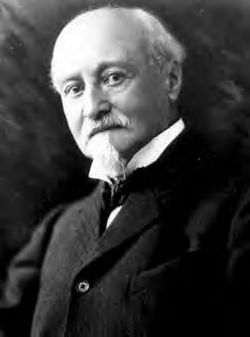
Octave Chanute
French-American civil engineerWikipedia
22
MENTIONS
5
EPISODES
5
PODCASTS
Search complete. 22 mentions across 5 episodes found for "Octave Chanute".
Sep 25, 2026

Maria CasperNARRATOR
We then discussed the subject of gliders for some time, and I finally decided that the thing to do was to build a glider at the factory and to take advantage of the very abrupt and convenient hills at Hammondsport to try it out.
Maria CasperNARRATOR
We therefore built a double-surface glider of the Chanute type.
Maria CasperNARRATOR
As almost every schoolboy knows, in this day of advanced information on aviation, a glider is, roughly speaking, an aeroplane without a motor.
Maria CasperNARRATOR
Usually it has the same surfaces as a modern aeroplane, and it may be made to support a passenger by launching it from the top of a hill in order to give it sufficient impetus to sustain its own weight and that of a rider.

Bill NicksGUEST
Yeah, and I do tours here in Kansas City in character.
Bill NicksGUEST
One of my characters is Octave Chanute, who designed and built the first railroad bridge over the Missouri River, the Hannibal Bridge.
Bill NicksGUEST
Right by the Buck O'Neill Bridge.
Bill NicksGUEST
Okay.
Bill NicksGUEST
That's why the stockyard's located here because then the buyers from back east could come to the ranchers in the west and meet up and cook their deals.
Bill NicksGUEST
And so the bridge was important.
Bill NicksGUEST
And when I do my Kansas City tour, I do it as Octave Chanute.
Bill NicksGUEST
And, of course, in all humility, he says, welcome to my town because he built the piece of infrastructure that caused Kansas City to be the big city.

Will ReitzHOST
They wanted to use physics to create lift on wings so that a pilot could go fast and have control, similar to how an automobile works.
Will ReitzHOST
This is Octave Chanute.
Will ReitzHOST
He was one such engineer who was trying to achieve flight.
Will ReitzHOST
Earlier in his career, he encouraged four small southeast Kansas towns, New Chicago, Chicago Junction, Alliance, and Tioga.

HeatherHOST
And he was the guy that was able to figure out how to build the engine that nobody else could figure out how to build to get that plane in the air.
HeatherHOST
Or there was also a man by the name of Octave Chanute, who was a scientist, had worked in aviation, and he took the Wright brothers under his wing and he mentored them.
HeatherHOST
He shared all of his research and findings and data.
HeatherHOST
He became the shoulders on which the Wright brothers stood and also shared his network.

speaker_3NARRATOR
places.
speaker_3NARRATOR
after considering the practical effect of the dihedral principle we reached the conclusion that a flyer founded upon it might be of interest from a scientific point of view but could be of no value in a practical way we therefore resolved to try a fundamentally different principle we would arrange the machine so that it would not tend to right itself we would make it as inert as possible to the effects of change of direction or speed and thus reduce the effects of wind gusts to a minimum we would do this in the fore and aft stability by giving the aeroplanes a peculiar shape and in the lateral balance by arching the surfaces from tip to tip just the reverse of what our predecessors had done then by some suitable contrivance actuated by the operator forces should be brought into play to regulate the balance lillienthal and chanute had guided and balanced their machines by shifting the weight of the operator's body but this method seemed to us incapable of expansion to meet large conditions because the weight to be moved and the distance of possible motion were limited while the disturbing forces steadily increased both with wing area and with wind velocity in order to meet the needs of large machines we wished to employ some system whereby the operator could vary at will the inclination of different parts of the wings and thus obtain from the wind forces to restore the balance which the wind itself had disturbed this could easily be done by using wings capable of being warped and by supplementary adjustable surfaces in the shape of rudders as the forces obtainable for control would necessarily increase in the same ratio as the disturbing forces the method seemed capable of expansion to an almost unlimited extent A happy device was discovered whereby the apparently rigid system of superposed surfaces, invented by Wenham and improved by Stringfellow and Chanute, could be warped in a most unexpected way, so that the aeroplanes could be presented on the right and left sides at different angles to the wind.
speaker_3NARRATOR
This, with an adjustable horizontal front rudder, formed the main feature of our first glider.
speaker_3NARRATOR
the period from eighteen eighty five to nineteen hundred was one of unexampled activity in aeronautics and for a time there was high hope that the age of flying was at hand but maxim after spending one hundred thousand dollars abandoned the work the ader machine built at the expense of the french government was a failure lilienthal and pilcher were killed in experiments and chanute and many others from one cause or another had relaxed their efforts though it subsequently became known that professor langley was still secretly at work on a machine for the united states government the public discouraged by the failures and tragedies just witnessed considered flight beyond the reach of man and classed its adherents with the inventors of perpetual motion we began our active experiments at the close of this period in october nineteen hundred at kitty hawk north carolina our machine was designed to be flown as a kite with a man on board in winds from fifteen to twenty miles an hour but upon trial it was found that much stronger winds were required to lift it suitable winds not being plentiful we found it necessary in order to test the new balancing system to fly the machine as a kite without a man on board operating the levers through cords from the ground this did not give the practice anticipated but it inspired confidence in the new system of balance in the summer of nineteen o one we became personally acquainted with mr when he learned that we were interested in flying as a sport and not with any expectation of recovering the money we were expending on it he gave us much encouragement at our invitation he spent several weeks with us at our camp at kill devil hill four miles south of kitty hawk during our experiments of that and the two succeeding years he also witnessed one flight of the power machine near dayton ohio in october the machine of nineteen o one was built with the shape of surface used by lilienthal curved from front to rear like the segment of a parabola with a curvature one twelfth the depth of its chord but to make doubly sure that it would have sufficient lifting capacity when flown as a kite in fifteen or twenty mile winds we increased the area from hundred sixty five square feet used in nineteen hundred to three hundred and eight square feet a size much larger than lilienthal pilcher or janoot had deemed safe Upon trial, however, the lifting capacity again fell very far short of calculation, so that the idea of securing practice while flying as a kite had to be abandoned.
speaker_3NARRATOR
Mr. Chanute, who witnessed the experiments, told us that the trouble was not due to poor construction of the machine.
speaker_3NARRATOR
We saw only one other explanation, that the tables of air pressures in general use were incorrect.
speaker_3NARRATOR
We then turned to gliding, coasting downhill on the air, as the only method of getting the desired practice in balancing a machine.
speaker_3NARRATOR
after a few minutes practice we were able to make glides of over three hundred feet and in a few days were safely operating in twenty seven mile winds in these experiments we met with several unexpected phenomena we found that contrary to the teachings of the books the centre of pressure on a curved surface travelled backward when the surface was inclined at small angles more and more edgewise to the wind we also discovered that in free flight when the wing on one side of the machine was presented to the wind at a greater angle than the one on the other side the wing with the greater angle descended and the machine turned in the direction just the reverse of what we were led to expect when flying the machine as a kite the larger angle gave more resistance to forward motion and reduced the speed of the wing on that side the decrease in speed more than counterbalanced the effect of the larger angle the addition of a fixed vertical vane in the rear increased the trouble and made the machine absolutely dangerous it was some time before a remedy was discovered this consisted of movable rudders working in conjunction with the twisting of the wings the details of this arrangement are given in specifications published several years ago The experiments of 1901 were far from encouraging.