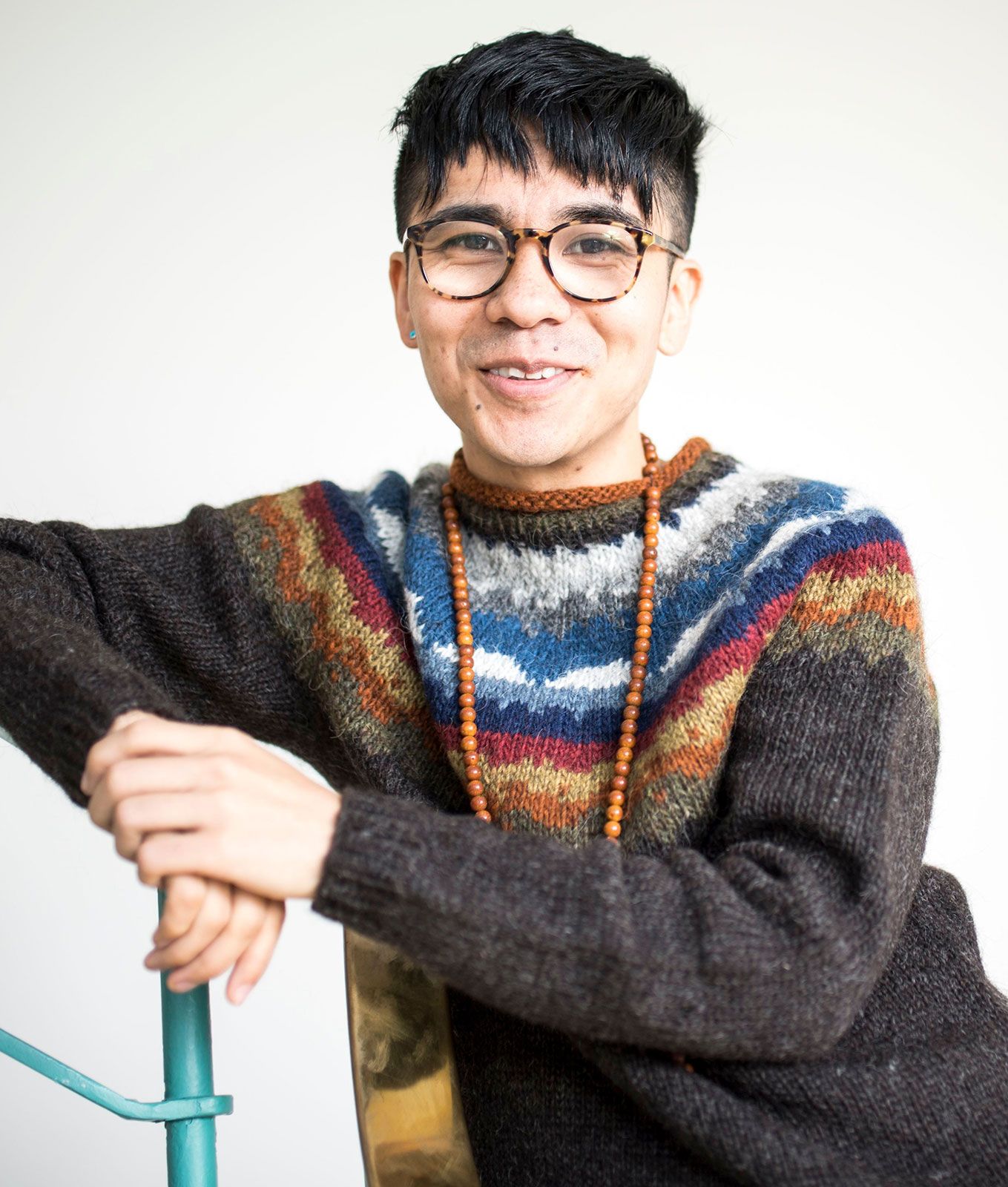
Ocean Vuong
American poet and essayist
17
APPEARANCES
12
PODCASTS
Aug 28, 2026


Sharif ShanahanGUEST
I hope that you enjoy today's offering, brought to you by the Academy of American Poets.
Ocean VuongGUEST
I set out in the blue American night, the stupid sparkler raised in my fist, electroshocked dandelion.

speaker_2MODERATOR
Why did you decide not to change her name?

Ocean VuongGUEST
She lived in Richmond Hill, uh, which at the time after World War II was a Lithuanian community.
11 MINS LATER


Ocean VuongGUEST
But it seems like around post-World War II America, arising at the same time as the upper middle class experiment of institutionalizing creative writing in the MFA program, I say this as an MFA teacher myself, um, you kind of create...
29 MINS LATER


Ocean VuongGUEST
Yeah, it's ha- it's, it's a challenge, um, as an artist, 'cause for me, it's important for me to tellOf my experience- Mm-hmm ... of my mother.
Chase MeltonGUEST
Could you tell us about that night and maybe just what it was like to experience this mother-son relationship, particularly so tied with your work as well?


Ocean VuongGUEST
Well, uh, it starts with a young man who's standing on the edge of a bridge contemplating jumping, and he's stopped by an 82-year-old woman with dementia, and they end up living together, um, in the course of a year.
6 MINS LATER
speaker_5SOUNDBITE_SPEAKER
[laughs]


Rachel MartinHOST
It's his first since the death of his mother from cancer in twenty nineteen, and that's where we started our conversation, that most universal kind of loss that is so different for each of us.
Ocean VuongGUEST
Um, you know, the, the, the worst moment for me came actually two years after she was gone, and w-- I realized what many people have already realized was grief is not linear.
Ocean VuongGUEST
I was so smug in my, in my healing that I thought, you know, two years gone, I, I can-- I'm teaching again.
Ocean VuongGUEST
And then one day I woke up in the middle of the night, two in the morning, and I thought, "Oh God, I gotta tell my mom this thing." I had this brilliant idea I wanna tell her, and I get out of bed.
Ocean VuongGUEST
The first flag I ever saw in my life was a Puerto Rican flag, hung, uh, o- on a dash with a, a pair of boxing gloves.
Ocean VuongGUEST
[chuckles] Um, and, you know, so you-- I would, I would grow up hearing, um, Spanish, and it was...
Ocean VuongGUEST
I was surrounded by Haitian Creole, Jamaican, and to me, that was the bedrock of my imagination as, um, as an immigrant.
Ocean VuongGUEST
And so I wanted to capture this because I think when I look up, like, stories about Connecticut, you would, of course, hear about Mark Twain, Wallace Stevens, and but they were different Connecticuts.
Ocean VuongGUEST
And I think a fictional place is a wonderful conduit because it is, um, stained with history, but still holding the potentials of something else, which is why I, I love fiction because, in a way, it's a, it's a suggestion of an otherness that perhaps we can still move forward towards.


Ocean VuongGUEST
At the end of my semester, in every class, I have my students do something very simple, and I do it as well.
Ocean VuongGUEST
Why are you here? Why did you sacrifice so much?" And I tell them, "Go back to that person that first found this art, the person who read a poem and said, [gasp] just like Emily Dickinson said, 'My head is taken off,' right? And then decided that they wanna do that for other people.
17 MINS LATER

Alison StewartHOST
Would you read a bit from your book for us? I think this section sets up sort of where Hai is in his life when we meet him.
Ocean VuongGUEST
He was born in Vietnam 14 years after the big war everyone loved talking about but no one understood, least of all himself."The year was 1989, a year best known for the fall of the Berlin Wall and the Tiananmen Square protest.
Ocean VuongGUEST
George Bush Sr. had defeated Michael Dukakis to be the 41st president, and My Prerogative by Bobby Brown was at the top of the charts.
Ocean VuongGUEST
It was a time of the floppy disk, denim jackets, leg warmers, Cool Ranch Doritos, and pasta salad.
Alison StewartHOST
"... where we would go to school." And I found that to be interesting, and I, and I kind of heard that a little bit in what your answer was.
Ocean VuongGUEST
I think for so many folks who are on the margins of society, there is so much inherent shame about where we should belong and where we should have access to, and so when she offers a place to stay for him, he almost thinks he mishears her, and, and that part of that is internalized shame.
Ocean VuongGUEST
Why would a stranger let me have a place to live and stay? And I think what I'm interested in this book is the things that we owe each other even when society tells us we're not supposed to.
Ocean VuongGUEST
In, in many places, we're supposed to just owe things to our family and friends, but I do believe a community is an extension of a kind of web, webbed kinship, and in this sense, she realized he's at the end of his rope, and he quickly realizes that he could be more useful to her than he was ever useful to himself.
Ocean VuongGUEST
And perhaps instead of a grand arc of finding reason to live, it's actually realizing the minute mundane actions, that we are actually much more helpful to someone next to us, and maybe that is an accretion of the will to live rather than a big central thesis that we s- so hunger for in this culture.
Alison StewartHOST
Would you read a bit from your book from us? I think this section sets up sort of where Hai is in his life when we meet him.

Ocean VuongGUEST
... of process, um, she inspires me to no end, and it's a, it's a, it's a great honor to just h- have her be aware of my work.
Ocean VuongGUEST
Um, but, you know, fast food particularly is interesting, having worked in it, written about it.
Ocean VuongGUEST
It's a kind of sinister beauty that industrialization in America has, um, achieved, to, to do something so fine-tuned-...to chemically induce a product, like a McDonald's french fry, so that it can be replicated without break, consistently, through time, against all odds, even against, bio-degradation.

Bella FreudHOST
And you mentioned about style being closer to desire, and I wondered if you had a style icon.


Ocean VuongGUEST
It's transformed, and when you're using language, you know, it, it's, you can create it, use it to, to divide people and build walls, or you can turn it into something where we can see each other more clearly as a bridge.
Ocean VuongGUEST
And that that notion that you are a participant in the future of language is something I think our American education failed us.
Ocean VuongGUEST
Language is always changing, and I think it's the poets, the writers, and even the youth, they're, they're using language to cast new meaning in the same way Chaucer just winged English spelling.
Ocean VuongGUEST
The Colt gun factory was in Hartford, and it sold weapons to both sides during the Civil War.


Tonya MosleyHOST
Can I have you read an excerpt from the book that really describes this setting?
Ocean VuongGUEST
It's a town where high school kids, having nowhere to go on Friday nights, park their stepfather's trucks in the unlit edges of the Walmart parking lot, drinking Smirnoff out of Poland Spring bottles and blasting Weezer and Lil Wayne, until they look down one night to find a baby in their arms and realize they're 30-something, and the Walmart hasn't changed except for its logo, brighter now, lending a bluish glow to their time-gaunt faces.
Ocean VuongGUEST
It's where fathers in blue jeans flecked with wood stain stand at the edges of football fields, watching their sons steam in the reddened dawn, one hand in their pocket, the other gripping a cup of Dunkin' Donuts.
Ocean VuongGUEST
They could be statues for what it means to wait for a boy to crush himself into manhood.
Ocean VuongGUEST
And each morning, you'd sit on the frost-dusted bleachers, a worn copy of To The Lighthouse on your lap, and watch the players on the field, blue tomahawks shivering on their jerseys, their plastic pads crackling in the mist.
Ocean VuongGUEST
And when you turn the page, it would slip right off the binding, flutter through the field, gathering inky blotches through the wet grass until it tangles between the boys' legs and disintegrates under a pair of black cleats, the words gone to ground.
11 MINS LATER
Tonya MosleyHOST
Can I have you read an excerpt from the book that really describes this setting?
Ocean VuongGUEST
It's a town where high school kids, having nowhere to go on Friday nights, park their stepfather's trucks in the unlit edges of the Walmart parking lot, drinking Smirnoff out of Poland Spring bottles and blasting Weezer and Lil Wayne, until they look down one night to find a baby in their arms and realize they're 30-something, and the Walmart hasn't changed except for its logo, brighter now, lending a bluish glow to their time-gaunt faces.
Ocean VuongGUEST
It's where fathers in blue jeans flecked with wood stains stand at the edges of football fields, watching their sons steam in the reddened dawn, one hand in their pocket, the other gripping a cup of Dunkin' Donuts.
Ocean VuongGUEST
They could be statues for what it means to wait for a boy to crush himself into manhood.
Ocean VuongGUEST
And each morning, you'd sit on the frost-dusted bleachers, a worn copy of To The Lighthouse on your lap, and watch the players on the field, blue tomahawks shivering on their jerseys, their plastic pads crackling in the mist.
Ocean VuongGUEST
And when you turn the page, it would slip right off the binding, flutter through the field, gathering inky blotches through the wet grass until it tangles between the boys' legs and disintegrates under a pair of black cleats, the words gone to ground.
20 MINS LATER

Ocean VuongGUEST
(laughs) It's like impossible, right? A lot of th- this country is founded on the nuclear family and one alternative to that, you can say, is the found family, chosen family.
Ocean VuongGUEST
But there's a huge sector I think I wanted to tap into which is the circumstantial family, the family at work, the family cobbled arbitrarily together during a shift.
Ocean VuongGUEST
And there's an intimacy and bond and kinship there that actually corrodes ideology.

Jeffrey BrownCORRESPONDENT
But sometimes you bring it to the surface in, in different ways, right?
Ocean VuongGUEST
Yes, because I think we don't get to choose how we're, how we get a life, and we don't get to choose whether we're victims or not.
Ocean VuongGUEST
But I wanted to, you know, create that interface, because it's such a unique one.
Ocean VuongGUEST
The, the, the idea of, uh, this single mother refugee immigrant, who is absolutely traumatized by this American war brought forth by American foreign policy.
Ocean VuongGUEST
And so I, I always say that my Americanness, my citizenship began way before, uh, I ever arrived in this country.
Ocean VuongGUEST
My Americanness began when American bombs started to fall in Southern Vietnam, and that widens the scope of what America is and who gets to be American.
14 MINS LATER
Chase MeltonGUEST
It's very interesting to deal with that, like, latency period between, um, something that happened to you, which of cou- of course still continues, but then realizing that that has stuck with you and s- for such a long time without you really dealing with it or even allo- giving yourself the grace to process it.


37 MINS LATER