obsessive-compulsive personality disorder
DisorderWikipedia
173
MENTIONS
22
EPISODES
18
PODCASTS
Search complete. 173 mentions across 22 episodes found for "obsessive-compulsive personality disorder".
Nov 4, 2026

Mark RuffaloGUEST
Let the trait psychologists dimensionalize all of that.
Mark RuffaloGUEST
It makes complete sense that narcissism is on a continuum, that obsessionality is on a continuum when it comes to OCPD.
Mark RuffaloGUEST
But borderline and antisocial are really syndromes that can be validated.
Mark RuffaloGUEST
So that's sort of what I would list.

Lois Choi-KainGUEST
of the BPD patient.
Lois Choi-KainGUEST
And that line is super fine between, you know, sometimes I see people who diagnose avoidant and dependent together, and I'm like, why is that not borderline? But really, it is more on the level of functioning, in my opinion, because OCPD, for instance, is so common.
Lois Choi-KainGUEST
It's like 10%.
Lois Choi-KainGUEST
And that is because it's an adaptation that survives evolutionary selection because these people can buy their rigid perfectionism in a way that actually promotes their livelihood in the world for if they find the right niche for their obsessionality and their hyper-conjunctiousness, they can actually do good enough.
Lois Choi-KainGUEST
And I think there is a way that avoidance can find its own niche if it's not too disruptive.
Lois Choi-KainGUEST
But I think that is poorly boundary.
Lois Choi-KainGUEST
We don't have good studies that really delineate the dependent from the person who has borderline, nor do we have, you know, good endpoints to what classifies as OCPD or avoidance at a more severe level of personality functioning, which opens the door to this alternative model of personality disorder in Section 3 of the DSM that does pay attention to levels of personality functioning.
Lois Choi-KainGUEST
And I think that is an important point.

Jonathan MurphyHOST
Those types of patients that come to me and they're embarrassed about it are usually the ringers, the most textbook cases of inattentive hyperactive ADHD.
Jonathan MurphyHOST
And I'm getting into an ADHD storytelling loop now, but to go back to the OCPD, which I definitely don't have, ADHD loophole.
Jonathan MurphyHOST
Say that comorbidity is rare.
Jonathan MurphyHOST
I've seen it, whether it's a chicken or the egg situation, but it's about core pathology.
Jonathan MurphyHOST
Ego dystonic, I know that the things I'm thinking are bad versus ego syntonic.
Jonathan MurphyHOST
Oh, like this is like my brain's thinking about stuff and like that's normal.
Jonathan MurphyHOST
A lot of times OCPD can be that, but it can be worked out.
Jonathan MurphyHOST
OCPD is curable, but it's a very much a therapy.

Gary TrosclairHOST
That's very gratifying to me, but it also makes me concerned about all the people who may never feel understood and they have a hard time navigating their world.
Gary TrosclairHOST
Many people who are driven, perfectionistic, type A, obsessive-compulsive, and OCPD find themselves out of step with the world, misunderstood and frustrated by its foolishness, sloppiness, and carelessness.
Gary TrosclairHOST
If this is you, you may have a different mindset than most people.
Gary TrosclairHOST
To you, there's always something wrong and you've got to fix it.
Gary TrosclairHOST
But I'm getting ahead of myself.
Gary TrosclairHOST
Let's define our terms.
Gary TrosclairHOST
The medical name for the most serious example of the condition I'm referring to is obsessive-compulsive personality disorder, also known as OCPD.
Gary TrosclairHOST
Note, this is not OCD.

Mark RuffaloGUEST
List those on axis one and let the trait psychologists dimensionalize everything else.
Mark RuffaloGUEST
Narcissisms on a dimension, OCPD, obsessionalities on a dimension, but borderline and antisocial are syndromes.
Mark RuffaloGUEST
Retain those.
FuHOST
These are so far all on the same level, the top level of the diagnostic hierarchy.
Greg HillHOST
I don't know if I might be headed towards some kind of, uh, fibromyalgia or some sort of a lung d- what, what's the one that the old people get? The lung disease?
Jermaine WigginsHOST
OCPD, right?
Greg HillHOST
Yes.
Greg HillHOST
[laughs] That could probably be coming.

Greg HillHOST
Um, I don't know if I might be headed towards some kind of, uh, fibromyalgia or some sort of a lung d- what, what's the one that the old people get? The lung disease?
Jermaine WigginsHOST
OCPD?
Courtney CoxHOST
Right.
Greg HillHOST
Yes.

Bonnie EastHOST
And it's CBT Skills to Overcome Rigidity, Allow Imperfection, and Improve Your Relationships.
Bonnie EastHOST
So we learned a lot about OCPD.
Bonnie EastHOST
Yes.
Bonnie EastHOST
And then one of the things I think we both really admired about the book, well, there's so much to admire, but there's this one sort of chapter on what do you value or what you value.
Bonnie EastHOST
And of course, the slant is what do you value and is that at odds with behavior that is OCPD driven? And just for anyone who didn't listen last week, OCPD is very different from OCD.
Bonnie EastHOST
They're two completely different diagnoses.
Bonnie EastHOST
You know, they're not the same.
Bonnie EastHOST
And

Sarah MirelesGUEST
So I'll just kind of preface that RODBT is really designed, it wasn't designed specifically for neurodivergent individuals, but it tends to help a lot with neurodivergent individuals.
Sarah MirelesGUEST
So it works, it can be really, really helpful for folks on the autism spectrum and especially folks with personality characteristics of OCPD, obsessive compulsive personality disorder.
Sarah MirelesGUEST
And so it's, and anxiety too, because there tends to be a theme or a pattern where some individuals, in order to feel safe, we tend to want to feel like we have more predictability and control over a situation or an outcome, because it's really, really uncomfortable to have that uncertainty or not knowing what's happening, especially if something bad could happen.
Sarah MirelesGUEST
So like in social situations or trying a new skill, learning how to cook for the first time, for example, there might be a little bit more rigidity or being closed off to putting ourself out there or trying something new because we don't want to experience that, you know, feeling out of control or something going wrong or feeling embarrassed or shame.
21 MINS LATER
Sarah MirelesGUEST
But also, if you want to learn more, too, about those diagnosis or even OC PD, you can visit my website.
Sarah MirelesGUEST
It is Sarah Mireles therapy dot com.
Sarah MirelesGUEST
I have a specific page for OCPD.
Sarah MirelesGUEST
You can also find RODBT therapists on radicallyopen.net. And then also if you're interested in learning, if you're a parent and you're interested in learning more about how to help your neurodivergent teen or young adult, you can visit my other website or go through my main website, which is www.parentsofneurodiversteens.mykajabi.com. And then I'll also include the links with Michelle and Kate.

Ramani DurvasulaHOST
I'll talk about the difference between the two in a minute.
Ramani DurvasulaHOST
But obsessive compulsive personality disorder, and I'm going to call this OCPD because it's going to be a mouthful if I have to keep saying it, but OCPD.
Ramani DurvasulaHOST
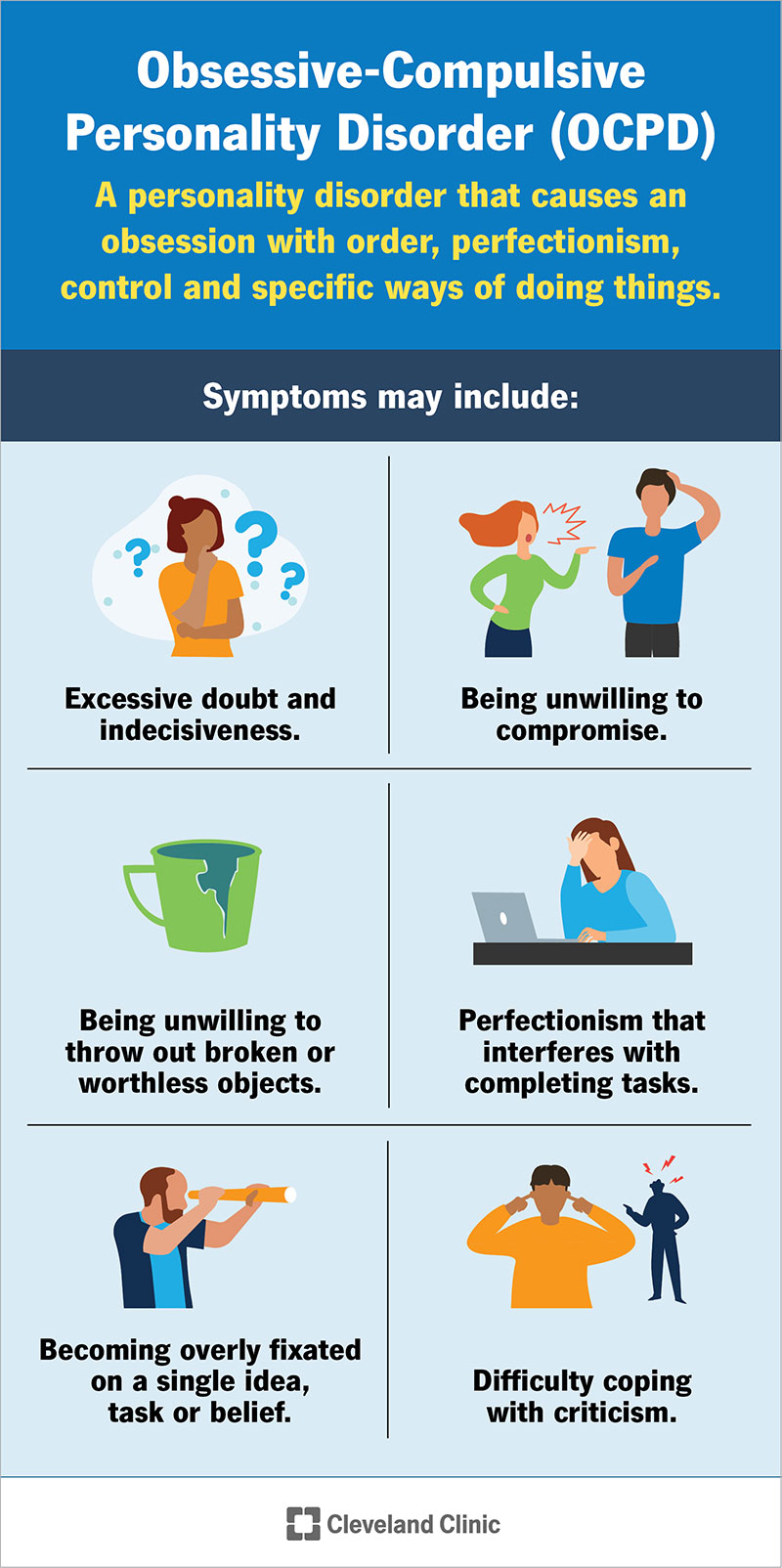
is characterized by this sort of sense of workaholism, workaholicism, rigid perfectionism, inflexibility, having a very narrow emotional expression, and having a lot of difficulty establishing close relationships and maintaining those close relationships, a lot of it because of this rigidity and sort of this need to garner all of their identity through work.
Ramani DurvasulaHOST
So there's a preoccupation with being orderly, with perfectionism, with always being in control, mental control, relationship control.
Ramani DurvasulaHOST
It's really dumb that this is what they named this disorder.
Ramani DurvasulaHOST
It's a very foolishly named disorder, but we're sort of stuck with it.
Ramani DurvasulaHOST
So when we look at this diagnostically, the kinds of patterns we see in somebody with OCPD is that they get really over-focused on rules and details and schedules and organizations so much so that they almost lose the point of the activity.
Ramani DurvasulaHOST
Like they'll be planning a birthday party and they'll have this big binder that's all about the birthday party and they'll get upset that something's not color-coded right and they lose track of the whole idea that this was supposed to be a joyous birthday party.
12 more episodes mention obsessive-compulsive personality disorder.
Create an account to see the whole feed, search across every transcript, and follow the entities you care about.