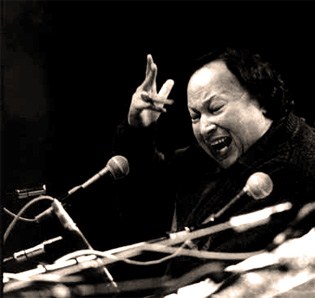
Nusrat Fateh Ali Khan
Pakistani singer and songwriterWikipedia
15
MENTIONS
12
EPISODES
12
PODCASTS
Search complete. 15 mentions across 12 episodes found for "Nusrat Fateh Ali Khan".
Oct 7, 2026

speaker_4ADVERTISER
decades yeah yeah okay he's
HinaHOST
so goaded but like there's a difference in their voice so like Rahat has a little bit more of a high pitch tone and his son has like a very low pitch kind of like Nusrat Fateh Ali Khan cool so a lot of people are saying that he's gonna be like you cannot be the goat like you can't be Nusrat Fateh Ali Khan but like they're like he sounds so similar to him yeah And oh my God, you guys, goosebumps.
HinaHOST
Goosebumps.
HinaHOST
Okay.

Shashaa TirupatiGUEST
So, uh, daddy, what he would do is he'd bring like, he had the biggest thing.
Shashaa TirupatiGUEST
stash of cds and audio cassettes so we would have we would have everybody from Nusrat sahab to you go back Suraiya ma'am, Noor Jahan ma'am, Lata ji, Asha Chai and all the way up to like he would he would actually have VHS recordings of old black and white performances like not just the movies but performances of Rafi sahab singing and recording live and Naushad sahab and all of that so There was Pakistani music, a lot of that in my house.
Shashaa TirupatiGUEST
So we grew up in that vicinity.
Shashaa TirupatiGUEST
So how can you not be influenced by it is my point.

SimonHOST
Cinematographer Roger Deakins enhances the film's emotional impact with his use of colour and texture, creating a visually arresting experience.
SimonHOST
The soundtrack, featuring contributions from Nusrat Fateh Ali Khan and Bruce Springsteen, adds a hauntingly spiritual dimension to the film.
SimonHOST
Dead Man Walking is a thought-provoking drama that challenges viewers to consider the complexities of justice and humanity.
SimonHOST
It is a film that resonates long after the credits roll, prompting reflection on the nature of forgiveness and the possibility of redemption.

Tom WrightGUEST
And this is analogous to the whole book.
Tom WrightGUEST
Just to get a taste of what it's like to read an Ayad Akhtar books, in the space of 10 pages, you can go from everything from Nusrat Fateh Ali Khan to Kafka.
Tom WrightGUEST
You can go from the Teletubbies to Rilke.
Tom WrightGUEST
He is constantly moving because this is a mind that is fascinated by ideas and by ideas of the spirit, by ideas of politics, of culture.

Zeth LundyHOST
It's largely instrumental, though there are voices in here.
Zeth LundyHOST
Jeff Buckley's Elvis, Nusrat Fateh, Ali Khan is on this.
Zeth LundyHOST
Yuson Dor is on this, the Senegalese singer who you know from Peter Gabriel's In Your Eyes.
Zeth LundyHOST
Baba Mal is on this.
Zeth LundyHOST
And so this is where a lot of people heard You So Endure.
Zeth LundyHOST
Well, they heard You So Endure first, I guess, on In Your Eyes.
Zeth LundyHOST
But, you know, a lot of people probably didn't, people who weren't Jeff Buckley didn't know about Nusrat Fateh Ali Khan.
Zeth LundyHOST
before this record came out.

Tess CallahanHOST
Mm hmm.
Ayad AkhtarGUEST
The book has this episode, this scene in which, late in the book, the narrator recounts meeting the great Sufi singer Nusrat Fateh Ali Khan when he was a much younger man, which I did encounter him as a younger man in Italy, and a discourse around what Nusrat Fateh Ali Khan is talking about when he gets into a state where the music is carrying him to something he gets very close to, gets so close that when it's over, There's this extraordinary sadness, this bereftness.
Tess CallahanHOST
Yeah.
Ayad AkhtarGUEST
And that that bereftness is something that he says, you know, he would he used to say in his father actually talked quite about quite a bit about this is it's a necessary condition.

Tess CallahanHOST
Mm hmm.
Ayad AkhtarGUEST
The book has this episode, this scene in which, late in the book, the narrator recounts meeting the great Sufi singer Nusrat Fateh Ali Khan when he was a much younger man, which I did encounter him as a younger man in Italy, and a discourse around what Nusrat Fateh Ali Khan is talking about when he gets into a state where the music is carrying him to something he gets very close to, gets so close that when it's over, there's this extraordinary sadness, this bereftness.
Tess CallahanHOST
Yeah.
Ayad AkhtarGUEST
And that, that bereftness is something that he says, you know, he would, he used to say in his father actually talked quite about it quite a bit about this is it's a necessary condition.

speaker_0NARRATOR
That idea, that the smallest changes within a strict musical grammar can alter the emotional world of a piece, seems to me exactly the sort of problem Coltrane would have wanted to spend years exploring.
speaker_0NARRATOR
As long as we are engaging in wishes, another one is Coltrane playing with Nusrat Fateh Ali Khan.
speaker_0NARRATOR
I think the obsessive quality of recitation and repetition in Nusrat's Qawwali, the long improvisations, the slow building crescendos and the eventual arrival at something close to ecstasy would have appealed enormously to Coltrane.
speaker_0NARRATOR
In fact, I feel he was searching for something like that sound in a Love Supreme and the quest becomes a little clearer in the recently discovered Seattle recordings.
speaker_0NARRATOR
There is something in the repeated invocation of the phrase itself and in the turbulence of resolution and pursuance that feels as though he is trying to reach a state beyond improvisation, where repetition and intensity become a form of spiritual transport.
speaker_0NARRATOR
He finds some resolution in Psalm, but I think exposure to the Jalandhar-Faisalabad-Kawali tradition, where a phrase can be repeated, worried at, teased and intensified until it becomes almost incantatory, might have nudged him further along that journey, to find it in his own way.
speaker_0NARRATOR
That would have been an incredible collaboration.
speaker_0NARRATOR
We lost Nusrat too young and I don't know if he ever heard Coltrane but I would have loved to hear what the two of them might have found in each other's music.

Wajahat AliGUEST
I sometimes just go for the old classical Beethoven and Mozart.
Wajahat AliGUEST
You put in some for Nusrat Fateh Ali Khan.
Wajahat AliGUEST
So it's like, for me, that's a nice mix.
Wajahat AliGUEST
I just go and then, and then old, you know, it's really one of the first albums, the first two albums I ever bought.

SujoyHOST
Like, she's got such a sharp vocal.
SujoyHOST
Um, and then there is a Kaise Mukhde Pe, like the Nusrat Fateh Ali Khan Qawwali version of that here sung as a, a, a, as a mujra number by [laughs] Asha Bhosle, which, uh, comes out of nowhere.
Asim BerniHOST
[laughs]
SujoyHOST
Yeah, go on.
2 more episodes mention Nusrat Fateh Ali Khan.
Create an account to see the whole feed, search across every transcript, and follow the entities you care about.