Number needed to treat
21
MENTIONS
7
EPISODES
6
PODCASTS
Search complete. 21 mentions across 7 episodes found for "Number needed to treat".
Sep 14, 2026

Forrest HansonHOST
So here's what I mean by that.
Forrest HansonHOST
If you look at number needed to treat for all of these different interventions, what you typically find for them is that the NNT is around four or five or six or seven.
Forrest HansonHOST
So what that means is that relative to placebo, which is a huge topic here that we haven't dug into yet, but I'm hoping to, each of these interventions, something like Cymbalta, which is an SNRI, it's sometimes prescribed for depression and anxiety disorder, but it's also prescribed for chronic pain, uh, including chronic musculoskeletal pain, fibromyalgia, all of that.
Forrest HansonHOST
About four in 10 people on this ne- uh, hit 50% pain relief.
Forrest HansonHOST
Big problem, one in six people also stop taking the drug because it gives them stomach distress that is so intense that they don't want to be on it anymore.
Forrest HansonHOST
So this is not great for the medication side of the spectrum.
Forrest HansonHOST
Problem is that for, like, CBT for chronic pain, as near as I can tell, NNT is about one in four.
Forrest HansonHOST
So it's better, but it's not great, and a lot of those effects tend to go away over time.

John MandrolaHOST
The thesis was that the diagnosis of anatomic disease led to more statin use.
John MandrolaHOST
But when you look at Scott Hart, the delta in statin use was really small, and if it was due to statins, you'd have to posit an NNT of about 3 for the statins, which is hugely higher than what we know statins do.
John MandrolaHOST
So if you can explain why Scott Hart showed that CTCA was an event reducer, But CTCA in a higher risk group of patients in this trial did nothing.
John MandrolaHOST
I'm all ears.

Simon ThornleyGUEST
And of course, these medicines like Wegovy and Ozempic are given all sorts of statistics to justify their use, and often you'll see relative benefits such as a nineteen percent benefit in terms of all-cause mortality or a zero point four four percent absolute risk reduction, not of-- uh, not so often used.
Simon ThornleyGUEST
Um, that translates to an NNT of about two hundred and twenty-five patients treated for four years to prevent one death.
Simon ThornleyGUEST
And it, it's a lot of treatment, but it sounds okay compared to playing lotto.
Simon ThornleyGUEST
Um, but, uh, what I've come across is that actually the area between these two curves is the average survival difference, and that actually works out to be a week for four years treatment, which is fairly modest.

speaker_1HOST
The absolute risk reduction, the actual difference between 6.8% and 0.7% is 6.1 percentage points.
speaker_1HOST
So walk us through the number needed to treat the NNT.
speaker_2HOST
Right.
speaker_2HOST
The number needed to treat is the most practical metric for a bedside clinician.
speaker_2HOST
It tells you exactly how much effort you have to expend to get one positive result.
speaker_2HOST
You just take 100 and divide it by the absolute risk reduction of 6.1.
speaker_1HOST
which gives us an NNT of roughly 16.
speaker_2HOST
Correct.
speaker_1HOST
It is.
speaker_1HOST
So we naturally wanna look at the number needed to treat, or NNT.
speaker_2HOST
The clinical bottom line.
speaker_1HOST
Right.
speaker_1HOST
The data tells us you would need to use a Macintosh-style video laryngoscope on roughly 21.5 patients to achieve one additional first-pass success compared to just using a direct laryngoscope.
speaker_1HOST
Okay.
speaker_1HOST
For the hyperangulated blade, that NNT drops down to about 10.7.
speaker_2HOST
Which honestly, in the realm of clinical trials, an NNT of roughly eleven to prevent a procedural failure is quite impressive.

Andrew BiltHOST
It just truly is what it is, and you have to be able to understand that in order to have a conversation with your patients and have a shared decision-making conversation.
Andrew BiltHOST
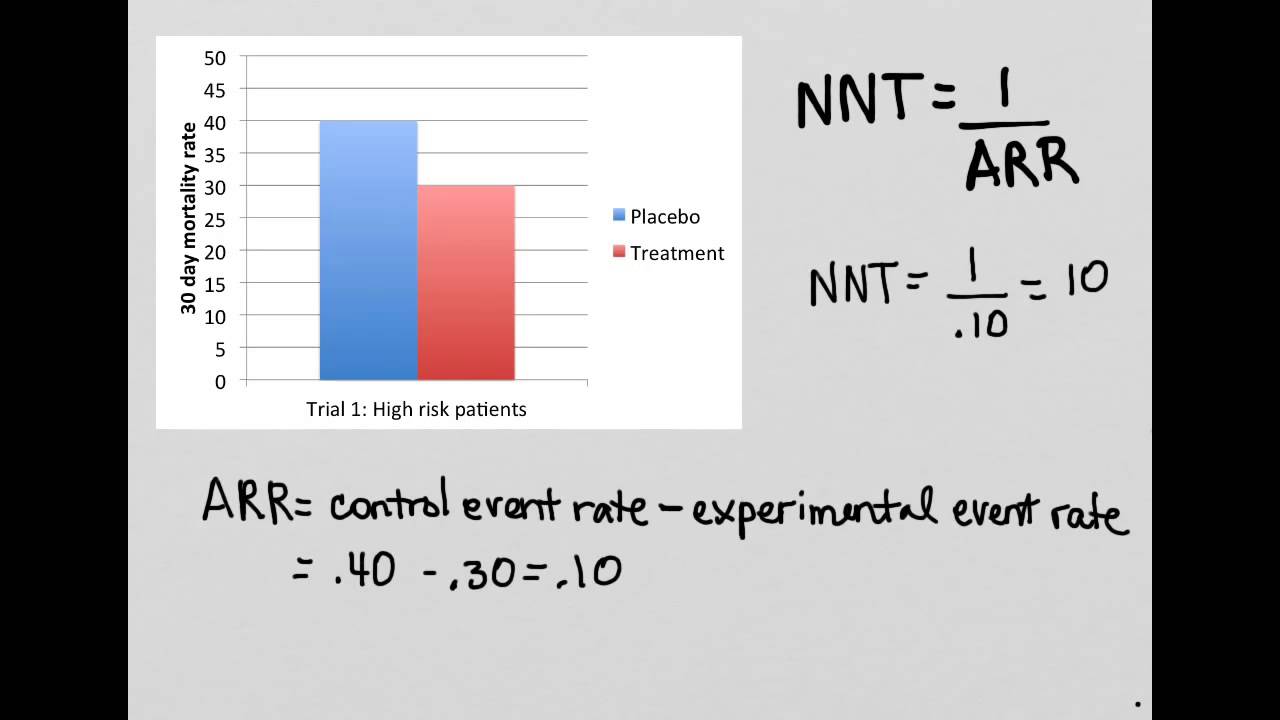
In order to calculate the a- NNT, you need to know the absolute difference.
Andrew BiltHOST
The absolute difference is just subtracting the two numbers.
Andrew BiltHOST
So let's do some practice.
12 MINS LATER
speaker_1UNKNOWN
Relative risk can sound amazing even when the benefit's small.
speaker_1UNKNOWN
Read the article.
speaker_1UNKNOWN
Calculate the NNT because shared decision-making means giving patients numbers they can see.
speaker_1UNKNOWN
Who was studied? Inclusion and exclusion.