Nuclear fuel
6
MENTIONS
3
EPISODES
3
PODCASTS
Search complete. 6 mentions across 3 episodes found for "Nuclear fuel".
Sep 10, 2026

Daven HiskeyHOST
Thankfully however, or unfortunately depending on your perspective, U-235 is not the only fissile isotope.
Daven HiskeyHOST
In general, most isotopes heavier than Actinium with an odd number of neutrons are fissile, with the most common nuclear fuels other than U-235 being Plutonium-239, Plutonium-241, and Uranium-233.
Daven HiskeyHOST
Plutonium-239 and U-241 can be bred in a nuclear reactor by bombarding common U-238 with neutrons.
Daven HiskeyHOST
When U-238 absorbs a neutron, it becomes Neptunium-239, which then decays via beta emission into Plutonium-239.

John BatchelorHOST
The bombs have similar effects, but they're derived quite profoundly differently.
John BatchelorHOST
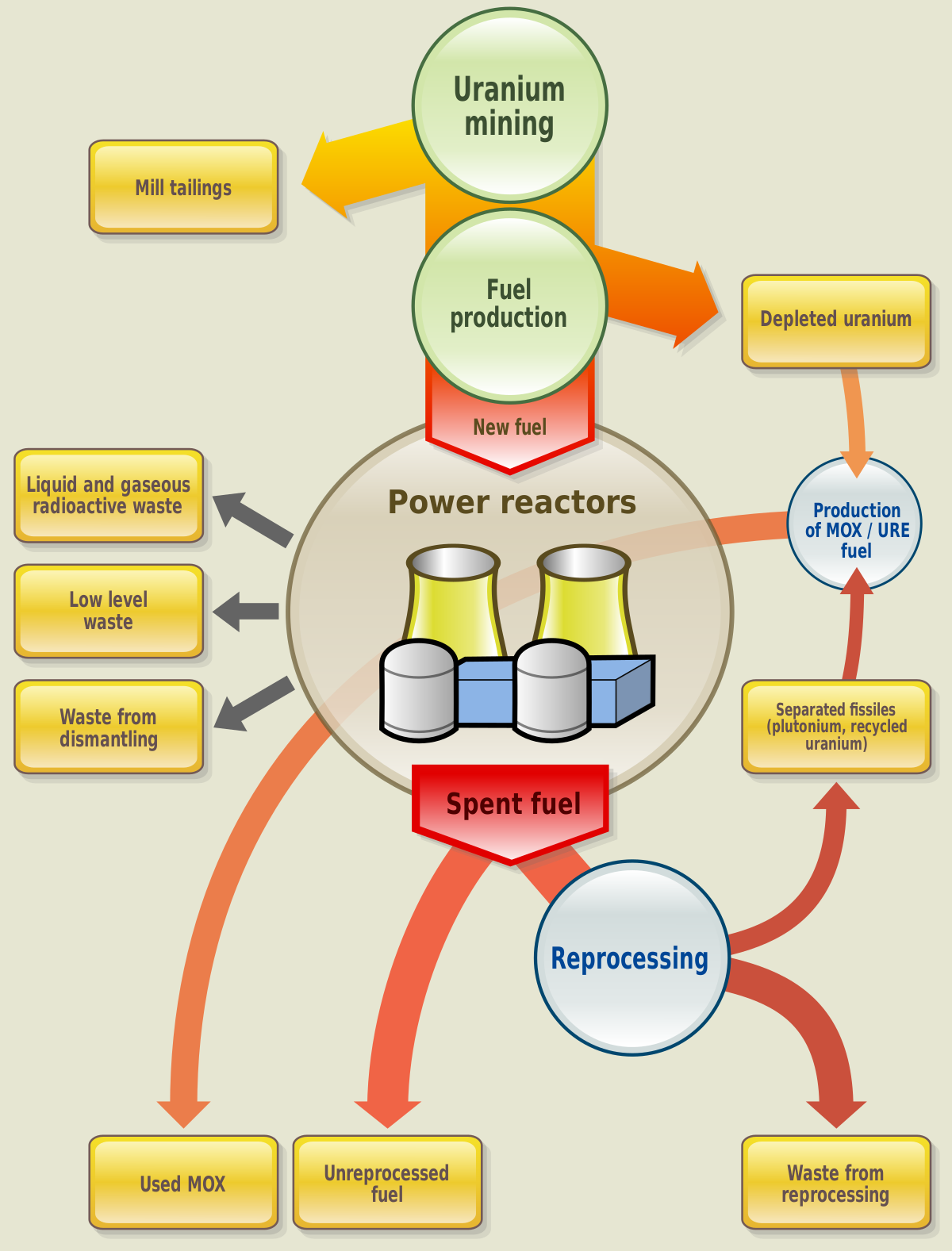
The enrichment process is part of the nuclear fuel cycle.
John BatchelorHOST
However, you stop enrichment at 3% for a reactor.
John BatchelorHOST
You take it to 90% for a bomb.

Joe CalnanHOST
country.Okay, fantastic, fantastic.
Joe CalnanHOST
Yeah, no, um, there's, uh, there's lots to unpack there, but I think, you know, uh, just to keep with this kind of, uh, the foreign policy and kinda like the Canada as that trusted partner, I think that, you know, it, it's important to note that, um, for the longest time Russia really dominated fuel, nuclear fuel supply chains, and that, that became kind of one of the, um, I, I think there was the, this whole Atoms for Peace program, uh, where it was trying to convert Russia's huge nuclear program, which was largely, like, focused on nuclear reactors, but also on nuclear weapons, uh, their whole Rosatom supply chain.
Joe CalnanHOST
Um, United States kind of gave up quite a bit of its own nuclear supply chains, handed over to Russia, uh, as a, I, I suppose, a little bit of an olive branch after the end of the Cold War, after, after 1991 and the collapse of the Soviet Union.
Joe CalnanHOST
Um, but, uh, th- this turned out to be a little bit, um, I, I, I don't wanna say it was, uh, naive at the time because it was really, like, a vote of confidence in this global system, but now with the Russian invasion of Ukraine, there's all these questions about Russia's dominance over these supply chains.
Joe CalnanHOST
But the, the nuclear energy strategy explicitly frames, uh, this pillar on the nuclear fus- fuel supply chain around geopolitics.
Joe CalnanHOST
So it's not only just this positive building relationships, but also providing an alternative to that, uh, that supply chain dominated by a, uh, sincere geopolitical adversary, especially to Europe.
Joe CalnanHOST
And, uh, this, uh, section explicitly says that, uh, and I quote, "Nuclear fuel supply chains are bifurcating with Western and Allied markets moving away from a hostile aggressor in favor of reliable actors," unquote.
Joe CalnanHOST
So, um, I, I guess we've, we've already really unpacked a lot of this, but, uh, just to, just to allow you to, to expand on it further, it, how do you see Canada really making this, uh, argument for be- for having that trust, uh, becoming the central supplier of nuclear fuel and fuel-related services for, um, for our allies and partners, and, you know, especially where it comes to the countries that are geopolitically aligned with us?