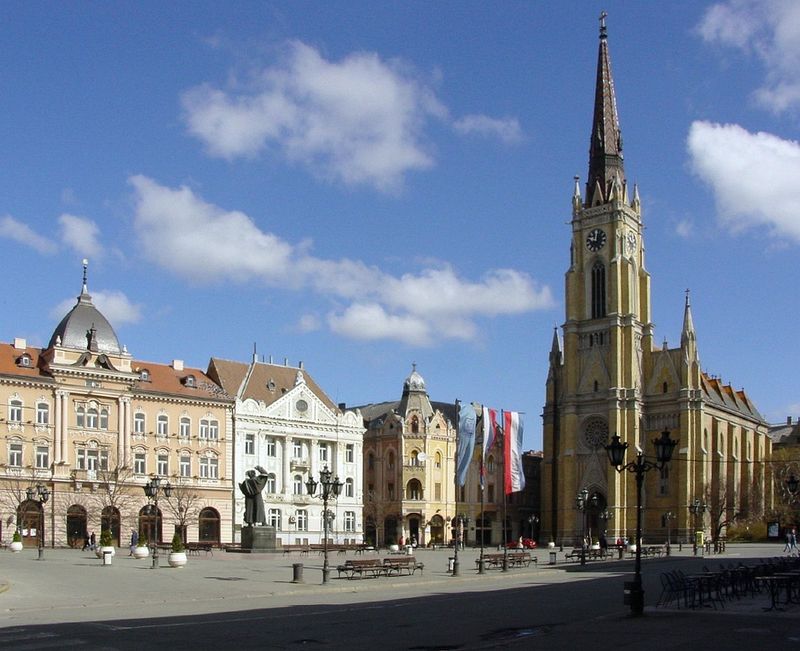
Novi Sad
City in SerbiaWikipedia
289
MENTIONS
160
EPISODES
137
PODCASTS
Search complete. 289 mentions across 160 episodes found for "Novi Sad".
Nov 11, 2026

Michaela KüfnerHOST
Well, there's always trigger events or trigger issues.
Michaela KüfnerHOST
And clearly in the Serb example, it was the collapse of the Novi Sad, this roof.
Michaela KüfnerHOST
That's your hometown, right?
Natalija PetrovićGUEST
Exactly.
Selçuk GültaşlıHOST
Serbia has witnessed an extraordinary political transformation.
Selçuk GültaşlıHOST
What began as student-led protests following the deadly Novi Sad railway station collapse in November 2024 evolved into a nationwide movement challenging Aleksandar Vucic's populist authoritarianism, institutional capture, and entrenched patronage networks.
Selçuk GültaşlıHOST
Through decentralized organization, civil disobedience, and unprecedented civic mobilization, students transformed public indignation into electoral power, securing a parliamentary majority in October, 2026, and ending 14 years of SNS dominance.
Selçuk GültaşlıHOST
Yet profound questions remain about democratic institutionalization and the durability of this transformation.
Filip BalunovićGUEST
As you said in your introduction, the struggle has lasted for two years.
Filip BalunovićGUEST
The student movement started as a social actor.
Filip BalunovićGUEST
They mobilized in grief, firstly, after the deadly collapse on the railway station in the second largest city of Novi Sad.
Filip BalunovićGUEST
But slowly, step after step, they managed somehow to translate this grief into a political force that finally managed to defeat the authoritarian ruler.

Selçuk GültaşlıHOST
Serbia stands at a historic crossroads.
Selçuk GültaşlıHOST
Nearly two years of student-led protests, sparked by the 2024 Novi Sad railway station tragedy, culminated in the October 25 electoral defeat of Alexander Vucic's ruling coalition.
Selçuk GültaşlıHOST
Yet the transition from authoritarian rule to democratic consolidation remains uncertain.
Selçuk GültaşlıHOST
Today, we welcome Professor Nebojsa Vladisevlevic, who teaches comparative and Serbian politics at the University of Belgrade, a former president of the Serbian Political Science Association.
11 MINS LATER
Nebojša VladisavljevićGUEST
So there's quite a lot of work to do.
Selçuk GültaşlıHOST
Right.
Selçuk GültaşlıHOST
The Novi Sad railway station tragedy triggered nearly two years of student-led protests that ultimately challenged Vucic's political dominance.
Selçuk GültaşlıHOST
What explains the movement's success, where previous opposition parties and protest campaigns had failed, was its decisive advantage, organizational innovation, moral legitimacy, or the regime's declining capacity to maintain public consent.

speaker_1HOST
Yeah.
speaker_1HOST
The student protests in Belgrade began over the 2024 Novi Sad railway station canopy collapse.
speaker_1HOST
God, that's awful.
speaker_1HOST
It really is.

Aaron BastaniHOST
And it was a movement of students who finally took him down.
Aaron BastaniHOST
The catalyst for the movement was a November 2024 disaster when the awning of the recently renovated Novi Sad railway station collapsed, that of course is the second largest city in Serbia, killing 16 people who had been sitting or walking beneath it.
Aaron BastaniHOST
That in turn led to protests in the city with young people calling for the resignation of officials over allegations of corruption and negligence during the reconstruction of the station.
Aaron BastaniHOST
Those student-led protests soon spread to Belgrade and other cities across the country, with growing numbers of people calling for the government to go.
8 MINS LATER
Filip UbovicGUEST
They started early December.
Filip UbovicGUEST
And these were in
Aaron BastaniHOST
response to this tragedy in Novi Sad? To the
Filip UbovicGUEST
tragedy in Novi Sad, yes.

Daniela VancicHOST
So elections wouldn't have been held until next year, but Vucic called snap elections.
Daniela VancicHOST
And then they took place against a backdrop that was... two years of really unrest in Serbia and mass mobilization of people that was triggered by the collapse of a canopy of a train station in Novi Sad, which was then found out, you know, killed 16 people, including children, a pregnant woman.
Daniela VancicHOST
It was a total tragedy.
Daniela VancicHOST
And it was found out this was a brand new train station canopy.
Daniela VancicHOST
You know, they also arrested a former head of criminal police and the director there.
Daniela VancicHOST
Plus an owner of Alta Bank is one of the major banks in Serbia because of financial investigations.
Daniela VancicHOST
Also, they've arrested a principal of a school in Novi Sad who refused to comply with a court order to reinstate teachers who went on strike and protested.
Daniela VancicHOST
And then also arrested the head of Serbia's meteorology institute.

Roifield BrownHOST
This is Mid-Atlantic.
Roifield BrownHOST
A movement born in grief has redrawn Serbia's political map, following the deaths of 16 people in Novi Sad.
Roifield BrownHOST
But after two years of demonstrations, the student-backed electoral list has run an outright parliamentary majority, defeating the political camp of Alexander Vutic.
Roifield BrownHOST
But winning an election and transforming a country are very different undertakings.
Aleksandra KrstićGUEST
I'm very well, thank you.
Roifield BrownHOST
I suppose the first question is why? Take us back to the reason for the student list and what are their aims?
Aleksandra KrstićGUEST
So as you already mentioned in the intro, there was a very huge movement, the student movement that actually wanted to fight for justice and for solidarity and to try to help people responsible for the terrible tragedy at the Novi Sad railway station two years ago.
Aleksandra KrstićGUEST
to actually hold them responsible and to fight for accountability and transparency of the government and to see who actually is responsible for this tragedy.

Gulshan SachdevaGUEST
No, it's not.
Gulshan SachdevaGUEST
Only a couple of weeks back, I was both in Belgrade and also in Novi Sad and saw, in fact, a couple of kids came.
Gulshan SachdevaGUEST
They just stopped the traffic for 15 minutes and everybody stopped.
Gulshan SachdevaGUEST
And then after that, everything started moving.

Matthew RemskiHOST
And so it feels like the communist model is winning in some places and the anarchist model is winning elsewhere.
Matthew RemskiHOST
So what triggered the Serbian wave? Well, we have to go back to November of 2024, when in Novi Sad, 100 kilometers northwest of Belgrade, the canopy over a new train station, which had been opened and inaugurated by Vucic standing alongside Viktor Orban a few months before, and this train station was supposedly a symbol of Vucic's managerial prowess and technocratic savvy, the thing collapsed.
Matthew RemskiHOST
and it killed 16 normal people going about their normal lives.
Matthew RemskiHOST
And in dying, they exposed the lazy, venal neglect of the capitalist class who are happy to profit over endangerment.
Matthew RemskiHOST
Nonetheless, in October, the Vucic Coalition rejected a law banning lithium mining and exploration.
Matthew RemskiHOST
Which brings us to November 1st, 2024.
Matthew RemskiHOST
11.52 a.m., the newly reconstructed canopy of Novi Sad's railway station caves in.
Matthew RemskiHOST
16 people are killed.

Damir DamianowskiHOST
So I'll give you the very brief backstory just for the sake of time.
Damir DamianowskiHOST
So about two years ago in Serbia in a northern city called Novi Sad, what happened was a railway station canopied So, you know, when you go out the front of the railway station, there's a covering.
Damir DamianowskiHOST
It was made of concrete.
Damir DamianowskiHOST
It collapsed and killed 16 people.
150 more episodes mention Novi Sad.
Create an account to see the whole feed, search across every transcript, and follow the entities you care about.