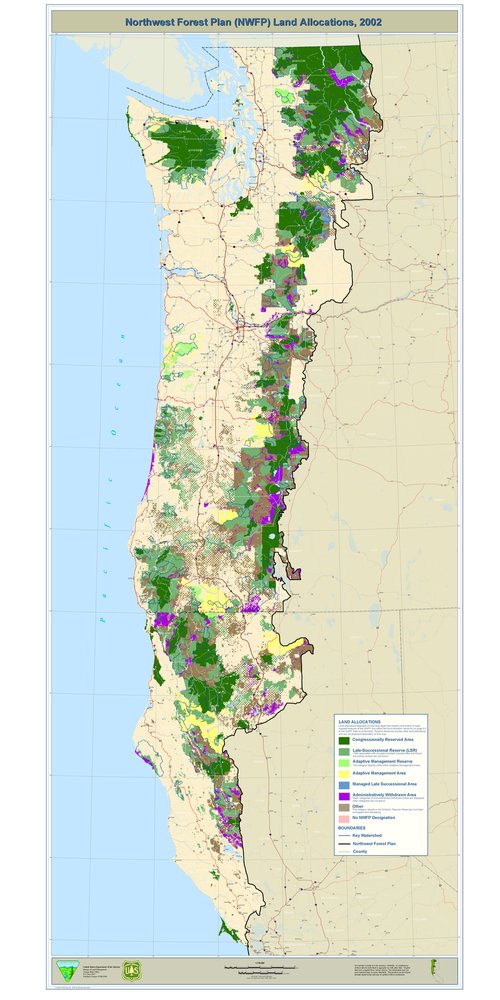
Northwest Forest Plan
9
MENTIONS
7
EPISODES
7
PODCASTS
Search complete. 9 mentions across 7 episodes found for "Northwest Forest Plan".
Oct 14, 2026

Hazel RobinGUEST
So they're rolling back NEPA, which is the National Environmental Policy Act, the Endangered Species Act.
Hazel RobinGUEST
They're doing revisions to the Bureau of Land Management Resource Management Plan, the Northwest Forest Plan, the Blue Mountains Forest Plan, and it's really horrendous what's happening there.
Hazel RobinGUEST
And oh, oh, the other thing I forgot to say is the roadless rule.
Hazel RobinGUEST
They're trying to get rid of the roadless rule, which would be a huge, a huge issue because of what you just talked about.

Tom WheelerGUEST
So i- if there is anybody who would be quick to blame the timber industry, I, I'm sure it would be us, but this goes beyond, uh, habitat modification and destruction.
Tom WheelerGUEST
So one thing that we know is that, uh, because of the Northwest Forest Plan, we're actually seeing increasing amounts of spotted owl habitat coming back online-
Michael DunneHOST
Hmm
Tom WheelerGUEST
...

Rick SohnGUEST
As your listeners probably know, that's about enough to run two and a half typical sized sawmills or veneer plants or, or something like that.
Rick SohnGUEST
And what happened is that before the Clinton-Gore era and before the Northwest Forest Plan and all that stuff that happened in the mid-'90s, they were harvesting closer to, to in excess of a billion board feet a year off the BLM lands.
Natalie HeacockHOST
Wow.
Rick SohnGUEST
That went on from 1937 until 1990, approximately, when the spotted owl got enjoined in court and all that, all the harvests got enjoined in court.

Hal HerringGUEST
And, uh, but I see...
Hal HerringGUEST
What I see there is, um, an amazing absorption of disinformation over 20-something years where a lot of people are confusing the Northwest Forest Plan, which was the spotted owl, with the roadless rule, and that it somehow bans logging and all this stuff, right? When it, when really what it was is simply a taxpayers for common sense concept of stopping the p- the taxpayer building roads to s- marginal timber supplies.
Hal HerringGUEST
Um, there was a fire down at Maverick ski area, um, over there kind of west of you there, you know-
Mark KenyonHOST
Yeah

Mark HaggertyGUEST
So in Oregon, for example, the counties that have the BLM ONC lands and Forest Service lands that were really productive for timber, that were clear cut through the 60s, 70s, and into the 80s, they did get tens of millions of dollars in some cases from the federal government.
Mark HaggertyGUEST
And when the Northwest Forest Plan came in and the timber management policies were changed, for good reason in a lot of cases, those revenues declined.
Mark HaggertyGUEST
But what had happened in the interim is Oregon had a tax rule.
Mark HaggertyGUEST
The state really restricted how properties could be assessed for property taxes.

HadleyHOST
what about that one?
SharanHOST
But autumn is super relevant to you because a lot of critical habitat was designated in 1992 and 1994 in the Northwest Forest Plan, which set aside something called late successional reserves, which were old growth kept off limits for the owl.
SharanHOST
And there were also other species that it protected.
SharanHOST
There's
SharanHOST
And then the Biden administration restored most of it.
SharanHOST
And then now the timber industry is back in court trying to strip the 3.5 million acres again.
SharanHOST
And the administration is moving to amend the Northwest Forest Plan.
SharanHOST
um to return logging to the old growth habitat

Chris WoodGUEST
We're going to bring all the stakeholders together and figure this thing out.
Chris WoodGUEST
So they created the Northwest Forest Plan in 1994.
Chris WoodGUEST
And The Forest Service, by the time Mike Dombeck, who I worked for, he was the chief, the guy who ran the agency.
Chris WoodGUEST
By the time he got there in 97, the agency was effectively in like its seventh or eighth year of this transition period where no longer was it finding its value and its worth in figuring out how to engineer roads into remote timber sales and then selling timber.