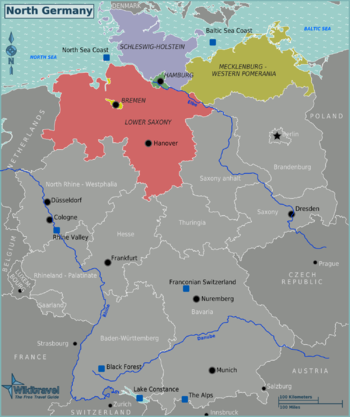
Northern Germany
RegionWikipedia
255
MENTIONS
42
EPISODES
38
PODCASTS
Search complete. 255 mentions across 42 episodes found for "Northern Germany".
Sep 13, 2026

KateGUEST
Okay.
KateGUEST
And I love the city and I love northern Germany and not as many people get up there.
Lynne NiemanHOST
Yeah.
KateGUEST
So those are my top three.
23 MINS LATER
Lynne NiemanHOST
But they don't they don't hit some of some of those areas, which to me, like the Black Forest, you know, if you have time, you could you could pair it a little bit with Bavaria if you wanted to, since everything is south.
Lynne NiemanHOST
So let's move up to Hamburg, right? That's way up in the north.
Lynne NiemanHOST
And that definitely, I agree, you don't hear much about northern Germany.
Lynne NiemanHOST
So I think that's actually where my ancestry is from, is like northwestern Germany.

Piotr NatterNARRATOR
All LibriVox recordings are in the public domain.
Piotr NatterNARRATOR
For more information, or to volunteer, please visit LibriVox.org. Recording by Piotr Natter It is impossible to assign any precise date for the beginning of the Hanseatic League, or to name any single factor which explains the origin of that loose but effective federation of North German towns.
Piotr NatterNARRATOR
Associated action and partial union among these towns can be traced back to the 13th century.
Piotr NatterNARRATOR
In 1241 we find Lübeck and Hamburg agreeing to safeguard the important road connecting the Baltic and the North Sea.
Piotr NatterNARRATOR
The impetus of this remarkable movement of expansion not only carried German trade to the east and north within the Baltic Basin, but reanimated the older trade from the lower Rhine region to Flanders and England in the west.
Piotr NatterNARRATOR
Cologne and the Westphalian towns, the most important of which were Dortmund, Züst and Münster, had long controlled this commerce, but now began to feel the competition of the active traders of the Baltic, opening up that direct communication by sea from the Baltic to Western Europe which became the essential feature in the history of the League.
Piotr NatterNARRATOR
The necessity of seeking protection from the sea rovers and pirates who infested these waters during the whole period of Hanseatic supremacy, the legal customs, substantially alike in the towns of North Germany, which governed the groups of traders in the outlying trading posts, the establishment of common factories or counters, comptors, at these points, with aldermen to administer justice and to secure trading privileges for the community of German merchants, such were some of the unifying influences which preceded the gradual formation of the League.
Piotr NatterNARRATOR
In the century of energetic commercial development before 1350, the German merchants abroad led the way.

Rick HoppeGUEST
So I started working on it.
Rick HoppeGUEST
And I have found that by and large, first off, the first thing is, is that we haven't gotten over doing analysis of intelligence information from the days of worrying about masses of Soviet armor sweeping across the North German plane, the invasion of the Soviets.
Rick HoppeGUEST
So our analysis systems are set up for something like that.
Rick HoppeGUEST
The second thing is, is that I have to admit that there is a certain politicization, and I'm not talking about left, right, Democrat or Republican, but when your boss is married to a certain idea, turning in an assessment that contradicts that idea is not a career progression for you.

Michael LeggiereGUEST
A lot of times this is seen as, oh, this is an ad hoc thing thrown together by Napoleon in 1807.
Michael LeggiereGUEST
When he issues the, I'm sorry, 1806, when he issues the Berlin Decree, which takes this prohibition on British imports and extends it to North Germany, people say, oh, that's just the result of military victory.
Michael LeggiereGUEST
And it's just the color of him winning in North Germany.
Michael LeggiereGUEST
But really, This was a long-term national security policy that the French had going all the way back to the revolution to close North Germany because North Germany was seen as the key to prosperity.
Michael LeggiereGUEST
That's where all British goods came through.
Michael LeggiereGUEST
So no, by no means was this just a knee-jerk reaction to military victory.
28 MINS LATER
Michael LeggiereGUEST
Everybody is probably who's listened, who listened to your podcast, probably aware of the desperation of the last government of the revolution, the Directory, when it sent Napoleon to Italy, not just to drive out the Austrians, but to basically loot the entire peninsula and send the riches of Italy back to float the government.
John ViscardoHOST
Got it.

Adam MarcetichNARRATOR
this collection was enriched by the magnificent scriptural and classical volumes brought from the continent by archbishop theodore in the seventh century under archbishop cinchley in the fifteenth century this library was provided with a dwelling of its own built over the priors chapel and containing sixteen bookcases of four shelves each at this time a catalogue was already in existence made by prior estry at the end of the thirteenth or beginning of the fourteenth century and records about three thousand volumes the monastery of st mary's at york owned a library which was founded by archbishop egbert egbert's pupil alcuin whom charlemagne charged with the care of the educational interests of his empire soon after taking up his residence at st martin's at tours desired the emperor to send to britain for those books which we so much need thus transplanting into france the flowers of britain that the garden of paradise may not be confined to york but may send some of its scions to tours richard de bury the famous old book collector or bibliomaniac to whom reference has already been made bequeathed his books which outnumbered all other collections in this country to the university of oxford where they were housed in durham college which he had endowed he has left an interesting account of how he gathered his treasures which may fitly be quoted here aided by royal favor he tells us we acquired a most ample facility of visiting at pleasure and of hunting as it were some of the most delightful coverts the public and private libraries of both the regulars and the seculars then the cabinets of the most notable monasteries were opened cases were unlocked caskets were unclasped and astonished volumes which had slumbered for long ages in their sepulchres were roused up and those that lay hid in dark places were overwhelmed with the new light thus the sacred vessels of science came into the power of our disposal some being given some sold and not a few being lent for a time the embassies with which he was charged by edward the third gave him opportunity for hunting continental coverts also what a rush of the flood of pleasure rejoiced our hearts as often as we visited paris the paradise of the world there in very deed with an open treasury and untied purse-strings we scattered money with a light heart and redeemed inestimable books with dirt and dust richard de bury also furthered his collection by making friends of the mendicant friars and allured them with the most familiar affability into a devotion to his person and having allured cherished them for the love of god with munificent liberality the affability and liberality of the good bishop attained their object and the devoted friars went about everywhere searching and finding and whenever he visited them placed the treasures of their houses at his disposal although the mendicant orders were originally forbidden property of any kind this rule was afterwards greatly relaxed especially as regards books and in richard de bury's time the friars had amassed large libraries and were well known as keen collectors In France, it was not an uncommon practice for a monastery to levy a tax on its members or its dependent houses for the increase of its library, and in several houses it was customary for a novice to present writing materials at his entry, and a book at the conclusion of his novitiate.
Adam MarcetichNARRATOR
As early as the close of the eleventh century, Marquardt, Abbey of Corvey in North Germany made it a rule that every novice on making his profession should add a book to the library.
Adam MarcetichNARRATOR
the monastic libraries met their doom at the time of the reformation and of the suppression of the religious houses nearly all the books at oxford including the gifts of richard de bury were burnt by the mob and under elizabeth the royal commissioners ordered the destruction of all capes vestments albs missals books crosses and such other idolatrous and superstitious monuments whatsoever since those who ought to have been more enlightened classed missals and books among idolatrous and superstitious monuments it is not to be wondered at that the ignorant and undiscriminating mob should glory in their wanton destruction books that escaped the fire or the fury of the mob were put to various uses as waste paper they were employed for scouring candlesticks and cleaning boots for the wrapping up of the wares of grocers and soap-sellers and were exported by shiploads for the use of continental bookbinders on the continent too fire wars plunder and suppression dispersed or destroyed many of the monastic collections a comparatively recent instance of book destruction caused by the fury of the rabble is afforded by the great losses undergone by bristol cathedral library in the riots which took place in connection with the passing of the reform bill the palace was set on fire and the library which was lodged in the chapter-house was brought out and most of the volumes hurled into the flames others were thrown into the river into ditches and about the streets and although about eleven hundred were subsequently recovered from second-hand clothes dealers and marine stores only two copies and one set remained intact as a natural consequence of the revival of learning in the fourteenth century private libraries began to increase in size and number and the collection of books was no longer left to monks and priests king john of france gathered a little library some say of only twenty volumes which laid the foundation of the great royal library now the bibliothque nationale These he bequeathed to his son, Charles V, who increased the number to 900, for his known fondness for books and reading obtained for him presentation volumes for many of his subjects.
Adam MarcetichNARRATOR
His books included works of devotion, astrology, medicine, law, history, and romance, with a few classical authors.

Peter WatsonHOST
We don't know how the Germans are building these things, but we do know where.
Peter WatsonHOST
Last night I flew a reconnaissance mission over North Germany and I found an isolated factory.
Peter WatsonHOST
And my infrared camera picked up this.
Peter WatsonHOST
And he holds up a

Brian ChappellHOST
Please be seated.
Brian ChappellHOST
Roll call was at 4.30 a.m. in Ravensbrück, the concentration camp in North Germany.
Brian ChappellHOST
Corrie Ten Boom would write about it later, saying that in the chill air at 4.30 a.m., even midwinter, the roll call would take sometimes up to three hours in which the women would have to stand in ranks waiting for whatever arbitrary decision of the guards would finally let them go.
Brian ChappellHOST
One day, the woman standing in front of Corrie Ten Boom, the Dutch girl, whose father, the watchmaker, had made a decision to hide Jews in their house, watched as the woman in front of her, fainting from standing out on the cold, was then beaten mercilessly by the one they would call the beast of Ravensbrück, the hyena, the woman who took her rage unbridled out on those who fell.

Vidas PinkeviciusHOST
For students it's, [laughs] it's would be very limited, limiting if, uh, if they only practice and, uh, perfect one historical, uh, style, o- one national school of organ composition, for example.
Vidas PinkeviciusHOST
Somebody in love with North German music would only play music from Hamburg and Lubeck, uh, from 17th century, but not from 18th century, for example.
Vidas PinkeviciusHOST
Um, or somebody in love with Italian r- romantic music, uh, those operatic transcriptions, um, or Padre David de Bergamo, for example, those really, uh, fun pieces to listen and to play, would only play Italian music, no- nothing else, during their formative years.
Vidas PinkeviciusHOST
That, that I think would be, uh, too limiting, too limiting.
5 MINS LATER
Vidas PinkeviciusHOST
So we were talking about, uh, how specialization affec- affects, uh, concert opportunities and per- personal branding.
Vidas PinkeviciusHOST
But, um, for example, um, you were already mentioning at the beginning if students should specialize or, or be more generals at the beginning, right? Um, has your take on this, um, was, was always like this or changed over the years?
Ausra Motuzaite-PinkevicieneHOST
Of course, it changed over the years because, you know, when I was a student, of course, I had to play everything, but my favorite actually field was, you know, the North German Baroque, uh, music and, um, to some extent J.S. Bach.
Ausra Motuzaite-PinkevicieneHOST
But, uh, afterwards, I realized that, you know, I cannot play only this because basically I don't have suited instruments, historically accurate instruments in Lithuania for this kind of music.

Sacinandana SwamiHOST
So I do hope that today my lecture will give all of us a frame in which we can put these spiritual experiences plus, and that is perhaps most important for me, plus I wish to give you of course a few hints and practices and inspirations for your own Spirta practices I have thought deeply about what I want to say so I used to come regularly to Switzerland.
Sacinandana SwamiHOST
I could speak in such a way that no one would recognize my North German accent.
Sacinandana SwamiHOST
I was able to even converse in Swiss German and almost understand everything, but I guess I was never accepted 100% as a Swiss person.
Sacinandana SwamiHOST
So, good.
Sacinandana SwamiHOST
Now the question to the men.
Sacinandana SwamiHOST
I must say for myself, I'm from North Germany and it's the worst thing for a man to cry in public in North Germany.
Sacinandana SwamiHOST
I remember once someone showed me there was a burial or funeral ceremony for a head of state and all the people who came, politicians, they spoke some good things and achievements about that head of state.
Sacinandana SwamiHOST
I don't remember who it was.
32 more episodes mention Northern Germany.
Create an account to see the whole feed, search across every transcript, and follow the entities you care about.