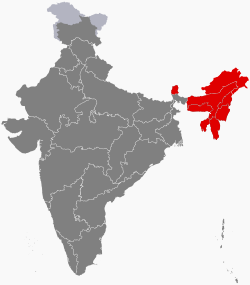
Northeast India
Region in IndiaWikipedia
18
MENTIONS
12
EPISODES
12
PODCASTS
Search complete. 18 mentions across 12 episodes found for "Northeast India".
Nov 19, 2026

Dwaine C. PerryGUEST
But what I found was interesting was in East...
Dwaine C. PerryGUEST
Eastern India, there's a whole big section called Nagaland, and it borders into the Himalayas and stuff.
Dwaine C. PerryGUEST
And what was so impressive was, I don't know how the Indians are saying these are Indians, but that's sort of like what it was.
Dwaine C. PerryGUEST
Nagaland was like the national Indian area.

Rituparna PatgiriGUEST
Nancy Fraser developed a critique called the counter public or the subaltern public and she you know criticized Habermas and said that the public sphere has always been fragmented it is heterogeneous it is multiple and diverse in nature and in the Indian context there have been many scholars who have worked on the public sphere and the counter public sort of alluding to the fact that how especially In the Indian independence movement, you see this fragmented public sphere because not everyone has the same issue.
Rituparna PatgiriGUEST
They have different kinds of issues, which we are seeing unfolding now that, you know, what kind of issues do Dalits have? What kind of issues does the North East have? What kind of issues do the Muslims have, etc.? ? And in the Assamese context, I found it very interesting to look at the mobile theater as exhibiting certain characteristics of a counterparty.
Rituparna PatgiriGUEST
So I see that the audience is very heterogeneous, which means that it is not a concert piece like Habermas would argue, because, you know, people are not really in that way.
Rituparna PatgiriGUEST
assuming mobile theater to be a very sophisticated form of theater and a lot of criticism which scholars and drama critics bring in is that that this is not theater is this art and i do have a whole chapter on this where i you know unpack some of these issues however when one looks at the audience one sees that it gives an opportunity for a farmer for you know a homemaker for a student a teacher everyone to come and enjoy the there are also demarcated seatings and the gallery is the most important part because it's less in price but at the same time I think most action happens in the gallery so I've had young people tell me that they wanted to sit in the gallery when they were young but their parents would chide them and say no good people don't sit there especially for women it's even more true so I as part of my field work have wanted to sit in the gallery and I would tell the producer or the person getting me the ticket that Can I go and sit in the gallery? And they were like, no, no, ma'am.

Rick RidingsGUEST
are clearly Jewish descendants.
Rick RidingsGUEST
And in their oral tradition, this people in Northeast India called the Bene Menashe, there were about 10,000 of them.
Rick RidingsGUEST
Now about 4,000 have already been brought back to Israel.
Rick RidingsGUEST
But it's a fulfillment of the word of God that he would bring every single Jewish person back, all that they got into exile.

Smita PrakashHOST
is absolutely...
Smita PrakashHOST
Yeah, even in Northeast India, I've seen in villages and things like that, though they call it tribal worship, pagan worship, but these are all cultural traditions which they have kept, survived, centuries absolutely and they they take great pride in having preserved that yes and it is something that even though there is modernization which has come in into the cities and towns even in uh even in the northeast of India there is still that that traditions will continue yes you know they might have adapted to modern way of life but those traditions and that is something that we have to teach every successive generation and
Meenakshi JainGUEST
just one thing that the zamindars in Bengal They always educated their daughters.
Meenakshi JainGUEST
Why? Because the daughter would get married to a family of comparable status, having land and all that.

Sandeep MenonGUEST
As much as say Haryana and that side produce so as Haryana produces wrestlers.
Sandeep MenonGUEST
So Northeast produces a lot of players in a lot of sports.
Sandeep MenonGUEST
Manipur is like a factory.
Sandeep MenonGUEST
My sister went to Manipur.
9 MINS LATER
Amit VarmaHOST
Whereas on the other hand, you have Bangalore, where they started off playing against bigger British guys.
Amit VarmaHOST
So you had a shorter passing, nimbler kind of game happening.
Amit VarmaHOST
Similarly in the Northeast.
Amit VarmaHOST
And it's also so fascinating that you get these different styles of play from all of these different places.

SmitGUEST
Devaji Saikya is the secretary of the board, right? And he will...
SmitGUEST
I mean, he will see to it that Assam or North East gets a team.
SmitGUEST
Yeah, yeah.
SmitGUEST
That's a huge market.

Simon WhistlerNARRATOR
Established by Indian independence leader Sabhas Chandra Bose, the Legion was first seen as a way of forcing India's independence from Britain through conflict, with little help from the most despised and feared dictator of the age.
Simon WhistlerNARRATOR
Numbers never got above 5,000, and recruits were volunteers, some expatriates living in Germany at the time and others prisoners of war whose heads had been turned against the British by some carefully placed propaganda most of these soldiers were given non-combat roles in occupied countries in Europe but were also involved in the Axis defense of Europe after D-Day on the other side of the world and fighting alongside a different nation but against the same the Indian Liberation Army ILA was a much larger Enterprise that numbered some 43 000 men again principally fighting for Indian independence from Britain fighting alongside the Imperial Japanese Army the ILA was formed of Indian prisoners of war and first saw combat during Operation Yugo in which Japanese troops attempted to break through into India through the Northeast Indian regions of Manipur and the Naga Hills of all the collaboration stories here this is certainly one of the more understandable with the indian people often suffering horribly under british rule it's not hard to see how many thousands could be easily swayed by another power offering to help rid india of its colonial master after the war the british government fearing mass revolts and uprisings across its empire in support of groups like the ila banned the bbc and other media organizations from covering the topic in india a series of trials were held with various charges of treason torture murder and abetment to murder placed against the accused but a massive public outcry over the trials led to almost all of it being scrapped today the ila is still openly revered by many in india as heroes of the independence movement while mothers look upon them as little more than traitors the final nation we're going to look at today is certainly one of the most complex when it comes to the notion of collaborators the soviet union was of course essentially an occupying force in itself so it's hardly surprising that there were numerous instances of groups choosing to fight alongside the nazis rather than their soviet oppressors however what may come as a shock was the sheer numbers that chose to do so estimates here are a little blurry but perhaps as many as a million people under soviet rule chose to fight for the other side in one way or another in what is considered ukraine today but was then divided between the soviet union and poland memories of stalin's terror famine and various purges through the 1930s that had killed millions remained a lingering point of hatred when it came to the Soviet Union even before Operation Barbarossa there were large numbers of Ukrainians who had actively chosen to back the Germans and this rose dramatically after Hitler sent his troops into the Soviet Union the collaboration here comes in various shapes and sizes including administrative duties policing the German military within units such as the SS Division Galicia and even as concentration camp guards those working within the auxiliary police forces became implicated actions against the Jews and very much participated in the mass roundups that led to some 1.2 to 1.6 million Ukrainian Jews being murdered the Turkistan Legion was another group that fought in the Wehrmacht during World War II composed almost exclusively of those of Turkic descent a collection of ethnic groups across a wide expansive area but mostly situated in Central Asia Though initially considered racially inferior by the Nazis , the Germans changed their tune after the difficulties of invading the mammoth Soviet Union became apparent, and they sought any help they could find.
Simon WhistlerNARRATOR
The Turkestan Legion eventually numbered some 16,000 men, with the majority of their combat coming in Yugoslavia before they were mostly captured by the Allies and eventually returned to almost certain death or lengthy imprisonment in the Soviet Union.
Simon WhistlerNARRATOR
we could go on and on about groups that chose the nazis over the soviet union because there were just so many there was an armenian legion with around 18 000 men an azerbaijani legion with 13 000 georgian legion with 14 000 all of whom actively chose the other side other than spending time in a prisoner of war camp however hitler never quite took to the soldiers from the east and they were often shuffled around to areas where the wehrmacht could afford to deploy some foreign troops who they didn't entirely trust one of these places was the small dutch island of texel where the majority of the georgian legion was deployed in the final stages of the war along with around 400 germans just after midnight on the 6th of april 1945 just over a month before the final german surrender and with adolf's dreams already well and truly in tatters the georgians along with members of the dutch resistance rose up and took control of most of the island half the germans were killed almost immediately but the uprising had expected an allied landing which never came and when the remaining german artillery batteries began pounding away at where they thought the rebels were the situation degenerated quickly Such was the determination to hang on to Texel.

speaker_0GUEST
Emmanuel Hospital Association is a network of 2019 hospitals, 44 health and development projects, and five nursing schools established in the year 1969 with the vision of being a fellowship for transformation through caring.
speaker_0GUEST
The goal is to provide access to appropriate, relevant, cost-effective healthcare to marginalized rural communities with limited access to such care in rural North and Northeast India.
speaker_0GUEST
This map shows the locations of EHA's hospitals.
speaker_0GUEST
which closely shadow the aspirational districts, that is, the most underdeveloped districts of the country.

Subir SinhaGUEST
And this is not even a new phenomenon.
Subir SinhaGUEST
It used to be restricted to some places, Kashmir, for example, then also the Indian Northeast, where there are lots of demonstrations going on.
Subir SinhaGUEST
And then Mr. Modi brought all of this into the demonstrations that the farmers were using, you know, the so-called farmers movement.
Subir SinhaGUEST
And in the movement against the Citizenship Amendment Act of 2020, which was a big demonstration at the time of the pandemic, which resulted in, which ended through a massive sort of spate of violence in which many Muslims and some Hindus also died.

Duncan McDuie-RaGUEST
I went, did a... undergraduate degree in communications and media studies, did a postgraduate degree in development studies and became really interested in cities in the global south, for want of a better term, but particularly in Asia.
Duncan McDuie-RaGUEST
And then when I did my PhD, I worked in the region known as Northeast India, but it's the region where India borders Myanmar, Bangladesh, Bhutan, Nepal, China.
Duncan McDuie-RaGUEST
And in that region, I've studied cities in that region, and I've studied migrants from that region living in cities elsewhere in India.
Duncan McDuie-RaGUEST
And through that work, I realized that this sort of attunement to different things in the urban environment shaped the way I looked at cities, shaped what I was interested in, shaped the way I was attracted to sort of neighborhoods and signs and aesthetics and surfaces and it wasn't really at the forefront of my research but it was sort of always lurking there and so through my academic career I sort of worked first on mobilities and migration in that sense but very much looking at frontiers, liminal zones, borderlands, contested territories, and how cities form, are made and unmade in those areas and those regions.
Duncan McDuie-RaGUEST
And I thought that would be easy, but that ended up being quite hard.
Duncan McDuie-RaGUEST
And the discipline I had to kind of exercise in that, I think was a real challenge.
Duncan McDuie-RaGUEST
But that's kind of how I got from sort of Frontiers of Northeast India, where insurgency means something so different to thinking about play in cities around the world as an insurgent act.
Duncan McDuie-RaGUEST
And to me, that trajectory is really seamless and obvious.
2 more episodes mention Northeast India.
Create an account to see the whole feed, search across every transcript, and follow the entities you care about.