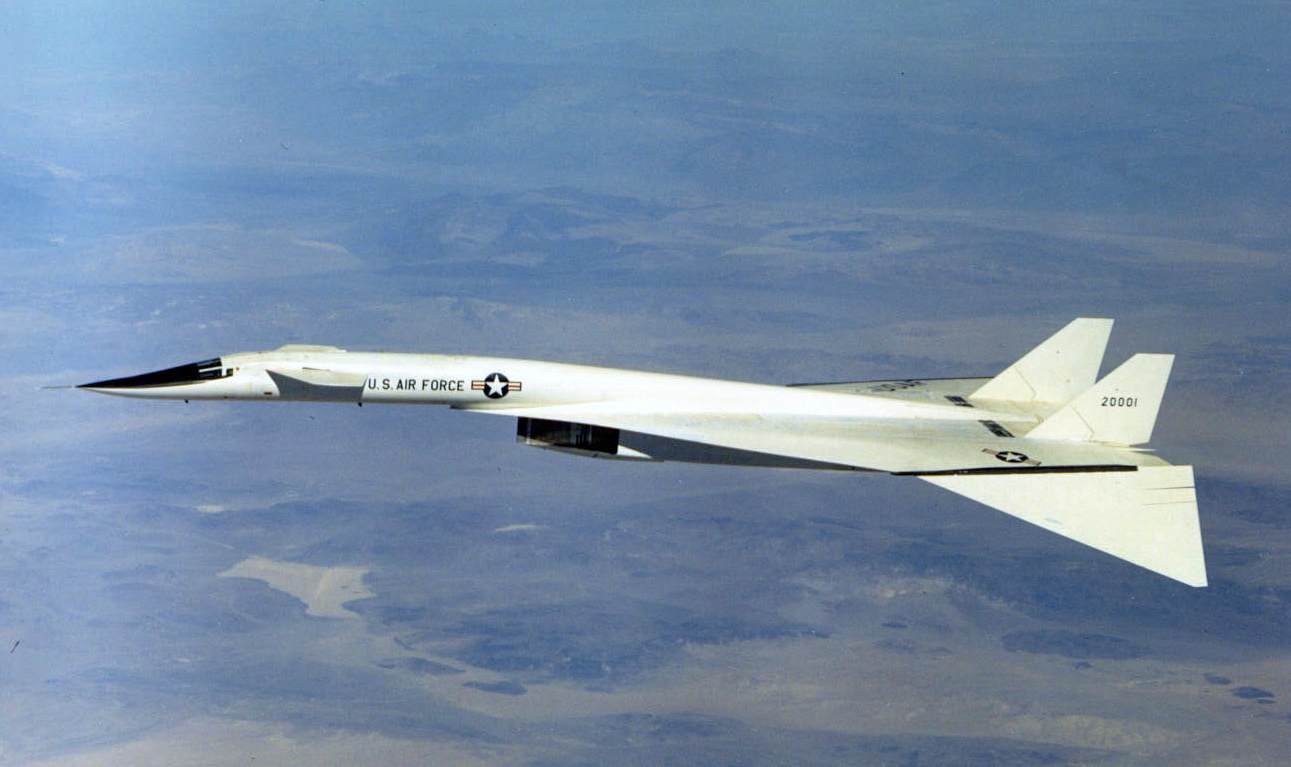
North American XB-70 Valkyrie
Strategic bomberWikipedia
12
MENTIONS
7
EPISODES
5
PODCASTS
Search complete. 12 mentions across 7 episodes found for "North American XB-70 Valkyrie".
Oct 17, 2026

Dagogo AltraideHOST
From the 1960s onwards in the military, there was gradual innovation in regards to supersonic aviation.
Dagogo AltraideHOST
Some classic examples include the 1964 North American XB-70 Valkyrie.
Dagogo AltraideHOST
It was a bomber that could cruise at Mach 3 for thousands of miles.
Dagogo AltraideHOST
Only two were ever made.
speaker_2SOUNDBITE_SPEAKER
Anyway,
AaronHOST
yeah, you know, footage of XB-70 just never gets old.
AaronHOST
That is such a kick-ass looking airplane.
TonyHOST
It really is.

Tail DraggerHOST
An airplane built to carry a nuclear weapon at twice the altitude of Mount Everest, at three times the speed of sound, and return before any Soviet interceptor could climb high enough to even find it on radar.
Tail DraggerHOST
That is the North American XB-70 Valkyrie.
Tail DraggerHOST
I'm Taildragger, and you're listening to The Hangar on Radio Hangar.
Tail DraggerHOST
Today, we are going to talk about one of the most audacious aircraft ever built, an airplane that proved almost everything it set out to prove, was canceled for reasons that had nothing to do with its flying qualities, and nearly took both of its airframes to the desert floor before it was done.
Tail DraggerHOST
At Mach three, aerodynamic friction heats the skin of the aircraft to around six hundred degrees Fahrenheit in sustained cruise.
Tail DraggerHOST
Aluminum, the material of choice for almost every airplane flying in the late 1950s, softens and loses structural integrity at those temperatures.
Tail DraggerHOST
So North American had to build most of the Valkyrie's structure from stainless steel honeycomb panels and titanium.
Tail DraggerHOST
They brazed the honeycomb panels together in a manufacturing process that was largely new to the American aerospace industry.
Tail DraggerHOST
A B-29 sitting on the floor under the lights.
Tail DraggerHOST
The white delta of the XB-70 Valkyrie, so long it barely fits inside.
Tail DraggerHOST
Aircraft you would drive four hundred miles to stand next to for five minutes.
Tail DraggerHOST
The kind of room where a grown pilot can lose an entire afternoon without trying.

AaronHOST
Yeah.
TonyHOST
So we, we talked about the F-40, or excuse me, the XB-70 mysteriously missing, um, at, uh, Edwards Air Force Base, and, and now there's people that are on X that are posting, like, like, people are getting job offers to work on the program.
TonyHOST
So Mike, uh, Relja, I hope I pronounced that.
AaronHOST
[laughs]
AaronHOST
... do something like that
TonyHOST
... just be a consultant.
TonyHOST
So, uh, uh, Sluggo brings up a good question: "Why did the XB-70 have drooping wing tips?"
AaronHOST
Oh, yeah.

Phil ThompsonHOST
The MiG-25 had not in fact been designed to be the aircraft the West so feared.
Phil ThompsonHOST
Conceived around 1960, the MiG-25 was intended to counter the American B-70 Valkyrie bomber.
Phil ThompsonHOST
The Soviet Union needed an interceptor of comparable performance quickly and without the resources or the time to develop a Western-style solution.
Phil ThompsonHOST
So Soviet designers built around existing technology.

Ted PajackiHOST
In 1942, the B-29 Superfortress, a revolutionary bomber that played a pivotal role in World War II, made its debut flight at Boeing Field in Seattle.
Ted PajackiHOST
In 1964, the North American XB-70 Valkyrie made its maiden flight from Palmdale, California to Edwards Air Force Base.
Ted PajackiHOST
Although the Valkyrie never entered service as a bomber, the demonstration showcased the potential for sustained, long-range, supersonic flight in a transport-sized aircraft.
Ted PajackiHOST
In 1981, Sandra Day O'Connor was unanimously confirmed by the U.S. Senate to become the first female justice on the U.S. Supreme Court.