North American Review
MagazineWikipedia
22
MENTIONS
11
EPISODES
10
PODCASTS
Search complete. 22 mentions across 11 episodes found for "North American Review".
Oct 14, 2026

Tommy HersantNARRATOR
And now, standing in imagination by his grave, we ask, will the night be eternal? The brain says, perhaps, while the heart hopes for the dawn.
Tommy HersantNARRATOR
North American Review, November 1892.
Tommy HersantNARRATOR
This ends Ingersoll's lecture on Ernest Renan.

Michelle FryNARRATOR
Wherever he happened to be, in his office, at his home, on the boat, in the train, in the cab rattling through noisy streets, sitting, standing, reclining, he spoke the splendid words that the stenographer's art caught and reproduced for him.
Michelle FryNARRATOR
His famous replies to Judge Black in the North American Review were dictated at the billiard table in his home with cue in hand.
Michelle FryNARRATOR
A sentence and a paragraph, then a run with the balls.
Michelle FryNARRATOR
Another paragraph, another run, and so on to the end.

Brion McClanahanHOST
Now, I find it fascinating that any conservative calls Joseph Story an originalist because I think that's laughable.
Brion McClanahanHOST
"Persuaded of the great importance of the debate, Edward Everett of Massachusetts, an editor of the influential North American Review and a Webster supporter, wrote James Madison asking for his opinion on the constitutional questions that had been discussed." Um, now, Edward Everett is important because this is the man that made the nearly, like, three-hour speech before Abraham Lincoln's Gettysburg Address in 1863.
Brion McClanahanHOST
Edward Everett was a very important member of New England society.
Brion McClanahanHOST
So he's writing James Madison, and what do you think? "Hayne had cited both Jefferson and Madison as the fathers of those principles now avowed by him, including the right of state nullification.

Makaya UtiniHOST
And I'm Makaya Utini.
Makaya UtiniHOST
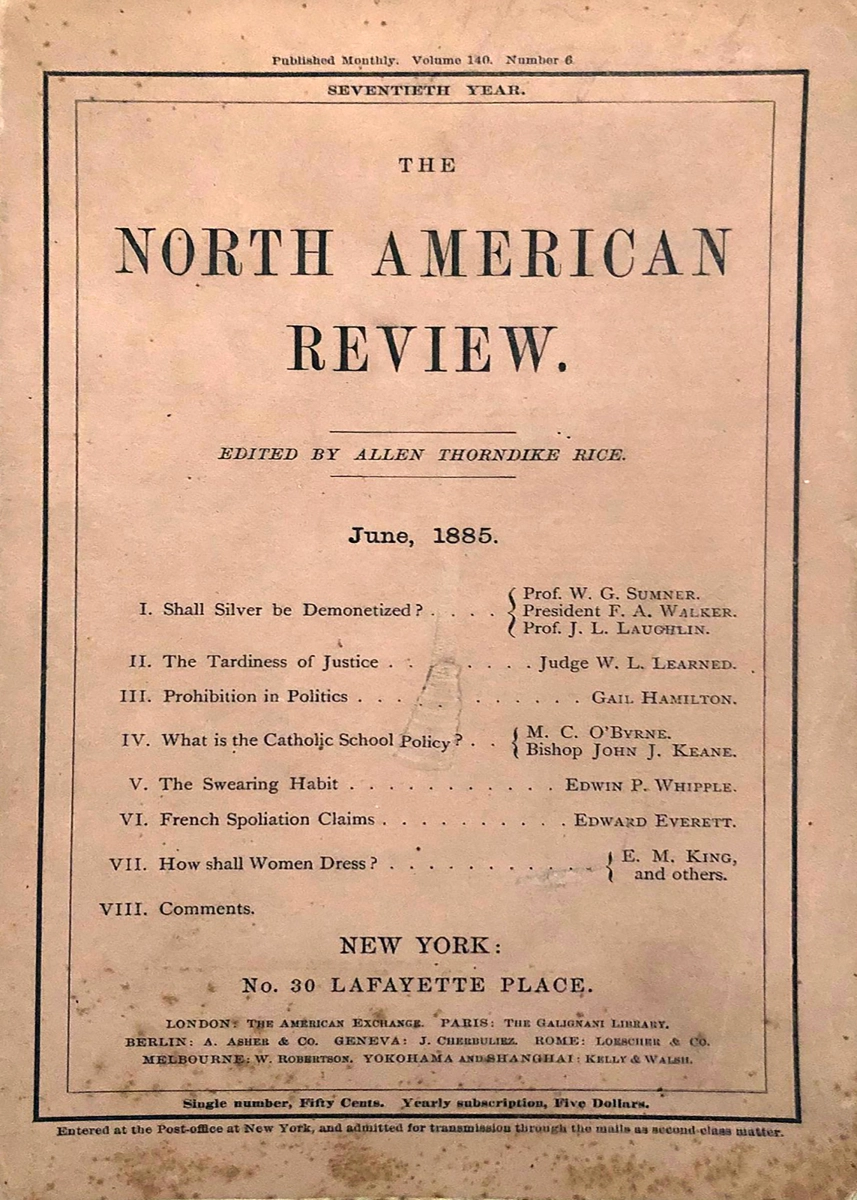
And today we're speaking with Jeremy Schraffenberger, poet, author, educator, and editor of the North American Review, America's oldest literary magazine.
Makaya UtiniHOST
Jeremy has published several collections of poetry and has won the Seattle Review's Poetry Prize, Arcana's Creative Nonfiction Prize, Revolver's Wanted Fiction Contest, and others.
Makaya UtiniHOST
In this episode, we discuss the history of the North American Review, Jeremy's editorial philosophy, and what kinds of submissions he's currently seeking.
Makaya UtiniHOST
There was a lot to cover, too much for one conversation, so we're going to have him back next year for round two.
Makaya UtiniHOST
In the meantime, we're excited to be with him today.
Ito OtiniHOST
Jeremy, thank you so much for joining us.
Ito OtiniHOST
We're so excited to have you.

Will TannerHOST
Of course, from the perspective of the Democrats and of many ordinary American working people, these reforms were necessary and long overdue, but Mellon saw only antagonism and hostility, end quote.
Will TannerHOST
As WASPs generally rejected running for public office, as a side note, H.W. Brands covers this very well in his book American Colossus, this group primarily pushed its desired policies through a mix of political writings in highbrow journals like the North American Review, Henry and Charles Francis Adams Jr. were famous for this, academia, and donating to friendly political parties, causes, and office seekers.
Will TannerHOST
This was particularly true through the Gilded Age and early Progressive Era, when the group's fortunes and influence were most intact.
Will TannerHOST
It faded as the class did until it reached the point of general irrelevance by the time the class died out.

Bruce CarlsonHOST
This is not going over well.
Bruce CarlsonHOST
Uh, the North American Review in September eighteen eighty-two publishes an article which exposes some of the horrible examples of assessments going on.
Bruce CarlsonHOST
They talk about in New York where a judge from the bench goes to a hotel room and then summons employees of the Postal Service to appear before him along with a clerk.
Bruce CarlsonHOST
It's like a court, but it's in a hotel room.
10 MINS LATER
Bruce CarlsonHOST
What if in diligence they explore these murky waters where our party cruised and cast their anchor near every shore where public confidence has been abused.
Bruce CarlsonHOST
So goes the story of Arthur and the ghost.
Bruce CarlsonHOST
The North American Review again after the election.
Bruce CarlsonHOST
It is a groundswell of which all surface disturbances are effects not causes.

CorrineHOST
AI and the Dangers of Electric Lightning by Peter C.
CorrineHOST
Early Thomas Edison published an article in the North American Review in November 1889 with the headline, The Dangers of Electric Lighting.
CorrineHOST
New York's hurried electrification had filled its streets with overhead wires, uneven installation, and high voltage lines that could kill people.
CorrineHOST
Safety had become a concern, and Edison argued that high tension currents particularly alternating current, posed an unacceptable danger.

CorrineHOST
AI and the Dangers of Electric Lightning by Peter C.
CorrineHOST
Early Thomas Edison published an article in the North American Review in November 1889 with the headline, The Dangers of Electric Lighting.
CorrineHOST
New York's hurried electrification had filled its streets with overhead wires, uneven installation, and high voltage lines that could kill people.
CorrineHOST
Safety had become a concern, and Edison argued that high tension currents particularly alternating current, posed an unacceptable danger.
1 more episode mentions North American Review.
Create an account to see the whole feed, search across every transcript, and follow the entities you care about.