Noh
128
MENTIONS
10
EPISODES
10
PODCASTS
Search complete. 128 mentions across 10 episodes found for "Noh".
Sep 3, 2026

Kevin O'SheaHOST
The idea of the drowned dead attacking a vessel also appears in Japanese theater.
Kevin O'SheaHOST
One famous example is a Noh play called Funa Benkei, or Benkei in the Boat.
Kevin O'SheaHOST
In the play, Minamoto no Yoshitsune is fleeing after falling out with his brother, Yoritomo.
Kevin O'SheaHOST
He sets out by sea with his retainer, Benkei.

TKHOST
They're all women.
TKHOST
Nowadays, Hanya are mostly known in their mask form, coming from the tradition of Noh theater, one of the oldest continuous stage performances in the world.
TKHOST
In the realm of Noh, three types of Hanya masks correspond with the real folkloric stages of female demon transformation.
TKHOST
You have the Nama Nari, the Chu Nari and the Hon Nari.
TKHOST
All of these are women in the midst of transforming due to the varying levels of jealousy and resentment that they harbor in their bodies.

Dan FrazeNARRATOR
We have already mentioned incidentally the theater as one of the favorite diversions of the people, and though it has never been regarded as a very refined amusement, it has done and is doing much for the education of the lower classes in the history and spirit of former times.
Dan FrazeNARRATOR
Regular plays were never performed in the presence of the emperor and his court, or the shogun and his nobles, but the Noh dance was the only dramatic amusement of the nobility.
Dan FrazeNARRATOR
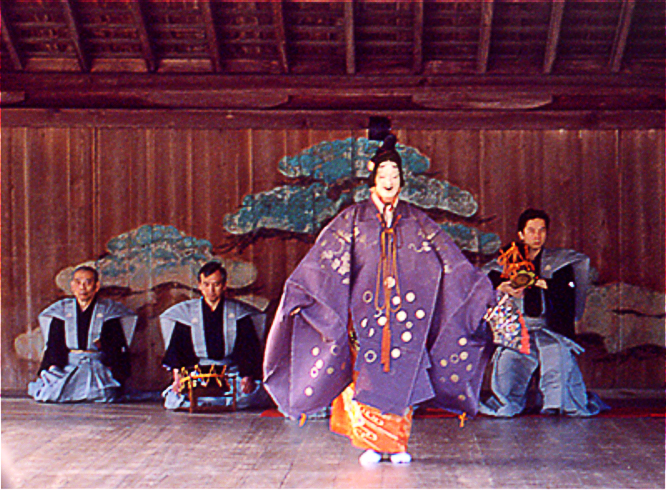
This Noh is an ancient Japanese theatrical performance, more perhaps like the Greek drama than anything in our modern life.
Dan FrazeNARRATOR
All the movements of the actors are measured and conventionalized, speech is a poetical recitative, the costumes are stiff and antique, masks are much used, and the chorus seated upon the stage chants audible comments upon the various situations.
Dan FrazeNARRATOR
This alone, the most ancient and classical of Japanese theatrical performances, is considered worthy of the attention of the emperor and the nobility, and takes the place with them of the more vulgar and realistic plays which delight common people.

MayaHOST
Mm-hmm
Yui TakeshimaGUEST
... which is like Kabuki is Noh theater.
MayaHOST
Yeah.
Yui TakeshimaGUEST
Um, all the traditional stuff.

Addison AndersonNARRATOR
Soon, other troupes began performing in the same style, and kabuki made history as Japan's first dramatic performance form catering to the common people.
Addison AndersonNARRATOR
By relying on makeup or kesho and facial expressions instead of masks and focusing on historical events and everyday life rather than folktales, kabuki set itself apart from the upper-class dance theater form known as Noh and provided a unique commentary on society during the Edo period.
Addison AndersonNARRATOR
At first, the dance was practiced only by females and commonly referred to as onna kabuki.
Addison AndersonNARRATOR
It soon evolved to an ensemble performance and became a regular attraction at teahouses, drawing audiences from all social classes.

Justin HebertHOST
The first was Sugata Sanshiro Part II, a sequel to his first feature film, which the studio more or less forced upon him and is generally considered his weakest film.
Justin HebertHOST
The second was titled The Men Who Tread on the Tiger's Tail, a comedic drama based on the Kabuki play Kanjin Chou, which was in turn based on the Noh play Ataka.
Justin HebertHOST
The film, as well as its sources of inspiration, follow the travails of Minamoto Yoshitsune, the younger brother of the first ruling shogun, Minamoto Yoritomo, who was forced to run for his life from said shogun after a misunderstanding.
Justin HebertHOST
Yoshitsune and his six loyal companions, including the famous warrior monk Benkei, attempt to reach friendly territory among the northern Fujiwara clan while disguised as monks.
Justin HebertHOST
Although the film was a period piece based on Kabuki and Noh plays, themselves both staples of Japanese culture, the Board of Censors repeatedly struck parts of the script from production, and in particular, disliked a character whose primary role was comic relief.
Justin HebertHOST
However, the film was completed in September of 1945, just after the end of the Pacific War, which gave Akira some hope that the film might be released without the interference of the ever-troublesome Board of Censors.
Justin HebertHOST
Although the Allies had dissolved the censorship apparatus of the Empire of Japan's government, they replaced it with their own censorship office, which was intent on assisting the overall mission of SCAP to destroy regressive values in Japan and transform its culture so that the nation could never again threaten world peace.

Dan RichterGUEST
Yeah, that's sort of the way I see it.
Dan RichterGUEST
So I wanted to do that, and I also very much wanted to get to Japan to study the Noh Theater and the Kabukizawa.
Dan RichterGUEST
Anyway, so I was in Paris and trying to figure out how to get to India.
Dan RichterGUEST
I didn't have any money.
13 MINS LATER
Dan RichterGUEST
And we became very good friends.
Dan RichterGUEST
And I was to support myself because I was studying.
Dan RichterGUEST
I would go to the Noh Theater every day to watch rehearsals and talk about technique and things like that.
Dan RichterGUEST
And I couldn't get into the Kabuki rehearsals, but they let me go to as many performances as I want.

speaker_1ADVERTISER
Paid for by Better Nevada PAC.
ExpatriateNARRATOR
Introduction to the Noh Plays of Japan.
ExpatriateNARRATOR
This is a LibriVox recording.
ExpatriateNARRATOR
All LibriVox recordings are in the public domain.
ExpatriateNARRATOR
For more information or to volunteer, please visit LibriVox.org. Recording by Expatriate in Bangor, Maine.
ExpatriateNARRATOR
The Noh Plays of Japan by various authors.
ExpatriateNARRATOR
Translated by Arthur Whaley, 1889-1966.
ExpatriateNARRATOR
Introduction.

speaker_1ADVERTISER
Visit SpinQuest.com for more details.
ExpatriateNARRATOR
Introduction to the Noh Plays of Japan.
ExpatriateNARRATOR
This is a LibriVox recording.
ExpatriateNARRATOR
All LibriVox recordings are in the public domain.
ExpatriateNARRATOR
For more information or to volunteer, please visit LibriVox.org. Recording by Expatriate in Bangor, Maine.
ExpatriateNARRATOR
The Noh Plays of Japan by Various Authors.
ExpatriateNARRATOR
Translated by Arthur Whaley, 1889-1966.
ExpatriateNARRATOR
Introduction.

Dan FrazeNARRATOR
We have already mentioned incidentally the theater as one of the favorite diversions of the people, and though it has never been regarded as a very refined amusement, it has done and is doing much for the education of the lower classes in the history and spirit of former times.
Dan FrazeNARRATOR
Regular plays were never performed in the presence of the emperor and his court, or the shogun and his nobles, but the Noh dance was the only dramatic amusement of the nobility.
Dan FrazeNARRATOR
This Noh is an ancient Japanese theatrical performance, more perhaps like the Greek drama than anything in our modern life.
Dan FrazeNARRATOR
All the movements of the actors are measured and conventionalized, speech is a poetical recitative, the costumes are stiff and antique, masks are much used, and the chorus seated upon the stage chants audible comments upon the various situations.
Dan FrazeNARRATOR
This alone, the most ancient and classical of Japanese theatrical performances, is considered worthy of the attention of the emperor and the nobility, and takes the place with them of the more vulgar and realistic plays which delight common people.