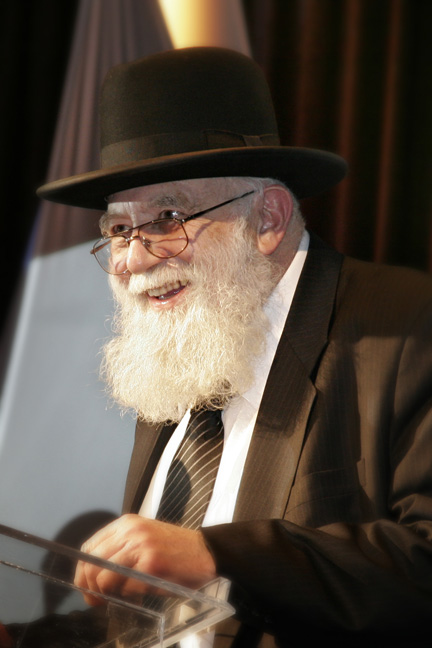
Noah Weinberg
RabbiWikipedia
9
MENTIONS
7
EPISODES
7
PODCASTS
Search complete. 9 mentions across 7 episodes found for "Noah Weinberg".
Sep 24, 2026

Andrea SimontovHOST
There are shapes that are not permissible, but what is most critical is that when we build it, when we construct it, we feel God's love, we feel his protection and we feel that embrace.
Andrea SimontovHOST
And, um, Rav Noah Weinberg, he would say, okay, he was known for saying that just like God is infinitely greater than any of his creations, his love for us is greater even more than a parent could love his only child.
Andrea SimontovHOST
Sit with that a minute.
Andrea SimontovHOST
God's love for us is greater than a parent's love for his only child.

David AaronGUEST
I wanna, wanna reach out.
David AaronGUEST
So, uh, basically what I did is, um, I contacted Rabbi Noah Weinberg of Aish HaTorah.
David AaronGUEST
And I asked him if for exchange of room and board, I would tutor guys.
David AaronGUEST
And, uh, I don't even know why he agreed to that, but he, he said okay.

Charlie HararyHOST
I believe it's the Rambam, for sure.
Charlie HararyHOST
Rav Noah Weinberg always speaks about this.
Charlie HararyHOST
I think he quotes the Rambam, that Avram Avinu loved Hashem.
Charlie HararyHOST
How do you know? Because he spent his whole life getting the world to love Hashem.

David FohrmanGUEST
But love is, at its best is not selfish, as dizzy and dancing and wonderful as it feels, right? And that is what compassion is about, the discovery of the win-win, of the hopelessly biased and connected with you, but not full of me and wanting to, to, to help you become who you are.
David FohrmanGUEST
I remember I wrote about this in my first book, The, The Beast That Crashes at the Door, uh, the chapter titled The Laughing Rabbi, right? When I actually went to Rabbi Weinberg, the Rosh Yeshiva, and I had this great question.
David FohrmanGUEST
And my question is, I don't understand, like, how could the Torah be about kindness, about connection, about altruism, right? Because every act of altruism, like, I wouldn't do it unless I was interested in it.
David FohrmanGUEST
Like the mother who selflessly sacrifices and saves her child, like, she does that because she wants to, so she's just self-interested, right? And you know what my Rosh Yeshiva's answer was? He laughed.

Yossi PaltielHOST
[instrumental music] Now, in the Yiddish Tanya, in Rabbi Weinberg's Tanya, it says that this Igeres HaKodesh doesn't have a mispar, right? All the Igeres HaKodesh have numbers.
Yossi PaltielHOST
So this one, it's a new letter, it doesn't have a number.
Yossi PaltielHOST
So he writes-- Weinberg writes that it's because it wasn't printed in the Igeres HaKodesh till Tof Rey Samech till the Rebbe Rashab redid the Tanya.

Oshi BloomHOST
Not just hear me and write notes, but listen.
Oshi BloomHOST
Anybody know the difference between hearing and listening? Anybody know? There's a rabbi named Rabbi Noah Weinberg, who is the founder of Eish.
Oshi BloomHOST
And he once said the following.
Oshi BloomHOST
He said, many times we hear to reply as opposed to listening to understand.

ShalomHOST
And so from that, with that hat on for a second, what is your perspective on this shared path? that we are this subsect of Orthodox Judaism.
ShalomHOST
And I'd love to hear more of your perspective on both, if this feels right to you to talk about right now, both its founding, this Noah Weinberg who started it, you know, 1967 or so, which is not, you know, the early 70s, which is only... 20 years after the Holocaust and he lived through it and then a constant Holocaust analogies and then got our parents in, you know, late 70s, early 80s.
ShalomHOST
I guess both our parents were involved there.
ShalomHOST
What was going on, do you think, for them emotionally?
26 MINS LATER
ShalomHOST
When you come out and you're actually happier.
ShalomHOST
I said this on a bigger podcast I was on recently.
ShalomHOST
I was like, listen, Noah Weinberg, you spent every day of your life selling the secrets of happiness.
ShalomHOST
And I'm just here to tell you the further I get from what you were teaching, the happier I become.