NLRP3
ProteinWikipedia
28
MENTIONS
14
EPISODES
14
PODCASTS
Search complete. 28 mentions across 14 episodes found for "NLRP3".
Sep 21, 2026

Russ ConroyHOST
Next, Dr. David Salmon from Moffitt Cancer Center discussed findings and implications from a Phase IIa study assessing Ophirnoflast in lower-risk MDS.
Russ ConroyHOST
Given that Ophirnoflast acts upstream as a first-in-class NUK7 and NLRP3 inflammasome inhibitor, how compelling are the biomarker data in proving true disease modification rather than just symptomatic erythroidous support?
David SallmanGUEST
Yeah, so I think the data supporting the concept is now over 10 years ago.
David SallmanGUEST
A really seminal publication was back in 2016 that kind of shows this pathway is central to sort of all subtypes of MDS, not just a specific one.

Rich JohannesenHOST
what's so exciting.
Richard HorowitzGUEST
Right, which is called the NLRP3 inflammasome pathway that we discussed earlier.
Richard HorowitzGUEST
So Dapsone had this dual effect of lowering inflammation in the brain independent of whether you have Lyme or not.
Richard HorowitzGUEST
And that's why the drug really needs to be looked at and repurposed.
Richard HorowitzGUEST
Because in a Korean study of over 4,000 people with leprosy, where they gave rifampin and dapsone for years, what they found is The ones who took Dapsone for 15 years, their Alzheimer's rates were six times lower than the people that never took Dapsone.
Richard HorowitzGUEST
And we don't know whether that population actually had Lyme or whether the Dapsone was just affecting this NLRP3 inflammasome pathway, lowering neuroinflammation in the brain.
Richard HorowitzGUEST
But the point is, this opens up a whole new area of research, considering that we are in the middle of an Alzheimer's epidemic, just like we're in the middle of a Lyme epidemic.
Richard HorowitzGUEST
And now I think You know, there's a reason why the Lyme epidemic may be affecting the Alzheimer's epidemic is because I discovered that all 16 M-synch factors are associated, but also that Borrelia burgdorferi is going to be one of the co-factors.

Gabrielle Hutcheson DonaldsonHOST
And it's for what N L R P three stands for is not like, so N O D like receptor family pyrin domain containing three.
Gabrielle Hutcheson DonaldsonHOST
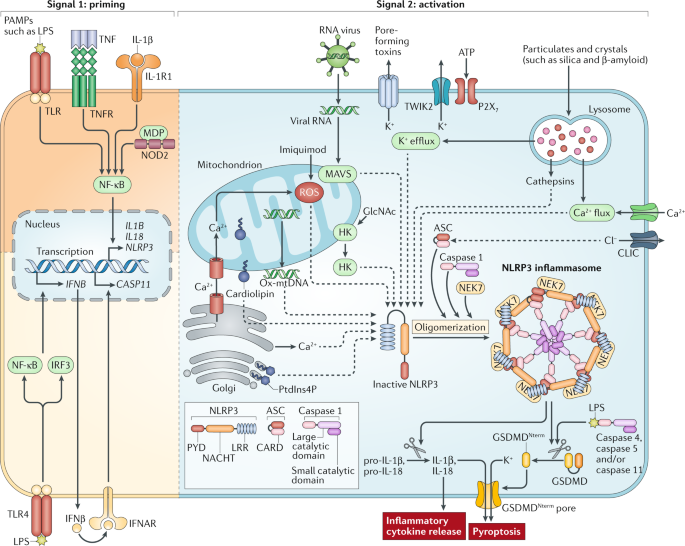
I'm not even going to keep on with that, okay? But the biology of this is quite interesting because that molecule NLRP3 activates and it causes, it has two stages.
Gabrielle Hutcheson DonaldsonHOST
One is priming and one is activation.
Gabrielle Hutcheson DonaldsonHOST
And think of the priming as it's getting the system ready and then the activation is, oh, something dangerous has actually happened.
Gabrielle Hutcheson DonaldsonHOST
So the signaling is, that this NLRP3 causes, right? The signal one, which is priming, the inflammatory receptors can activate signaling pathways, including NF-beta, okay? And that can increase the production of components like pro-IL-1-beta or pro-IL-18.
Gabrielle Hutcheson DonaldsonHOST
And the inflammasome-related machinery The cell is loading this ammunition and then the signal for activation comes in.
Gabrielle Hutcheson DonaldsonHOST
And so with activation of this involves multiple danger associated events such as reactive oxygen species, potassium influx, mitochondrial dysfunction, cellular stress.

Tony EstradaGUEST
And, and in this arena in early biotech and startup world, it's very rarely the first idea, the first target, um, that you bu- that you have in your initial vision that pans out.
Tony EstradaGUEST
Um, you know, we've been very fortunate, uh, to date in that NLRP3 and SARM1 specifically for 10b were our top two priority programs when we launched the company.
Tony EstradaGUEST
And we were able to deliver on advancing assets for both into the clinic within a two-year timeframe.
Tony EstradaGUEST
I think that's not very common.

Anthony ChaffeeGUEST
So your ratio of NAD+ NADH is actually improved, and this has been shown to reduce oxidative stress and improve in a number of different, um, ways, especially in, uh, it's protective to brain health as well.
Anthony ChaffeeGUEST
Ketones like beta-hydroxybutyrate, which is the main ketone body that's made when we're in ketosis, blocks NLRP3 inflammasome, and so this r-directly reduces inflammation throughout the body.
Anthony ChaffeeGUEST
And when you're in a high-stress state, you're working out all the time, you have inflammation building up, this is a very good thing.
Anthony ChaffeeGUEST
Um, also, you're not bringing in extra an-- um, um, inflamma-inflammatory factors, like from, from the different things that you're eating.
Anthony ChaffeeGUEST
Obviously, you know, from the talk we heard, uh, from Dr. Paul Mason today on concussions and how adventatiou- advantageous it is to be in ketosis at the point of concussion, this is obviously a huge advantage to any athlete going, uh, especially a contact athlete.
Anthony ChaffeeGUEST
And, uh, just to reiterate for people, um, you know, on-- watching this on YouTube, the reason being is because you have a secondary, uh, damage that comes after the, the initial concussion and insult, and, uh, this can cause inflammation, oxidative stress.
Anthony ChaffeeGUEST
And when you're in ketosis, those elevated ketones block inflammation like NLRP3 inflammasomes, and it reduces that inflammation and damage.
Anthony ChaffeeGUEST
It also allows you to get energy into the brain to, to, um, uh, heal, you know, help the brain heal and recover and also just function normally.

Jill CarnahanHOST
Yeah.
Bob MillerGUEST
Because when it's exposed, it can even directly talk to NLRP3, and that's...
Bob MillerGUEST
We spoke about that in another webinar, helping recruit and activate the inflammasomes-
Jill CarnahanHOST
Wow
Jill CarnahanHOST
[laughs]
Bob MillerGUEST
So you can see how this thing just keeps spinning.
Bob MillerGUEST
So mitochondrial stress leads to the NLRP3 recruitment, inflammasome activation.
Bob MillerGUEST
So look at all cardiolipin helps to do.

Richard HorowitzGUEST
These will stimulate a pathway called Nrf2.
Richard HorowitzGUEST
The third pathway is called NLRP3 inflammasomes.
Richard HorowitzGUEST
Now, this is important in cancer, in Alzheimer's disease, in most chronic illnesses that you're going to see.
Richard HorowitzGUEST
How do you shut it down? Well, it turns out these first two things we talked about, NF-kappa-B, Nrf2, if you take these supplements with curcumin, broccoli seed extract, resveratrol, by the way, is also a great Nrf2 stimulator, hits the sirtuin genes of the body for longevity, right? It's part of my protocol.
Richard HorowitzGUEST
It also affects NLRP3 inflammasomes, but you also do it with low-dose naltrexone and low-dose melatonin.
Gary BreckaHOST
Wow.
Gary BreckaHOST
Taken at night, before bed?
Richard HorowitzGUEST
Yeah, and if you have a problem sleeping with LDN, I take actually mine in the morning just to make sure it's not, but I take 4.5 milligrams of low-dose naltrexone compounded through Infuserv in Florida.

Jack KruseGUEST
When those crystals, uh, solidify, because the dielectric constant of water decreases, an inflammasome is triggered.
Jack KruseGUEST
That inflammasome pathway is the NLRP3 pathway, and this causes, you know, a unified disease, uh, pathway in diabetes.
Jack KruseGUEST
Okay? This is-- explains why diabetics often get gout.
Jack KruseGUEST
And then you gotta ask the next question that's present in centralized and functional medicine, because you know the functional medicine guys always try to tell you that, that insulin resistance is a big deal, and you know that centralized medicine, especially in Type 1 diabetics, often uses insulin.

Kuei-Ting TungSOUNDBITE_SPEAKER
Um, but it also, it causes a systemic inflammation.
Kuei-Ting TungSOUNDBITE_SPEAKER
There's a specific, uh, enzymes called NLRP3 inflammasome.
Kuei-Ting TungSOUNDBITE_SPEAKER
So, um, what it does is it increases the inflammation.
Kuei-Ting TungSOUNDBITE_SPEAKER
We call it systemic inflam- inflammation, and, uh, it also causes oxidative stress.

Alex KikelGUEST
... biology.
Alex KikelGUEST
And so usually those people that are more over-trained, you get more of that NLRP3 inflammasome, and that just drives so much more systemic inflammation.
Alex KikelGUEST
So those people get it, and they're hyper-responders 'cause you're cleaning out everything from the system that you've accumulated.
Alex KikelGUEST
So it makes sense that he got such a robust response.
4 more episodes mention NLRP3.
Create an account to see the whole feed, search across every transcript, and follow the entities you care about.