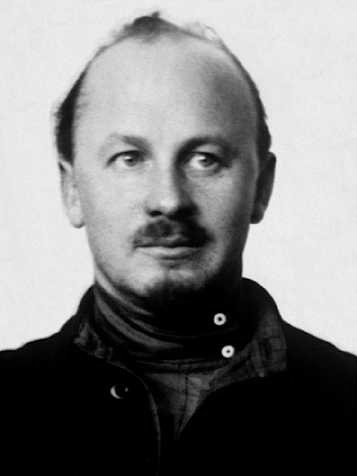
Nikolai Bukharin
Russian-Soviet politicianWikipedia
66
MENTIONS
22
EPISODES
14
PODCASTS
Search complete. 66 mentions across 22 episodes found for "Nikolai Bukharin".
Oct 19, 2026

Paul FryHOST
This fundamental plot, obviously a variant on the marriage plot but very much engaged also in what Benjamin would call the mechanical aspect of reproduction.
Paul FryHOST
This sort of plot, the characteristic plot of socialist realism, began to take hold officially so that in 1934 the Soviet culture minister Bukharin convened an International Soviet Writers' Conference in which it was simply decreed from on high that henceforth literary practice would consist, in the promotion of an exemplification of socialist realism.
Paul FryHOST
And since then, really right up until the fall of the Iron Curtain in 1989, since then, there really was a form of censorship.
Paul FryHOST
I

J. Otto PohlGUEST
Uh, but there was no affirmative action for them like there was every other nationality during this time.
J. Otto PohlGUEST
And in '36, you start to change, uh, with the new constitution, uh, written by, uh, Bukharin.
J. Otto PohlGUEST
And then you see at the end of the Great Terror, uh, Yagoda has already been replaced in, uh, '36 by Yezhov, who was half Russian.
J. Otto PohlGUEST
His mother was Lithuanian, uh, but he wasn't Jewish.

C. Derick VarnHOST
That, that is me saying that Lenin's analysis for what they, what they needed to be done was guided by basically responding to an ever-shifting political terrain.
C. Derick VarnHOST
And when you saw the debates in the 1920s in the Comintern, like between Trotsky and Stalin and Bukharin and Zinoviev and Kamenev and all that, I was like, well, all of them are citing Lenin, and frankly, they're all citing Lenin correctly.
C. Derick VarnHOST
Like, depending on the time period you're looking at Lenin at.
C. Derick VarnHOST
And it, it, it kind of got me thinking about the problem that Lenin presents for a lot of us because we do try to turn him into a very coherent set of, like, doctrines that we can add on to more fully fledge out the, the political side of Marxism because Marx and Engels' politics are...
Matthew Raphael JohnsonGUEST
Why don't we, why don't we, um, pause here because now the, what's gonna happen from here on in is the economic stuff.
Matthew Raphael JohnsonGUEST
Um, and we talk about people like Bukharin and everything else.
Matthew Raphael JohnsonGUEST
This is a natural break.
Matthew Raphael JohnsonGUEST
Um, but, um, again, everything, all of these fields, specialized education, sort of, but it had to be based on ideology.
11 MINS LATER
Pete QuiñonesHOST
Picking up where we left off last time.
Pete QuiñonesHOST
Even sharper changes gripped the economic life of the country.
Pete QuiñonesHOST
Bukharin publicly announced at a Communist Party conference in 1927 that, "During war communism, we purged a Russian petty and middle bourgeoisie along with leading capitalists.
Pete QuiñonesHOST
When the economy was later opened up to free trade, petty and middle Jewish bourgeoisie took the place of the Russian bourgeoisie and roughly the same happened with our Russian intelligentsia which bucked and sabotaged our efforts.
Pete QuiñonesHOST
Agursky cites a Seliga exiled with Trotsky in the Urals, quote, "Indeed, the Trotskyites were young Jewish intellectuals and technicians, particularly from Left Bundists." Quote, "The opposition was viewed as principally Jewish, and this greatly alarmed Trotsky.
Pete QuiñonesHOST
In March of 1924, he complained to Bukharin that among the workers it is openly stated, 'The kikes are rebelling,' and he claimed to have received hundreds of letters on the topic.
Pete QuiñonesHOST
Bukharin dismissed it as trivial." Then, quote, "Trotsky tried to bring the question of antisemitism to a Politburo session, but no one supported him." End quote.
Pete QuiñonesHOST
More than anything, Trotsky feared that Stalin would use popular antisemitism against him in their battle for power, and such was partially the case against U- Uglanov, then Secretary of the Moscow Committee of the CP.
Pete QuiñonesHOST
Quote, "Antisemitic cries were heard," end quote, during Uglanov's dispersal of pro-Trotsky demonstration in Moscow, November 7th, 1927.
28 MINS LATER
Pete QuiñonesHOST
No one from the persecutors would be accused of having their own national interest.
Pete QuiñonesHOST
It must be noted that the commission which prepared the decree abolishing the history and the philol- philology depart- departments at Russian universities was made up of Jews and non-Jews alike.
Pete QuiñonesHOST
Goikbar, Glarin, Radik, and Ropstein, as well as Bukharin and P- Pokrovsky, uh, Skvorzov, ba-ba-ba-ba.
Pete QuiñonesHOST
The theater superintendent, Comrade Nashatir, would have to act on the order, but Trotsky had dissuaded Lenin.
Pete QuiñonesHOST
And even after the October coup, the Moscow Soviet of Soldiers' Deputies had among its members, according to Bukharin, dentists, pharmacists, etc., representative of trades as close to the soldier's profession as to that of the Chinese emperor.
Matthew Raphael JohnsonGUEST
And that's the key fact.
Matthew Raphael JohnsonGUEST
These people knew nothing about the life of the laborer and certainly knew nothing about the life of the peasant.
3 HRS 22 MINS LATER
Pete QuiñonesHOST
What he feared was the reaction of the Russian people in the West.
Pete QuiñonesHOST
There were, however, already indications that the thing would pass without making waves.
Pete QuiñonesHOST
The decision was also-- The decision would also depend on, of course, on Trotsky, Kamenev, Zvoniev, Bukharin, but they were for the time absent from Moscow, and their mentality, with the possible exception, with the possible exception possibly of that of Kamenev, allowed to suppose none of them would have anything to say about it.
Pete QuiñonesHOST
Trotsky, as we know, approved of this without feeling any emotion.

Matthew Raphael JohnsonGUEST
Why don't we pause here because now what's going to happen from here on in is the economic stuff.
Matthew Raphael JohnsonGUEST
And we talk about people like Bukharin and everything else.
Matthew Raphael JohnsonGUEST
This is a natural break.
Matthew Raphael JohnsonGUEST
But again, everything, all of these fields, specialized education, sort of, but it had to be based on ideology.
11 MINS LATER
Pete QuiñonesHOST
... where we left off last time.
Pete QuiñonesHOST
"Even sharper changes gripped the economic life of the country.
Pete QuiñonesHOST
Bukharin publicly announced at a Communist Party conference in 1927 that during war communism we purged the Russian petty and middle bourgeoisie along with leading capitalists.
Pete QuiñonesHOST
When the economy was later opened up to free trade, petty and middle Jewish bourgeoisie took the place of the Russian bourgeoisie, and roughly the same happened with our Russian intelligentsia, which bucked and sabotaged our efforts.
Pete QuiñonesHOST
Agursky cites a Seliga exiled with Trotsky in the Urals, quote, "Indeed, the Trotskyites were young Jewish intellectuals and technicians, particularly from left Bundists." Quote, "The opposition was viewed as principally Jewish, and this greatly alarmed Trotsky.
Pete QuiñonesHOST
In March of 1924, he complained to Bukharin that among the workers it is openly stated, 'The kikes are rebelling,' and he claimed to have received hundreds of letters on the topic.
Pete QuiñonesHOST
Bukharin dismissed it as trivial." Then, quote, "Trotsky tried to bring the question of antisemitism to a Politburo session, but no one supported him." End quote.
Pete QuiñonesHOST
More than anything, Trotsky feared that Stalin would use popular antisemitism against him in their battle for power, and such was partially the case against U-Uglanov, then secretary of the Moscow Committee of the CP.
Pete QuiñonesHOST
Quote, "Antisemitic cries were heard," end quote, during Uglanov's dispersal of pro-Trotsky demonstration in Moscow, November 7th, 1927.
29 MINS LATER
Pete QuiñonesHOST
No one from the persecutors would be accused of having their own national interest.
Pete QuiñonesHOST
It must be noted that the commission which prepared the decree abolishing the history and the philol- philology depart- departments at Russian universities was made up of Jews and non-Jews alike.
Pete QuiñonesHOST
Goikhbar, Glarin, Radek, and Robstein, as well as Bukharin and P- Pokrovsky, uh, Skvortsov.
Pete QuiñonesHOST
The theater superintendent, Comrade Nashatyr, would have to act on the order, but Trotsky had dissuaded Lenin.
Pete QuiñonesHOST
And even after the October coup, the Moscow Soviet of Soldiers' Deputies had among its members, according to Bukharin, dentists, pharmacists, et cetera, representative of trades as close to the soldier's profession as to that of the Chinese emperor.
Matthew Raphael JohnsonGUEST
And that's the key fact.
Matthew Raphael JohnsonGUEST
These people knew nothing about the life of the laborer and certainly knew nothing about the life of the peasant.
3 HRS 16 MINS LATER
Pete QuiñonesHOST
What he feared was the reaction of the Russian people in the West.
Pete QuiñonesHOST
There were, however, already indications that the thing would pass without making waves.
Pete QuiñonesHOST
The decision was also-- The decision would also depend on, of course, on Trotsky, Kamenev, Zvonarev, Bukharin, but they were for the time absent from Moscow, and their mentality, with the possible exception, with the possible exception possibly of that of Kamenev, allowed to suppose none of them would have anything to say about it.
Pete QuiñonesHOST
Trotsky, as we know, approved of this without feeling any emotion.

Radhika DesaiGUEST
You know, P- that pamphlet that Lenin wrote in 1916, which I already alluded to earlier, he talks about imperialism as the highest stage of capitalism.
Radhika DesaiGUEST
Now, in this, he's using the term imperialism as more or less the equivalent of Bukharin's national capital or, uh, uh, Hilferding's finance capital or monopoly capital more generally and, and so on.
Radhika DesaiGUEST
So he's basically saying that capitalism has arrived at its monopoly phase.
Radhika DesaiGUEST
These were just different names for talking about the same thing, and that it is at the highest form because from here it has nowhere else to go and it's time to, to transform it.
12 more episodes mention Nikolai Bukharin.
Create an account to see the whole feed, search across every transcript, and follow the entities you care about.