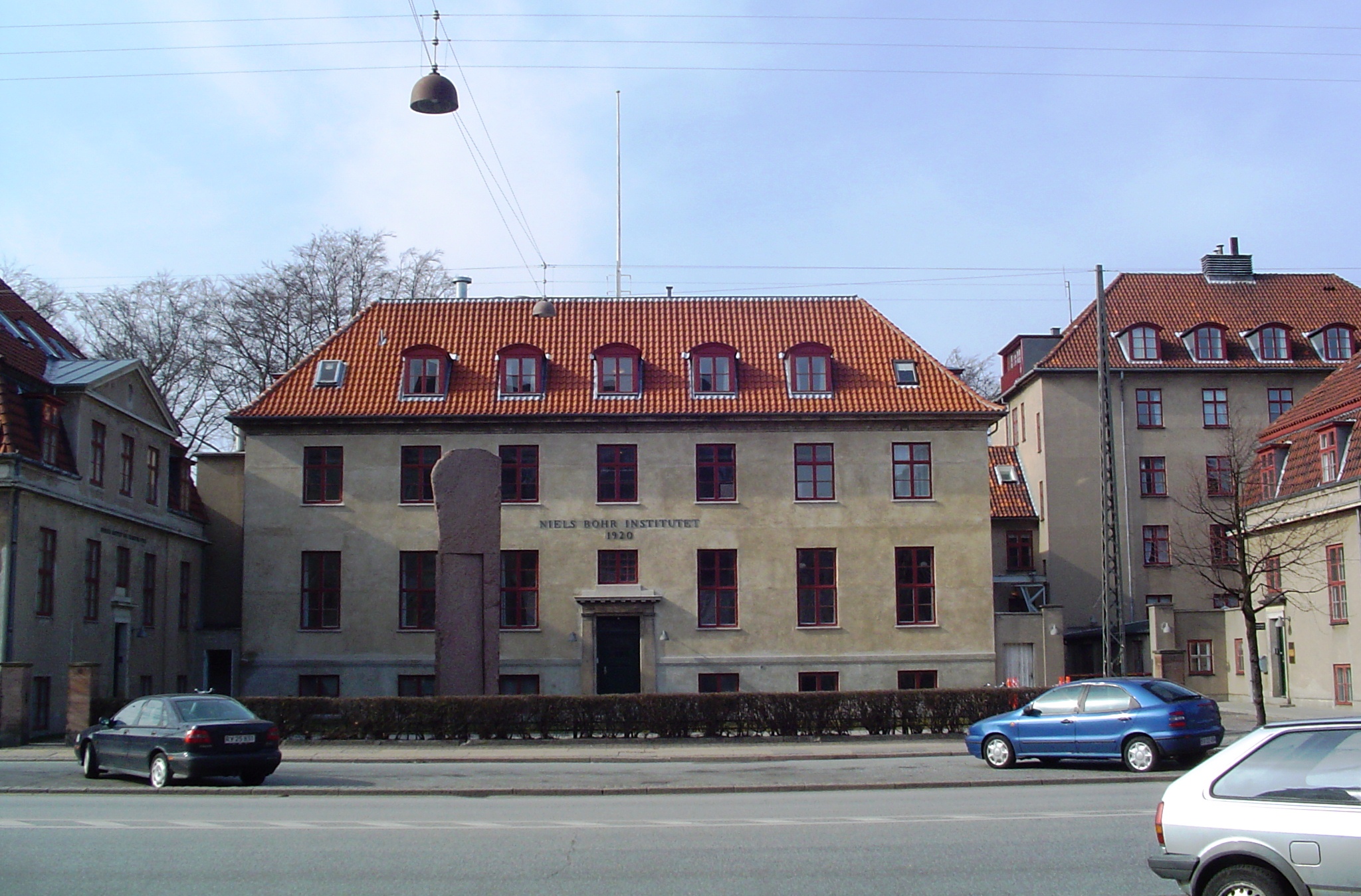
Niels Bohr Institute
Research institute in Copenhagen, DenmarkWikipedia
11
MENTIONS
7
EPISODES
6
PODCASTS
Search complete. 11 mentions across 7 episodes found for "Niels Bohr Institute".
Oct 6, 2026

Mudiwa GavazaHOST
Yeah.
Markus ThillGUEST
And disordered systems and essentially what we did, uh, that's why I also went to Israel and I gave lectures at Weizmann Institute, but I also was at n- give lectures at Niels Bohr Institute and elsewhere, lectures around the world.
Markus ThillGUEST
Uh, this part of statistical physics is actually the foundation of...
Markus ThillGUEST
And what I did at, um, uh, at Hebrew University, I was a member of the, um, um, Institute for, uh, Neural Computation.

Kevin KnuthGUEST
Um, let's see.
Kevin KnuthGUEST
And Dr., um, Daniel Kumba, who was, who was at the Niels Bohr Institute for some time, had, um, analyzed this radar data and looked at the acceleration made by, um, several jumps as the...
Kevin KnuthGUEST
So this UFO basically stayed about seven kilometers away from the airplane and just with every sweep of the-- it basically moved around the plane, and with every sweep of the radar, it would be on one side of the plane, and then the next sweep of the radar would be at the other side of the plane.
Kevin KnuthGUEST
So you can estimate the, um, minimum accelerations here.

Stuart GaryHOST
What happened in those first moments of the universe before the building blocks of life and the world as we know it came into existence? Physicists at CERN, the European Organization for Nuclear Research, are trying to answer this question by recreating some of the extreme conditions that prevailed in the universe at the very beginning of time.
Stuart GaryHOST
Now, researchers from the Niels Bohr Institute, together with colleagues from the ALICE collaboration at CERN's Large Hadron Collider, the world's biggest atom smasher, have come one step closer to understanding those conditions.
Stuart GaryHOST
At CERN, physicists collide atomic nuclei at some 99.9999% the speed of light, in the process creating the tiny droplets of primordial matter that filled the universe during its first millionth of a second of creation.
Stuart GaryHOST
This substance is known as quark-gluon plasma and thought to have been the earliest form of matter in our universe.
Stuart GaryHOST
For many years, scientists have assumed that creating this plasma required collisions between very heavy atomic nuclei, such as lead.
Stuart GaryHOST
But physicists from the Niels Bohr Institute have now succeeded in creating this primordial matter by smashing much smaller nuclei of oxygen-16 and neon-20 together.
Stuart GaryHOST
The study's lead author, Zhao Zhu from the Niels Bohr Institute and the University of Copenhagen, says they've pushed the boundaries for how small the atomic nuclei can be while still recreating this quark-gluon plasma.
Stuart GaryHOST
The discovery means scientists now know more about the fundamental conditions required for matter to transition into this extreme state.

Stuart GaryHOST
What happened in those first moments of the universe, before the building blocks of life and the world as we know it came into existence? Physicists at CERN, the European Organization for Nuclear Research, are trying to answer this question by recreating some of the extreme conditions that prevailed in the universe at the very beginning of time.
Stuart GaryHOST
Now researchers from the Niels Bohr Institute, together with colleagues from the ALICE collaboration at CERN's Large Hadron Collider, the world's biggest atom smasher, have come one step closer to understanding those conditions.
Stuart GaryHOST
At CERN, physicists collide atomic nuclei at some 99.9999% the speed of light, in the process creating the tiny droplets of primordial matter that filled the universe during its first millionth of a second of creation.
Stuart GaryHOST
This substance is known as quark-gluon plasma and is thought to have been the earliest form of matter in our universe.
Stuart GaryHOST
For many years, scientists have assumed that creating this plasma required collisions between very heavy atomic nuclei, such as lead.
Stuart GaryHOST
But physicists from the Niels Bohr Institute have now succeeded in creating this primordial matter by smashing much smaller nuclei of oxygen-16 and neon-20 together.
Stuart GaryHOST
The study's lead author, Zhao Zhu from the Niels Bohr Institute and the University of Copenhagen, says they've pushed the boundaries for how small the atomic nuclei can be while still recreating this quark-gluon plasma.
Stuart GaryHOST
The discovery means scientists now know more about the fundamental conditions required for matter to transition into this extreme state.

Tim DennisHOST
Whoa, that's a last name.
Tim DennisHOST
Gogila Shvili, uh, a particle astrophysicist at the University of Copenhagen's Niels Bohr Institute in Denmark, told space.com, "They carry away about 99% of the energy released when the core collapses, and a small change in how they behave can decide the fate of the whole star." Uh, much remains uncertain about which massive stars explode to birth neutron stars and which collapse to form black holes.
Tim DennisHOST
Uncovering these details could help shed light on a wide range of activity in the cosmos, like the way in which dying stars filled the universe with the kinds of matter that nowadays make up everything from planets to people.
Tim DennisHOST
So there you go.

AveryHOST
Even though plenty of stars are heavier, something is quietly removing the most massive stars from the exploding population.
AveryHOST
A new paper in Physical Review D from Mariam Gogilashvili and Irene Tamborra at the Niels Bohr Institute in Copenhagen, Tauntons름, points at an unlikely culprit, neutrinos changing identity.
AnnaHOST
Quick refresher.
AnnaHOST
When a massive star's core collapses, about 99% of the energy released leaves as neutrinos, and the explosion depends on a small fraction of that flood being reabsorbed by the gas just outside the core, heating it enough to revive the stalled shockwave.
AveryHOST
Something is quietly removing the most massive stars from the exploding population.
AveryHOST
A new paper in Physical Review D from Mariam Gogilashvili and Irene Tambora at the Niels Bohr Institute in Copenhagen, Taunton, points at an unlikely culprit, neutrinos changing identity.
AnnaHOST
Quick refresher.
AnnaHOST
When a massive star's core collapses, about ninety-nine percent of the energy released leaves as neutrinos, and the explosion depends on a small fraction of that flood being reabsorbed by the gas just outside the core, heating it enough to revive the stalled shockwave.