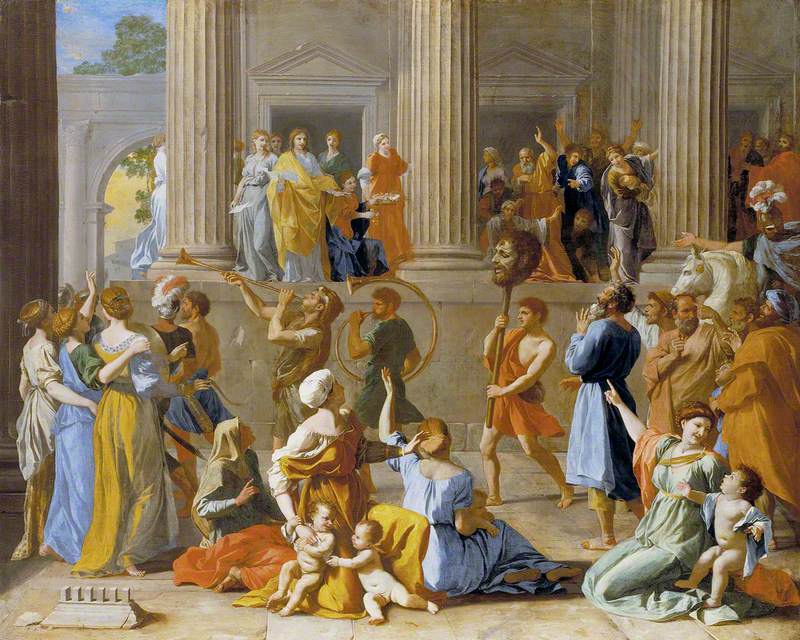
Nicolas Poussin
PainterWikipedia
12
MENTIONS
7
EPISODES
7
PODCASTS
Search complete. 12 mentions across 7 episodes found for "Nicolas Poussin".
Sep 19, 2026

Martin GayfordNARRATOR
He was a man in love with geometry, as many artists have been.
Martin GayfordNARRATOR
Among them, some of the painters Huglot most admired, such as Poussin and Piero della Francesca.
Martin GayfordNARRATOR
But Huglot was also dedicated to working from life, so his subjects were asked to take up the guise of regular geometric solids.
Martin GayfordNARRATOR
Her recent work had involved the model adopting, as far as was possible for a softly rounded human body, the form of the pyramids at Giza.

Pamela NagamiNARRATOR
It takes us back to Rollo and William of the Long Sword, to the Vikings and the Crusaders, to the conquerors of England and Sicily, to masterful prelates of the feudal age like Odo of Bayeux and Thomas Becket.
Pamela NagamiNARRATOR
It brings us down to the admirals and men of art and letters of the Grand Siècle, Tourville and Duquesne, Poussin, Malherbe, and the great Corneille, to Charlotte Corday and the days of the Terror, and to the painters and scholars and men of letters of the 19th century, Géricault and Millet, Laplace and Léopold Delisle, Flaubert and Maupassant, and Albert Sorel.
Pamela NagamiNARRATOR
It traces the laborious clearing of ancient forests, the rude processes of primitive agriculture, the making of Norman cider and the breeding of the Norman horse, the vicissitudes of trade in fish and marten skins, in pottery, cheap cottons, and strong waters, the development of a center of fashion like Trouville, or centers of war and commerce like Cherbourg and Havre.
Pamela NagamiNARRATOR
It describes the slow building of monasteries and cathedrals and the patient labors of priests and monks, as well as the conquest of the Canaries, the colonization of Canada, and the exploration of the Great West.

Jim NolanHOST
Of those who were immediate peoples of Michelangelo, or carried out his designs, Daniel de Volterra was one of the most satisfactory.
Jim NolanHOST
His chief work, The Descent from the Cross, was considered by Poussin one of the three great pictures of the world.
Jim NolanHOST
It is sometimes said to have been designed by Michelangelo, but that is only a conjecture.
Jim NolanHOST
It has much action and life in it, but is somewhat affected in pose and gesture, and Volterra's work generally was deficient in real energy and conception and execution.

Andrew BonneauGUEST
Yeah, absolutely.
Andrew BonneauGUEST
Um, yeah, I mean, it's, it's a method that, uh, uh, you know, illustrators have used in the, in the 20th century, and also it goes back even further to, uh, people like Poussin and Tintoretto, and I'm sure many other artists who we, we don't know they did this, but they probably did, where they would, um, make little clay figurines of, of, of people and, you know, construct a sort of box, you know, with a, with a, with a, with a window on one side and light could come in, and you could arrange the figures like, like a little dollhouse and observe the light coming through.
Andrew BonneauGUEST
And so, um, I knew that that was a way to do things.
Andrew BonneauGUEST
I started playing around with that.

Alexander AdamsGUEST
He's going to train himself.
Alexander AdamsGUEST
So he does all these paintings based on Poussin, the neoclassical French painter that, of course, you know very well, Nicholas Poussin.
Alexander AdamsGUEST
he does some variations on Poussin and he thinks that he's going to get people are going to be flawed because he's done these amazing versions and they're not they're not copies, per se, they are versions that are kind of highly schematic.
Alexander AdamsGUEST
So they're kind of almost pop art versions of Poussin landscapes.
Alexander AdamsGUEST
And he thinks, you know, this is it, you know, like, hey, I've got I've got the classical chops, but hey, I'm gonna be doing it in a contemporary way.
Alexander AdamsGUEST
And it's sort of sort of sort of sneaky, slightly ironic way.
Alexander AdamsGUEST
And of course, he falls flat on his face.
Alexander AdamsGUEST
People look at it and say, What are you doing? I don't know what you're doing.

BJ MillerGUEST
It's a, a painting called Et in Arcadia Ego.
BJ MillerGUEST
It's a painting by Nicolas Poussin, a seventeenth century, uh, painting.
BJ MillerGUEST
Um, so Et in Arcadia Ego, Latin for I, I too exist in paradise.
BJ MillerGUEST
And you ca- it's hard to see in that image, but there are these three, you know, wandering hikers just hanging out in Arcadia, just cruising around paradise, and they come across this tomb, a sarcophagus.

ArdenNARRATOR
Effect of atmospheric appearances on the mind.
ArdenNARRATOR
Nicholas Poussin.
ArdenNARRATOR
Gaspar Poussin.
ArdenNARRATOR
Heroic landscape represents an earth put to no use, a broken country without any tillage.
ArdenNARRATOR
Earnest, not precisely idyllic, but simple men, decent dwellings, but without comfort.