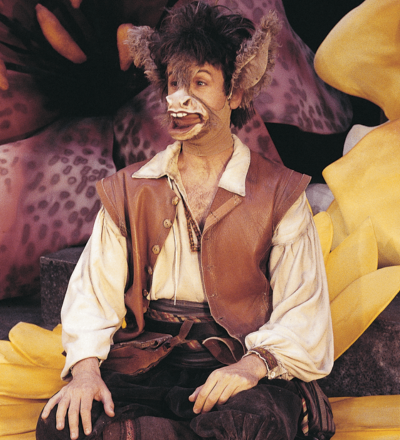
Nick Bottom
35
MENTIONS
7
EPISODES
7
PODCASTS
Search complete. 35 mentions across 7 episodes found for "Nick Bottom".
Oct 26, 2026

Patricia LintonHOST
After two years in the company in 1948, Alexander created the role of the jester in Ashton's full-length Cinderella.
Patricia LintonHOST
That was followed by Briaxis in Ashton's Daphnis and Chloe in 1951, Eros and Sylvia in 1952, Fire in Homage to the Queen in 1953, Birthday Offering in 1956, Terenio and Ondine in 1958, Elaine in La Female Garde in 1960, which has just had a production on at the Royal Opera House in the last season, Bottom in the Dream in 1964, Thursday in Jazz Calendar in 1968, William Meath Baker in Enigma Variations, also in 1968, Peter Rabbit in Ashton's film of Beatrix Potter in 1970, and lastly, Natalia Petrovna's husband...
Patricia LintonHOST
in a month in the country in 1976.
Patricia LintonHOST
And now that's 30 years of creating for Ashton.
21 MINS LATER
Alexander GrantSOUNDBITE_SPEAKER
He never wanted to bore the public.
Frank FreemanSOUNDBITE_SPEAKER
Yes, because he always said it's always better to be too short than too long.
Frank FreemanSOUNDBITE_SPEAKER
And the dream, Bottom,
Alexander GrantSOUNDBITE_SPEAKER
how

Iseult GillespieNARRATOR
This is further complicated by Helena's decision to follow them all into the woods in the hope of winning Demetrius' heart.
Iseult GillespieNARRATOR
At this point, the woods are getting crowded as the lovers are sharing the space with a group of rude mechanicals, a troupe of workers drunkenly rehearsing a play led by the jovial Nick Bottom.
Iseult GillespieNARRATOR
Unbeknownst to them, the humans have entered into the world of the fairies.
Iseult GillespieNARRATOR
Despite their magical splendour, Oberon and Titania, the king and queen of the fairies, have their own romantic problems.
Iseult GillespieNARRATOR
Furious at his inability to control Titania, the jealous Oberon commands the trickster Puck to squeeze the juice of a magical flower over her eyes.
Iseult GillespieNARRATOR
When she wakes up, she'll fall in love with the first thing she sees.
Iseult GillespieNARRATOR
On his mission, Puck gleefully sprinkles the juice over the eyes of the napping Demetrius and Lysander, and transforms Bottom's head into that of a donkey for good measure.
Iseult GillespieNARRATOR
As eyes flicker open, a night of chaos commences that includes broken hearts, mistaken identity, and transformations.

Ernest ChappellVOICE_ACTOR
Let's speak to my self briefly.
Ernest ChappellVOICE_ACTOR
I am prepared to deliver on short notice any one of a large number of Shakespearean parts; Othello, Romeo, Romeo, Bottom the weaver, King Henry IV, V, VI, Petruchio, oh, and, uh, Henry VIII.
James MonksVOICE_ACTOR
I am reasonably familiar with the characters of Shakespeare, sir.
Ernest ChappellVOICE_ACTOR
Ah, good.

AdrianHOST
Exactly.
ClaraHOST
And then, of course, you have Bottom the Weaver.
AdrianHOST
I love Bottom so much.
ClaraHOST
He's the best.
ClaraHOST
He and his amateur acting troupe, the Mechanicals, are out in the woods rehearsing a play.
AdrianHOST
Pyramus and Thisbe.
ClaraHOST
Right.
ClaraHOST
And Bottom famously gets his head turned into an ass's head by Puck.

speaker_4NARRATOR
Milton seems to have been upon the prowl here for his forest side.
speaker_4NARRATOR
In A Midsummer's Night Dream, a fairy addresses Bottom the weaver, "Hail, mortal, hail," which sufficiently shows she was not so herself.
speaker_4NARRATOR
Puck, or Robin Goodfellow, in the same play, calls Oberon, "King of shadows," and in the old song just mentioned, "The king of ghosts and shadows." And this mighty monarch asserts of himself and his subjects, "But we are spirits of another sort." The fairies, as we already see, were male and female.
speaker_4NARRATOR
Their government was monarchical, and Oberon, the king of fairyland, must have been a sovereign of very extensive territory.

Mr ForsterHOST
So, whilst the opening scene of A Midsummer Night's Dream adheres to many of the generic expectations of early modern comedy, two young lovers are separated by an older, ineffectual patriarch who will inevitably be overcome in the comic resolution of the final act, there is still something missing.
Mr ForsterHOST
The evident comic potential in the tangled love web of the four young Athenians is so far unrealised, and it is only with the arrival on stage of the most celebrated clown of the late Elizabethan period, Will Kemp, the first actor to play Bottom, that the play staggers into a more humorous vein.
Mr ForsterHOST
Nevertheless, within the comic malapropisms and bombastic flair we see in the clowning of the rude mechanicals, there is also a metatheatrical comment on the nature of acting on the early modern stage, defined by an altogether different kind of humour.
Mr ForsterHOST
So the question's on humour.
5 MINS LATER
Mr ForsterHOST
It kind of foreshadows the tragical mirth and tedious brief scene.
Mr ForsterHOST
Absolutely.
Mr ForsterHOST
And Bottom
Miss YemHOST
immediately agrees with Quince, doesn't he? And says, oh, yes, a very good piece and a merry.

Tait BrennanGUEST
That was my interpretation.
Victoria GartnerHOST
Both of these parts, both Bottom and Romeo, are traditionally male partners.
Victoria GartnerHOST
Yes.
Victoria GartnerHOST
And I wondered, like, how you felt or how you approached it to, like, play traditionally male roles, even though now, you know, we're making lots of progress, but especially Romeo.