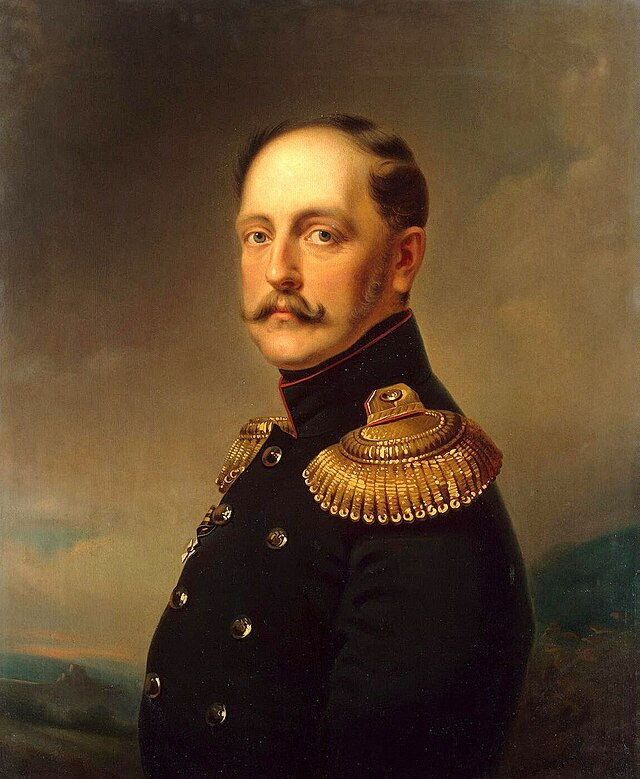
Nicholas I of Russia
Former emperor of RussiaWikipedia
444
MENTIONS
41
EPISODES
28
PODCASTS
Search complete. 444 mentions across 41 episodes found for "Nicholas I of Russia".
Sep 12, 2026

David Patrick HarryHOST
Historically, and this is what, again, we were talking about in the last week, the difference between patriotism and nationalism.
David Patrick HarryHOST
We're going to be looking at, as Jose brought up, Tsar Nicholas I.
David Patrick HarryHOST
He is clearly a patriot.
David Patrick HarryHOST
But he's certainly not a nationalist.
38 MINS LATER
David Patrick HarryHOST
And then you get to February with the first French Revolution.
David Patrick HarryHOST
This is a decisive event that transformed the regional unrest into a European revolutionary wave.
David Patrick HarryHOST
And this is where Tsar Nicholas I says, again, I'm paraphrasing.
David Patrick HarryHOST
I can't remember the exact quote.

speaker_6NARRATOR
A Voyage on an Ice Block by David Carr The breaking up of the ice in Russia is always a fine sight to look at, even upon a small stream like the Neva at St. Petersburg, which is a mere brook compared with the great rivers of the South.
speaker_6NARRATOR
As soon as the spring thaw sets in, all the wooden bridges are removed, and nothing checks the descending ice but the stone piers of the Nikolaevsky Bridge, named after its founder, the Tsar Nicholas.
speaker_6NARRATOR
Every morning, while the show lasts, the balustrades of this bridge are lined with a crowd of eager spectators, looking as intently at the wonderful sight as if they had never seen it before.
speaker_6NARRATOR
and a wonderful sight it is indeed far as the eye can reach the smooth dark surface of the river is one great procession of floating masses of ice of all shapes and sizes moving slowly and steadily downward But the place to see this famous sight at its best is the Volga, which, with its two thousand miles of length, brings down ice enough to overwhelm a whole city.

Gary ArndtHOST
By the mid-19th century, disputes over the Christian holy places had become part of a much larger geopolitical confrontation.
Gary ArndtHOST
France under Napoleon III championed Catholic claims, while Tsar Nicholas I of Russia championed Orthodox claims.
Gary ArndtHOST
France pressured the Ottoman Empire to restore Catholic rights to the church that it argued had been guaranteed by earlier treaties.
Gary ArndtHOST
Russia insisted that the Orthodox rights that had been established since 1757 be preserved.

Dan CumminsHOST
Always problems for the West.
Dan CumminsHOST
Britain, France, the Kingdom of Sardinia, and the Ottoman Empire, modern-day Turkey, all partnered up to fight against the Russian forces of Tsar Nicholas I, who was attempting to expand his influence in the Middle East and the Eastern Mediterranean.
Dan CumminsHOST
The British and the French got involved because Russia was a threat to their trade routes in this part of the world.
Dan CumminsHOST
The real spark that started this war was religious tension between Catholics and Orthodox people over access to Jerusalem and other holy sites controlled by the Ottoman Empire, something that also certainly was not new.

speaker_9NARRATOR
A Voyage on an Ice Block by David Carr The breaking up of the ice in Russia is always a fine sight to look at, even upon a small stream like the Neva at St. Petersburg, which is a mere brook compared with the great rivers of the South.
speaker_9NARRATOR
As soon as the spring thaw sets in, all the wooden bridges are removed, and nothing checks the descending ice but the stone piers of the Nikolaevsky Bridge, named after its founder, the Tsar Nicholas.
speaker_9NARRATOR
every morning while the show lasts the balustrades of this bridge are lined with a crowd of eager spectators looking as intently at the wonderful sight as if they had never seen it before and a wonderful sight it is indeed far as the eye can reach the smooth dark surface of the river is one great procession of floating masses of ice of all shapes and sizes moving slowly and steadily downward But the place to see this famous sight at its best is the Volga, which, with its two thousand miles of length, brings down ice enough to overwhelm a whole city.
speaker_9NARRATOR
At times the force of the current piles it up, sheet over sheet, into huge mounds, the crashing and grinding of which, as they dash against each other, make the very air shake.

speaker_0NARRATOR
He sharply criticized another high functionary, and I remarked in the latter's defense.
speaker_0NARRATOR
Still there is this to be said for him, that he never accepted service under Nicholas I.
speaker_0NARRATOR
And now he is in service under the reign of Shuvalov and Trepov, was the reply, which so correctly described the situation that I could say nothing more.
speaker_0NARRATOR
General Shuvalov, the chief of the state police, and General Trepov, the chief of the St. Petersburg police, were indeed the real rulers of Russia.
21 MINS LATER
speaker_0NARRATOR
The very reforms which made the glory of the beginning of his reign were now wrecked wholesale by means of bylaws and ministerial circulars.
speaker_0NARRATOR
A return to manorial justice and serfdom in a disguised form was openly expected in the old camp, while no one could hope at that time that the main reform, the abolition of serfdom, could withstand the assaults directed against it from the Winter Palace itself.
speaker_0NARRATOR
All this must have brought Karakasov and his friends to the idea that a further continuance of Alexander II's reign would be a menace even to the little that had been won, that Russia would have to return to the horrors of Nicholas I if Alexander continued to rule.
speaker_0NARRATOR
Great hopes were felt at the same time.

Matthew Raphael JohnsonGUEST
Russia single-handedly destroyed revolutionaries.
Matthew Raphael JohnsonGUEST
I mean, you know, in 1848, it was Nicholas I that put the emperor who had been driven out of Vienna back on the throne.
Matthew Raphael JohnsonGUEST
He didn't get thanked for it.
Matthew Raphael JohnsonGUEST
In fact, he got a war out of it.
2 HRS 4 MINS LATER
Matthew Raphael JohnsonGUEST
I never heard of a, any other political theorist say, "I'm not gonna tell you what's gonna happen afterwards," uh, just the purely negative, and they're kind of the same way here.
Matthew Raphael JohnsonGUEST
I don't think they could have said, I don't think they really knew 100%.
Matthew Raphael JohnsonGUEST
They knew that, um, Balthazar, as, as, uh, was written in the Apate of House after the murder of, uh, Nicholas II, um, had to go.
Matthew Raphael JohnsonGUEST
Orthodoxy needed to be destroyed, and the bulwark against revolution was the Russian Empire.
Pete QuiñonesHOST
Picking up where we left off last time.
Pete QuiñonesHOST
On twelfth and thirteenth October, before all other secondary schools, the pupils of two business schools, that of the Emperor Nicholas I and that of Feig, ceased to attend classes, being the most sensitive to revolutionary propaganda.
Pete QuiñonesHOST
On the fourteenth, it was decided to halt all the work in all the secondary schools, and business schools and students went to all the high schools of the city to force the pupils to go on course strikes.
Pete QuiñonesHOST
The rumor went around that in front of the Bera- Berezina High School, three students and three high school students had been wounded with swords by police officers.
17 MINS LATER
Matthew Raphael JohnsonGUEST
But the one thing that the Kerensky government did very well, and I've talked about this, I'm going to repeat it again.
Matthew Raphael JohnsonGUEST
This is very, by the third time.
Matthew Raphael JohnsonGUEST
That they created the extraordinary commission to look into the government of Nicholas II, the pogroms, Rasputin, all of these issues.
Matthew Raphael JohnsonGUEST
And they could find no fault.

Pete QuiñonesHOST
And here we go.
Pete QuiñonesHOST
"Due to his incessant energy, Nicholas I, throughout his reign, did not only face failures in his efforts to transform Jewish life in its different aspects.
Pete QuiñonesHOST
This was the case with Jewish agriculture.
Pete QuiñonesHOST
The regulations on obligations of recruitment and military service to the Jews, dated 1827, stipulated that Jewish farmers transferred on private plots were released, as well as their children, from the obligation to provide recruits for a period of fifty years, exemption incurring from the moment they actually began to engage in agricultural work.
Pete QuiñonesHOST
As soon as this regulation was made public, more Jews returned to the colonies than those who had absented, absented themselves on their own initiative." That had been signaled absent.
Matthew Raphael JohnsonGUEST
I, uh, I was reading the Jewish Encyclopedia just before we came on, on some of these issues, and it's, at least on, on...
Matthew Raphael JohnsonGUEST
I mean, normally the Encyclopedia and certain things is vaguely reasonable, but not when it comes to Russia, and certainly not when it comes to Nicholas I.
Matthew Raphael JohnsonGUEST
Even Wikipedia, in fact, if you go to antisemitism in the Russian Empire, it's, they come out and say that given everything we've, we've said, that Nicholas I wanted to destroy Jewish life, that he engaged in forcible conversion of Jews, and that even when, you know, they were, he, th- they make it seem like all Jews or young men were, Jewish young men were drafted and used as cannon fodder.
Matthew Raphael JohnsonGUEST
After Napoleon, um, after Drozhavin's stuff became, you know, his writings became well known, of course, he became a very famous poet, uh, apart from, from this question, um, uh, the Russians slowly but surely were, were educated.
Matthew Raphael JohnsonGUEST
Certainly Nicholas I, um, who will be his, uh, uh, his, his successor, knew the, knew the issue.
Matthew Raphael JohnsonGUEST
Um, Alexander II, not so much.
Matthew Raphael JohnsonGUEST
Uh, Alexander III and Tsar Nicholas II were aware of it, but they didn't have the enforcement mechanisms, uh, at hand.
Matthew Raphael JohnsonGUEST
So from Paul to Nicholas, the point was to, um, elevate the status of the Russian peasant, the Russian merchant, um, make them, you know, make them, you know, make them, uh, you know, they own property.
Matthew Raphael JohnsonGUEST
They always own property, but, but via the commune, of course, in Tsar Nicholas' time, uh, uh, they, they were able to own it in their own right.
34 MINS LATER
Pete QuiñonesHOST
They even used Jews as couriers for the connections between the various detachments of the Russian army.
Pete QuiñonesHOST
When the Russian army resumed possession of the land, the Jews welcomed the Russian troops with admiration, bringing bread and alcohol to the soldiers.
31 more episodes mention Nicholas I of Russia.
Create an account to see the whole feed, search across every transcript, and follow the entities you care about.