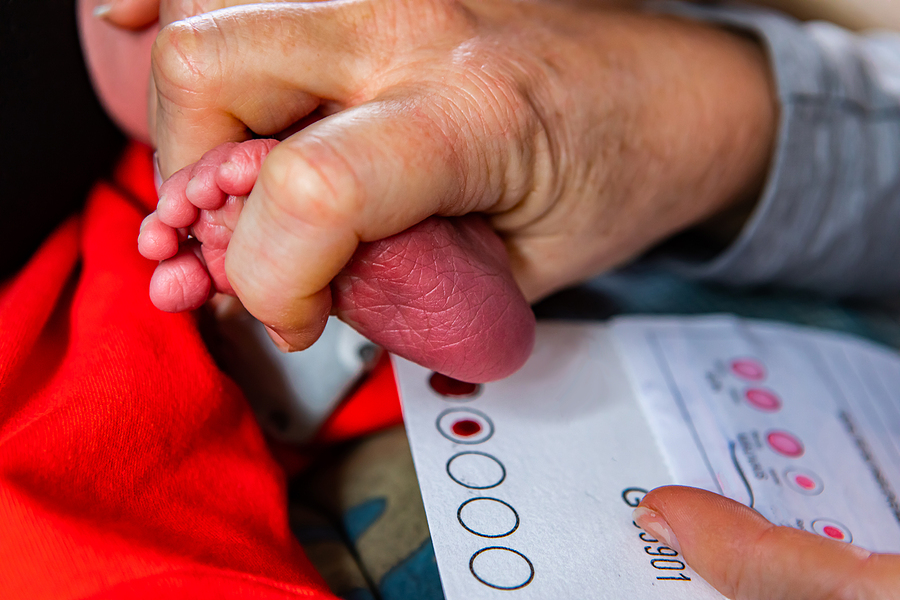
Newborn screening
Diagnostic testWikipedia
42
MENTIONS
8
EPISODES
7
PODCASTS
Search complete. 42 mentions across 8 episodes found for "Newborn screening".
Oct 14, 2026

Peter SzczewskiHOST
It's also a story about how the economics of a rare disease drug development works.
Madeline SpencerHOST
A recent publication looked at the efficacy of newborn screening to detect and treat Metachromatic Leukodystrophy, or MLD, in Europe.
Madeline SpencerHOST
Jim, why is this study relevant?
James RadkeHOST
It is relevant because it increases the evidence needed to make MLD part of newborn screening in the US, which is extremely important.
James RadkeHOST
Before I get into the published study, a brief background on MLD.
James RadkeHOST
It is a rare neurodegenerative disorder.
James RadkeHOST
MLD does have a treatment available, but it is only indicated for patients who are diagnosed before the decline occurs, which creates a bit of a catch-22.
James RadkeHOST
The babies look healthy, so there's no reason to test them for this very rare condition.
Saikat SantraGUEST
This could be recording this in the UK.
Saikat SantraGUEST
Of course, we are slightly different to the rest of Europe in that we don't have biochemical newborn screening.
Saikat SantraGUEST
So we're often not faced with that particular clinical scenario of an apparently well baby with a raised citrulline.
Saikat SantraGUEST
So in our experience, actually what distinguishes citrulline from those other conditions is usually how sick the baby is.
24 MINS LATER
James NurseHOST
And can I ask, we're talking about the importance of treating from an early age.
James NurseHOST
That obviously brings about how early we should be diagnosing or whether we should even be screening for citrin deficiency.
James NurseHOST
So can current newborn screening practices reliably identify citrin deficiency?
Johannes HäberleGUEST
My answer to that would be that newborn screening can currently not be recommended because there's no test that has an acceptable sensitivity and specificity.

Morgan TaylorHOST
Okay.
Morgan TaylorHOST
Every baby in the US is going to be screened for cystic fibrosis in that newborn screening test.
Morgan TaylorHOST
It is looking for immunoreactive trypsinogen, which is just a pancreatic enzyme that will be really high in babies with CF.
Morgan TaylorHOST
If you think about why, it's because that pancreatic duct is plugged up, so we're having a backage of all those pancreatic enzymes.

Rodrigo StarostaHOST
Yeah, that's a nice and simple treatment, right? What could go wrong with that? I do want to explore that a little bit more, but just wanted to do a quick segue with what David had talked about before, which is diagnosing those patients by chance.
Rodrigo StarostaHOST
And I think that that's our perfect time to talk about newborn screening for these disorders, right? So we have already newborn screening for other disorders of sugar metabolism, like galactosemia.
Rodrigo StarostaHOST
And at the most recent SIMD meeting, I just wanted to bring that Dr. Miao He at CHOP presented some really cool data about using glycoforms, specifically what she calls mannose 4A versus mannose 4B, to distinguish hereditary fructose intolerance from glycosylation disorders and potentially detect that on newborn screening.
Rodrigo StarostaHOST
David and, uh, Martijn, do any of you want to elaborate a little bit more about newborn screening for HFI? Why would we do it, and how would we do it?
Silvia RadenkovicHOST
Do we wanna do it? [chuckles]
Martijn BrouwersGUEST
Well, actually, um, last week, I spoke with, um, patient organizations from UK and Australia, and, well, this was the topic that they are really involved in.
Martijn BrouwersGUEST
So they really would like to have a newborn screening on HFI.
Martijn BrouwersGUEST
I think if you would apply all the criteria for newborn screening, you could discuss whether they would apply to HFI.

Amy WaldmanGUEST
This one seems to us was always a little bit more slowly progressive, which is why I, I felt it humbling to see the continued, uh, decline in the control arm even over that 15 months.
speaker_1HOST
Tell us about the challenge of now getting this on the newborn screening panels and, and that process.
Amy WaldmanGUEST
Newborn screening is a public health initiative, and what I mean by that is there is, there are many competing priorities for public health challenges, you know, not just rare disease.
Amy WaldmanGUEST
So I, I will say that first and foremost.
Amy WaldmanGUEST
The second thing to know is GFAP is rapidly accumulating in young patients, but we have not yet demonstrated whether it's high enough to be detectable at birth.

Leah WilsonGUEST
Right.
Leah WilsonGUEST
So in America today, if you have a baby, your baby does receive a newborn screening unless you know that you want to opt out and you live in one of the 47 states that will allow you to opt out because three of the states will put a misdemeanor on the mother.
Leah WilsonGUEST
Which ones are those? Nevada, California, and there's one other.
Leah WilsonGUEST
And I think it's a surprising one.
Leah WilsonGUEST
Oh, okay.
Leah WilsonGUEST
Something surprising.
Leah WilsonGUEST
So, and the whole thing about this newborn screening is, and I was listening to something even since we talked, and this gentleman who's one of the heads of the policy for newborn screening said, the litmus test for adding a condition to newborn screening, so the heel prick at birth, has always been if this rises to the severity that we would take a child from the mom for saying no, then we can add it to the screen.
Leah WilsonGUEST
So, friends, that's what's being added to the newborn screening are conditions where the medical cartel is going to tell you if baby has A, you must do B.

Eta Fosin-AddoGUEST
And this...
Eta Fosin-AddoGUEST
It's from the newborn screening through which many of these are detected.
Eta Fosin-AddoGUEST
Okay.
Eta Fosin-AddoGUEST
Yes.
Naute DuaHOST
So every year, we are adding 15,000 to about 18,000 babies.
Naute DuaHOST
Yes.
Naute DuaHOST
Interestingly, you've just mentioned newborn screening or testing.
Naute DuaHOST
How far are we with this? This is something I used to do with Prof.

Jasmine KencyHOST
Yeah.
Jasmine KencyHOST
Well, I'm really happy that you say that because, you know, we've got this nationally mandated newborn screening that happens within the first 24 to 48 hours of a child's birth.
Jasmine KencyHOST
OK.
Jasmine KencyHOST
And on that list is sickle cell.