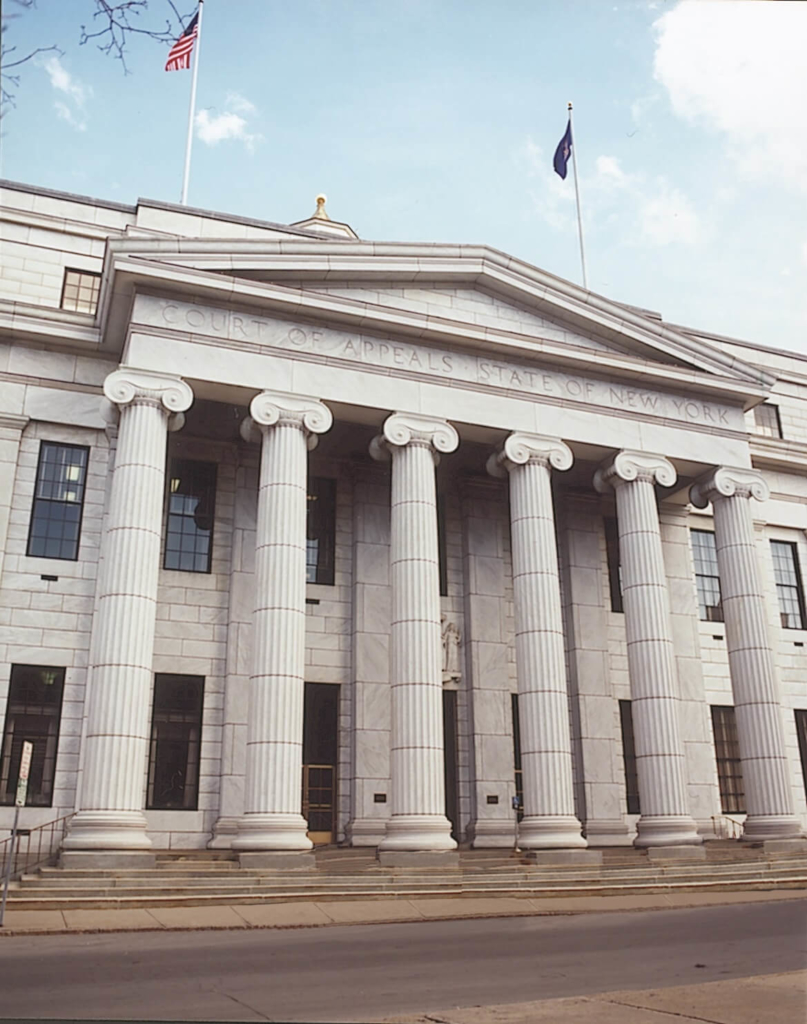
New York Court of Appeals
CourtWikipedia
37
MENTIONS
18
EPISODES
18
PODCASTS
Search complete. 37 mentions across 18 episodes found for "New York Court of Appeals".
Sep 28, 2026

Jack RussoHOST
No, it didn't.
Jack RussoHOST
That entire conviction was vacated in April 2024 by the New York Court of Appeals.
Jack RussoHOST
The highest court in the state actually looked at the trial and determined that the trial judge improperly admitted what's called uncharged acts evidence.
speaker_1HOST
Meaning the jury heard testimony from women whose allegations were not actually part of the official criminal charges, right?
20 MINS LATER
Jack RussoHOST
It can never be introduced simply to show criminal propensity.
speaker_1HOST
And the newsletter zeroes in on this.
speaker_1HOST
The author notes that the New York Court of Appeals vacated Weinstein's 2020 conviction specifically because the trial judge violated that 1901 Molyneux rule.
Jack RussoHOST
Right.

Claudia TenneyGUEST
Now, people may say, well, geez, that's New York State.
Claudia TenneyGUEST
But our New York State Court of Appeals, a far left-leaning court, or let's put it this way, they're all left-leaning, all appointed by either Cuomo or Governor Hochul, ruled unanimously that only citizens can vote in our elections.
Claudia TenneyGUEST
So why would we let people who are ineligible to vote get on our voter rolls.
Claudia TenneyGUEST
So cleaning up voter rolls actually became kind of part of a topic today with my sheriff's seminar.

Claudia TenneyGUEST
Now, people may say, well, geez, that's New York State.
Claudia TenneyGUEST
our New York State Court of Appeals, a far left leaning court, or let's put it this way, they're all left leaning, all appointed by either Cuomo or Governor Hochul, ruled unanimously that only citizens can vote in our elections.
Claudia TenneyGUEST
So why would we let people who are ineligible to vote get on our voter rolls.
Claudia TenneyGUEST
So cleaning up voter rolls actually became kind of part of a topic today with my sheriffs.

Stefanie Wilder-TaylorHOST
... following a 2020 trial, he was initially found guilty and sentenced to 23 years in prison.
Stefanie Wilder-TaylorHOST
However, four years later, the New York Court of Appeals overturned the ruling with a four to three vote.
Stefanie Wilder-TaylorHOST
At the time, it was reportedly decided that testimony from prior bad acts witness, witnesses, so other witnesses that have accused him of things, should not have been allowed because it was unnecessary to establish defendant's intent and served only to establish defendant's propensity to commit the crimes charged.
Stefanie Wilder-TaylorHOST
Yeah, duh.

Joan SummersHOST
Yeah.
Joan SummersHOST
So two years ago in a New York Court of Appeals ruling, his prior conviction for the 2020 case was overruled.
Joan SummersHOST
We'll get to that.
Joan SummersHOST
So this was the trial in which they retried him.
Joan SummersHOST
So like I said at the beginning, in 2020, the Manhattan Supreme Court overturned.
Joan SummersHOST
So they convicted him.
Joan SummersHOST
And then four years later, the New York Court of Appeals overturned the ruling in a 4-3 vote.
Joan SummersHOST
Their ruling was that, quote, it was reportedly decided that the testimony from, quote, prior bad acts witnesses should not have been allowed because it was, quote, an unnecessary to establish defendant's intent and and served only to establish defendants' propensity to commit the crimes charged.

Melissa IannuzzoHOST
Yeah, I don't either.
Melissa IannuzzoHOST
Uh, Drake's team also filed a separate motion asking the Second Circuit to certify a question of New York law to the New York Court of Appeals.
Melissa IannuzzoHOST
That motion was referred to the appellate merits panel, meaning the judges hearing the appeal will decide what to do with it, along with the appeal itself.
Melissa IannuzzoHOST
So there's multiple legal routes that Drake is asking the appellate court to consider.

Janae PierreHOST
But the ban's been tied up in litigation ever since and has never actually been enforced.
Janae PierreHOST
The New York Court of Appeals is now considering taking up the case.
Janae PierreHOST
That's the state's highest court.
Janae PierreHOST
And they'll have the final say.

Thomas HowardHOST
New York's highest court heard the weed smell case and said nothing.
Thomas HowardHOST
So Wednesday afternoon, the Third Circuit opinion in the New York Court of Appeals took arguments on the odor question in the official issue statement.
Thomas HowardHOST
Crimes suppression hearings and whether penal law 2205 enacted as part of the Marijuana Regulation and Taxation Act, with marijuana spelled wrong, applies to post-enactment suppression hearing concerning a pre-enactment search.
Thomas HowardHOST
Fascinating.

Kathleen NelsonNARRATOR
The courts have recognized this fully.
Kathleen NelsonNARRATOR
Thus, the Court of Appeals of New York declared in an important case, While not technically trustees, for the title of the corporate property was in the corporation itself, they were charged with the duties and subject to the liabilities of trustees.
Kathleen NelsonNARRATOR
Clothed with the power of controlling the property and managing the affairs of the corporation without let or hindrance as to third persons, they were its agents.
Kathleen NelsonNARRATOR
But as to the corporation itself, equity holds them liable as trustees.

speaker_5NARRATOR
obviously interlocking directorates and all that term implies must be effectually prohibited before the freedom of american business can be regained the prohibition will not be an innovation it will merely give full legal sanction to the fundamental law of morals and of human nature that no man can serve two masters the surprising fact is that a principle of equity so firmly rooted should have been departed from it all in dealing with corporations for no rule of law has in other connections been more rigorously applied than that which prohibits a trustee from occupying inconsistent positions from dealing with himself or from using his fiduciary position for personal profit and a director of a corporation is as obviously a trustee as persons holding similar positions in an unincorporated association or in a private trust estate who are called specifically by that name The courts have recognized this fully.
speaker_5NARRATOR
Thus, the Court of Appeals of New York declared, in an important case, While not technically trustees, for the title of the corporate property was in the corporation itself, they were charged with the duties and subject to the liabilities of trustees.
speaker_5NARRATOR
Clothed with the power of controlling the property and managing the affairs of the corporation, without letter hindrance, as to third persons, they were its agents.
speaker_5NARRATOR
but as to the corporation itself equity holds them liable as trustees while courts of law generally treat the directors as agents courts of equity treat them as trustees and hold them to a strict account for any breach of the trust relation for all practical purposes they are trustees when called upon in equity to account for their official conduct nullifying the law but this wholesome rule of business so clearly laid down was practically nullified by courts in creating two unfortunate limitations as concessions doubtless to the supposed needs of commerce first courts held valid contracts between a corporation and a director or between two corporations with a common director where it was shown that in making the contract the corporation was represented by independent directors and that the vote of the interested director was unnecessary to carry the motion and his presence was not needed to constitute a quorum second the courts held that even where a common director participated actively in the making of a contract between two corporations the contract was not absolutely void but voidable only at the election of the corporation the first limitation ignored the rule of law that a beneficiary is entitled to disinterested advice from all his trustees and not merely from some and that a trustee may violate his trust by inaction as well as by action it ignored also the laws of human nature in assuming that the influence of a director is confined to the act of voting Everyone knows that the most effective work is done before any vote is taken, subtly and without provable participation.
8 more episodes mention New York Court of Appeals.
Create an account to see the whole feed, search across every transcript, and follow the entities you care about.