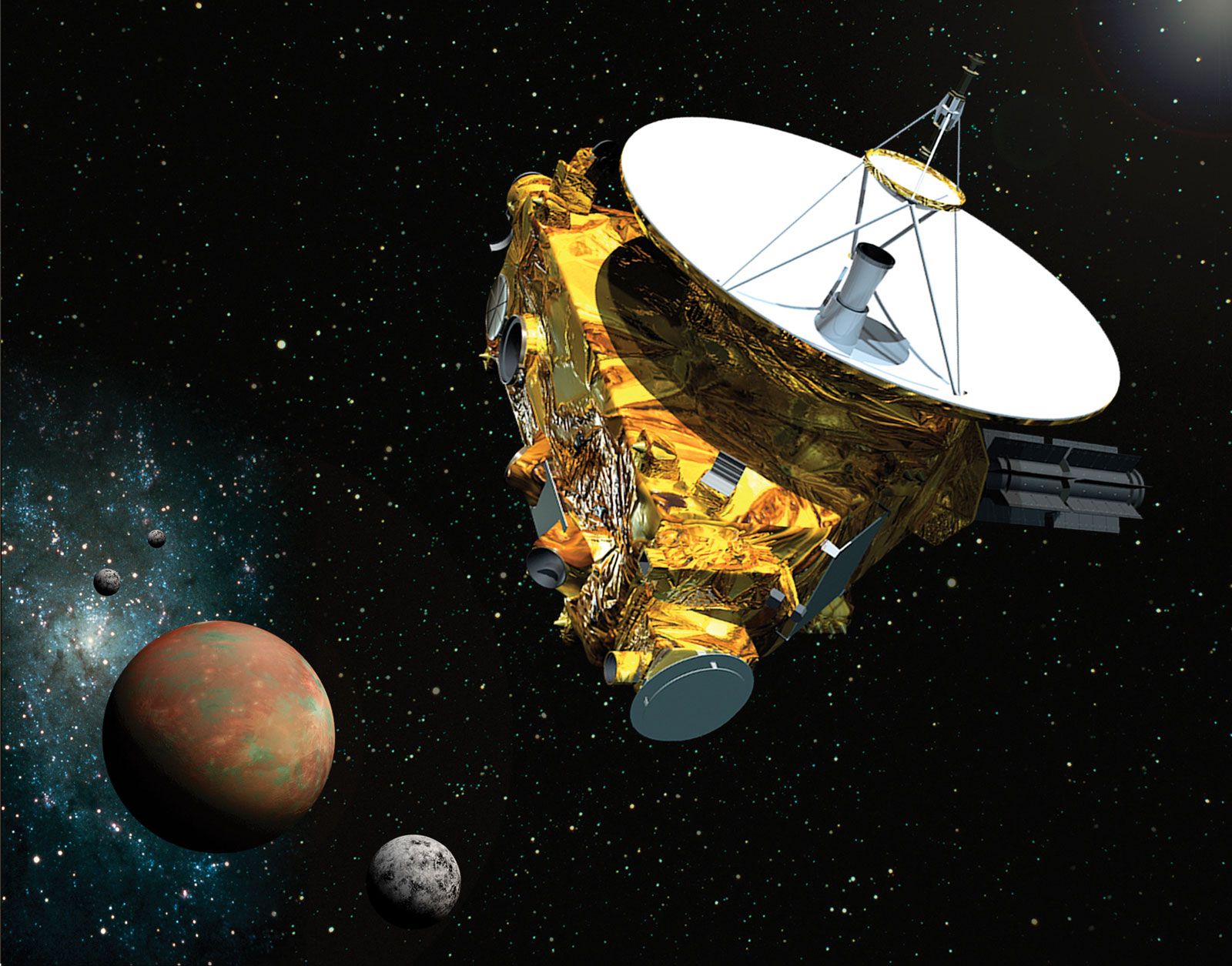
New Horizons
Space missionWikipedia
377
MENTIONS
77
EPISODES
36
PODCASTS
Search complete. 377 mentions across 77 episodes found for "New Horizons".
Sep 18, 2026

Charles LiuGUEST
We haven't seen any.
Neil deGrasse TysonHOST
We've got a fifth probe escaping the solar system, and that's, uh, the New Horizons mission-
Charles LiuGUEST
That's right
Neil deGrasse TysonHOST
... that flew, that flew by Pluto.

Cleo AbramHOST
Up until now, Pluto has been a dot, a smear, a few pixels.
Cleo AbramHOST
But the New Horizons probe is on its closest approach to Pluto right now, if you're watching on the date.
Cleo AbramHOST
As the probe has gotten closer, it's been sending us new images from views we've never seen before of the icy dwarf planet.
Cleo AbramHOST
There's the whale's tail, this complex band of terrain 1,600 kilometers long, and this target in the most recent image from July 12th.
Cleo AbramHOST
These dark and light regions tell us about Pluto's geology, and perhaps of frozen methane, nitrogen, or carbon monoxide frost.
Cleo AbramHOST
And as the probe gets closer, we'll get a clearer view of Pluto's heart and its largest moon, Charon.
Cleo AbramHOST
This is the view of Pluto we had before New Horizons, and this is our view now.
Cleo AbramHOST
This is history in the making.

Mike WongHOST
Many proponents of Pluto's restoration to the planet camp cite its breathtakingly active geology.
Mike WongHOST
In July 2015, NASA's New Horizons spacecraft arrived at Pluto after a nine-year journey.
Mike WongHOST
This reconnaissance mission unveiled a frigid world of mountains capped in methane frost, glaciers of churning nitrogen ice, puzzling pitted terrains, worlds encircling layers of atmospheric haze, and a possible cryovolcano.
Mike WongHOST
Geologically, Pluto is alive, constantly reinventing itself.

Josh CaldwellHOST
Um, but there's only, you know, if, you know, if a Mars, uh, orbiter is talking to one of those antennas, that uses up that antenna, and then if Artemis is using another one, that uses up that one, and if they're all in the same part of the sky...
Josh CaldwellHOST
When we were doing Cassini, it was a big deal because you had to, um, sort of schedule what was going on with your spacecraft at Saturn based on whether or not, for example, you know, the New Horizons spacecraft, which was on its way-
Jim CooneyHOST
Right
Josh CaldwellHOST
... to Pluto at that time, happened to be in the same direction as Saturn, 'cause then there would be-

Marla GehaHOST
Our final velocity must be much higher than the escape velocity of the Earth.
Marla GehaHOST
To achieve that higher delta v, the New Horizons mission to Pluto used three-stage rocket.
Marla GehaHOST
The first stage burned through and then was discarded.
Marla GehaHOST
The second stage burned through and was discarded.
Marla GehaHOST
10% of the mass is in the structure and the payload that's actually getting to orbit.
Marla GehaHOST
And if we want to go farther, let's say beyond Earth's orbit, at the most extreme example, the New Horizons mission, which went out to Pluto, over 99% of the initial mass of the rocket sitting on the launch pad was in fuel.
Marla GehaHOST
The payload itself, that is the satellite that actually whizzed by Pluto and took some beautiful pictures, was less than 0.1% of the total launch vehicle.
Marla GehaHOST
And so in the next few segments, we'll dig into why these numbers are so small and why it's actually kind of amazing that we can launch anything at all into space.

Alya Al NuaimiHOST
Here's what I really want to leave you with before we move on.
Alya Al NuaimiHOST
In 2015, a spacecraft called New Horizons finally flew past Pluto, and what it found completely surprised everyone.
Alya Al NuaimiHOST
Scientists expected a boring plane, greater world, right? But instead, they found mountains, a thin atmosphere.
Alya Al NuaimiHOST
Pluto is alive, it's extraordinary, and it doesn't need a label to prove that.
Alya Al NuaimiHOST
So expect or accept, let's say, imagine an entire atmosphere slowly turning into frost and settling onto the ground, the sky itself going to sleep.
Alya Al NuaimiHOST
that is just simply wow right so how do scientists even figure this out well that is such a great question if you've asked because we cannot exactly send someone there right to Pluto no way so the last spacecraft to visit Pluto was NASA's New Horizons missions which flew past Pluto backlog in 2015 around 10 or 11 years ago it gave us our first real close-up look at Pluto and it was amazing mountains of ice a huge heart-shaped region on the surface just stunning but New Horizons kept flying It is now even deeper into space, so the scientists had to come up with another way to study Pluto from here on planet Earth.
Alya Al NuaimiHOST
And the way they did it, it sounds almost like magic.
Alya Al NuaimiHOST
So basically, they waited for Pluto to pass in front of a distant star like a shadow crossing a light.

DavidHOST
So a spacecraft sends a powerful, fresh radio signal back to Earth, and we can, of course, clock that time and figure out the exact distance to where the spaceship is, and it's parked out there in space right next to these things.
DavidHOST
So I thought, come on, man, how are we doing this? Well, NASA claims that they have a spacecraft called New Horizons.
DavidHOST
They have so many of them out there now.
JakeHOST
It's not even funny.
DavidHOST
They have Voyagers and one and two.
DavidHOST
They got telescopes everywhere out there floating around that they can still control by radio joystick.
DavidHOST
New Horizons was launched January 19th of 2006 and it reached Pluto, our furthest planet away, on July 14th, 2015.
DavidHOST
So it took nine years to get there.

Carl FranklinHOST
Go for it.
Richard CampbellHOST
January, the New Horizons spacecraft, the one that had gone to Pluto, still going, uh, ca- had its next close flyby to a Kuiper Belt object.
Richard CampbellHOST
Today we call that Kuiper Belt object Arrokoth-
Carl FranklinHOST
Hmm
Richard CampbellHOST
New...
Richard CampbellHOST
That's 2019.
Richard CampbellHOST
It's been seven more years, and New Horizons is still whizzing out at very high speed.
Carl FranklinHOST
Yeah.
67 more episodes mention New Horizons.
Create an account to see the whole feed, search across every transcript, and follow the entities you care about.