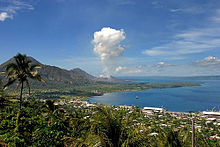
New Britain
Island in Papua New GuineaWikipedia
31
MENTIONS
11
EPISODES
9
PODCASTS
Search complete. 31 mentions across 11 episodes found for "New Britain".
Oct 29, 2026

Garry McCarthyGUEST
There was a female officer who was getting her head bashed against the ground and was afraid to shoot the person who was doing it before she lost consciousness because she was worried that she would get jammed up.
Garry McCarthyGUEST
What type of world are we living in? This is not the world that my dad, God rest his soul, did five years in the Marine Corps during World War II, got shot three times at American Samoa, Guadalcanal, New Guinea, and New Britain, and Iwo Jima to come back home and become a New York City police officer.
Garry McCarthyGUEST
Those are the blue-collar values that I was raised with.
Garry McCarthyGUEST
Where is that today? Where is it? My mom was a nurse.

Aaron BennettNARRATOR
great britain countered by establishing a protectorate over the southern solomons and by annexing the remainder of new guinea in nineteen o five the british crown passed administrative control over all its territories in the region to australia and the territory of Papua, with its capital at Port Moresby, came into being.
Aaron BennettNARRATOR
Germany's holdings in the region fell under the administrative control of the League of Nations following World War I, with the seat of the colonial government located in Rabaul on New Britain.
Aaron BennettNARRATOR
The Solomons lay ten degrees below the equator, hot, humid, and buffeted by torrential rains.
Aaron BennettNARRATOR
The celebrated adventure novelist Jack London supposedly muttered, If I were king, the worst punishment I could inflict on my enemies would be to banish them to the Solomons.
Aaron BennettNARRATOR
The location offered one of the best anchorages in the South Pacific and it was strategically located, 560 miles from the New Hiberties, 800 miles from New Caledonia, and 1,000 miles from Fiji.
Aaron BennettNARRATOR
The outposts at Tulagi and Guadalcanal were the forward evidences of a sizable Japanese force in the region, beginning with the 17th Army, headquartered at Rabaul.
Aaron BennettNARRATOR
The enemy's 8th Fleet, 11th Air Fleet, and 1st, 7th, 8th, and 14th Naval Base Forces also were on New Britain.
Aaron BennettNARRATOR
Beginning on 5 August 1942, Japanese signal intelligence units began to pick up transmissions between Noumea on Caledonia and Melbourne, Australia.

Aaron BennettNARRATOR
CHAPTER I.
Aaron BennettNARRATOR
THE GREEN INFERNO on the early morning of twenty sixth december nineteen forty three marines poised off the coast of japanese held new britain could barely make out the mile-high bulk of mount talawe against a sky-growing light with the approach of dawn flame billowed from the guns of american and australian cruisers and destroyers shattering the early morning calm the men of the first marine division commanded by major-general william h rupertus a veteran of expeditionary duty in haiti and china and of the recently concluded guadalcanal campaign steeled themselves as they waited for daylight and the signal to assault the yellow beaches near cape gloucester in the northwestern part of the island for ninety minutes the fire support ships blazed away trying to neutralize whole areas rather than destroy pinpoint targets since dense jungle concealed most of the individual fortifications and supply dumps after the day dawned and h hour drew near army airmen joined the preliminary bombardment four engine consolidated liberator be twenty four bombers flying so high that the marines off shore could barely see them dropped five hundred pound bombs inland of the beaches scoring a hit on a fuel dump at the cape gloucester airfield complex and igniting a fiery geyser that leaped hundreds of feet into the air twin engine north american mitchell b twenty five medium bombers and douglas havoc a twenty light bombers attacking from lower altitude pounced on the only japanese anti-aircraft gun rash enough to open fire the warships then shifted their attention to the assault beaches and the landing craft carrying the two battalions of colonel julian n frisbee's seventh marines started shoreward an l c i landing craft infantry mounting multiple rocket launchers took position on the flank of the first wave bound for each of the two beaches and unleashed a barrage intended to keep the enemy pinned down after the cruisers and destroyers shifted their fire to avoid endangering the assault troops at zero seven forty six the l c v p s landing craft vehicles and personnel of the first wave bound for yellow beach one grounded on a narrow strip of black sand that measured perhaps five hundred yards from one flank to the other and the leading elements of the third battalion commanded by lt col william k williams started inland two minutes later lieutenant-colonel john e weber's first battalion on the left of the other unit emerged on yellow beach two separated from yellow one by a thousand yards of jungle and embracing seven hundred yards of shore line neither battalion encountered organized resistance a smoke screen which later drifted across the beaches and hampered the approach of later waves of landing craft blinded the japanese observers on target hill overlooking the beach head and no defenders manned the trenches and log and earth bunkers that might have raked the assault force with fire by capturing this airfield complex the reinforced first marine division designated the back-hander task force would enable allied airmen to intensify their attack on the japanese fortress of rabal roughly three hundred miles away at the northeastern extremity of new britain although the capture of the yellow beaches held the key to the new britain campaign two subsidiary landings also took place the first on fifteen december at cape murcus on arroway bay along the south coast and the second on d day twenty sixth december at green beach on the northwest coast opposite the main landing sites two secondary landings the first subsidiary landing took place on fifteen december nineteen forty three at distant cape murcus across the arroway channel from the islet of arroway although it had a limited purpose disrupting the movement of motorized barges and other small craft that moved men and supplies along the southern coast of new britain and diverting attention from cape gloucester it nevertheless encountered stiff resistance marine amphibian tractor crews used both the new armored buffalo and older slower and more vulnerable alligator to carry soldiers of the hundred twelfth cavalry who made the main landings on orange beach at the western edge of cape fire from the destroyer u s s conningham supplemented by rocket equipped d u k w s and a submarine chaser that doubled as a control craft and a last-minute bombing by b twenty five silenced the beach defenses and enabled the buffaloes to crush the surviving japanese machine guns that survived the naval and aerial bombardment less successful were two diversionary landings by soldiers paddling ashore in rubber boats savage fire forced one group to turn back short of its objective east of orange beach but the other gained a lodgment on pillello island and killed the handful of japanese found there an enemy airman had reported that the assault force was approaching cape murcus and the fighters and bombers from rabaul attacked within two hours of the landing sporadic airstrikes continued throughout december although with diminishing ferocity and the japanese shifted troops to meet the threat in the south the other secondary landing took place on the morning of twenty sixth december The 1,500-man Stoneface Group, designated Battalion Landing Team 21 and built around the 2nd Battalion 1st Marines under Lt. Col. James M.
Aaron BennettNARRATOR
Master Sr., started toward Green Beach, supported by 5-inch gunfire from the American destroyers Reed and Smith.
Aaron BennettNARRATOR
LCMs, Landing Craft Medium, carried DUKW amphibian trucks, driven by soldiers and fitted with rocket launchers.
Aaron BennettNARRATOR
Aircraft base there would then support the division when, after a brief period of recuperation, it attacked Rabaul.
Aaron BennettNARRATOR
The decision to bypass Rabaul eliminated the landings there, but the Marines would nevertheless seize the Cape Gloucester airfields, which seemed essential for neutralizing the base.
Aaron BennettNARRATOR
the initial concept of operations which called for the conquest of western new britain preliminary to storming rabaul split the first marine division sending combat team a the fifth marines reinforced less one battalion in reserve the army's five hundred third parachute infantry would exploit the cape gloucester beachhead while combat team b the reinforced first marines provided a reserve for the operation revisions came swiftly and by late october nineteen forty three the plan no longer mentioned capturing rabal tacit acceptance of the modified allied strategy and also satisfied an objection raised by general rupertus the division commander had protested splitting combat team c and kruger agreed to employ all three battalions for the main assault substituting a battalion from combat team b the first marines for the landing on the west coast the airborne landing at cape gloucester remained in the plan however even though rupertus had warned that bad weather could delay the drop and jeopardize the marine battalions already fighting there the altered version earmarked army troops for the landing on the southern coast which kruger's staff shifted from gazmata to arwe a site closer to allied airfields and farther from rabal with its troops and aircraft although combat team b would put one battalion ashore southwest of the airfields the remaining two battalions of the first marines were to follow up the assault on cape gloucester by combat team c the division reserve combat team a might employ elements of the fifth marines to reinforce the cape gloucester landings or conduct operations against the off-shore islands west of new britain during a routine briefing on fourteen december just one day before the landings at our way macarthur off-handedly asked how the marines felt about the scheme of maneuver at cape gloucester colonel edwin a pollock the division operations officer seized the opportunity and declared that the marines objected to the plan because it depended on a rapid advance inland by a single reinforced regiment to prevent heavy losses among the lightly armed paratroopers better he believed to strengthen the amphibious forces than to try for an aerial envelopment that might fail or be delayed by the weather although he made no comment at the time macarthur may well have heeded what pollack said whatever the reason kruger's staff eliminated the airborne portion directed the two battalions of the first marine still with combat team b to land immediately after the assault waves sustaining the momentum of their attack and alerted the division reserve to provide further reinforcement sidebars Major General William H. Rupertus Major General William H. Rupertus, who commanded the 1st Marine Division on New Britain, was born at Washington, D.C. on 14 November 1889 and in June 1913 graduated from the U.S. Revenue Cutter Service School of Instruction.
Aaron BennettNARRATOR
instead of pursuing a career in this precursor of the u s coast guard he accepted appointment as a second lieutenant in the marine corps a vigorous advocate of rifle marksmanship throughout his career he became a member of the marine corps rifle team in nineteen fifteen two years after entering the service and won two major matches During World War I, he commanded the Marine Detachment on the USS Florida assigned to the British Grand Fleet.

Andy StewartHOST
The main challenge was the great number of islands spread over a vast area of sea notionally under the command of the Germans.
Andy StewartHOST
The reality was the controlling administration was concentrated on the islands of New Guinea, New Britain, and New Ireland.
Andy StewartHOST
The Australians were prepared for resistance but did not know to what extent nor the actual strength of the German armed military they might be facing.
Andy StewartHOST
As it transpired, there was only one point of resistance at the site of the wireless station at Bita Paka on the island of New Britain.
Andy StewartHOST
The Australians landed unopposed at Herbertshöhe in Blanche Bay on the 11th of September.
Andy StewartHOST
They believed there were two wireless stations, one operational at Bita Paka, four miles south of where they landed, and the other still under construction inland.
Andy StewartHOST
It was alleged that the high number of Melanesian deaths were due to bayoneting of prisoners by the Australians.
Andy StewartHOST
We'll come back to this.

DaleHOST
You know Rabaul.
DaleHOST
It's their big base on New Britain to the northwest.
DaleHOST
Bombers came down the slot that same afternoon.
DaleHOST
And on the night of August 8th and into the 9th, a Japanese cruiser force under Vice Admiral Gunichi Mikawa came screaming down past Savo Island and caught the Allied cruiser screen half asleep.

Chris TerrillNARRATOR
In the spring of 1943, the American Southwest Pacific Command considered its options for the task that now faced them.
Chris TerrillNARRATOR
It was already obvious that the main Japanese stronghold in the region was the fortress of Rabaul on the island of New Britain.
Chris TerrillNARRATOR
This was the headquarters of the Japanese Eighth Area Army, a force of 100,000 fighting men.
Chris TerrillNARRATOR
If Rabaul could be destroyed, then further progress towards the Philippines would become a far easier enterprise.
Chris TerrillNARRATOR
By early May 1943, General MacArthur and his colleagues had determined their plan.
Chris TerrillNARRATOR
MacArthur himself would lead an advance along the northeast coast of New Guinea, driving the Japanese back before crossing over to New Britain.
Chris TerrillNARRATOR
At the same time, his deputy, Admiral William Bull Halsey, would lead an invasion force from Guadalcanal through the Solomon Islands so that Rabaul could be attacked from two sides.
Chris TerrillNARRATOR
The operation was given the code name Cartwheel, and on the 30th of June, 1943, the fight back in the Pacific began.

John LongHOST
When he finally recovered enough to go back on active duty, he was instead assigned to the 7th Regiment, 1st Marine Division.
John LongHOST
Christmas Day 1943 found Ed on the, and the 7th on New Britain as part of Operation Cartwheel, MacArthur's drive to seize Cape Gloucester.
John LongHOST
On January 2nd, 1944, Barse took point for his platoon and led them into the jungle to a stream soon to be renamed Suicide Creek.
John LongHOST
Ed would later recall that one man, who seemed to be suffering a failure of nerve, was left behind on picket duty in the rear.
1 more episode mentions New Britain.
Create an account to see the whole feed, search across every transcript, and follow the entities you care about.